Deciphering intentions
Reading what people are trying to do with their lives before your product existed, with empathy, Jobs To Be Done and the practice of active listening.

In the tenth session of the Instituto Tramontana product management program we entered new territory. If until now we've worked on the fundamentals of software and the discipline of data, we now turn toward people: their intentions, their contradictions, their silences. Everything we've seen so far needs color. And that color comes from people.
This is, probably, the hardest part of the craft. Not for lack of techniques or frameworks, but because it forces us out of where we're comfortable. The screen is a magnificent refuge: we can analyze metrics, design flows, write user stories, review changelogs, all without having to engage with the people we're building for. But a product built without getting close to the people who will use it is a product built blindly, no matter how sophisticated our data may be.
Deciphering intentions means learning to read what people are trying to do with their lives when they interact with a product, long before that product ever existed. For that we need three things: a framework that helps us think about motivations, a capacity that allows us to connect with what others feel, and a practice that trains us to listen without colonizing.
Five lenses for looking at reality
The session proposes five lenses for looking at the reality of the people who use our products. Each lens reveals a different layer of understanding.
Looking at the world as a flow. People don't exist in a frozen instant. They have a past that conditions them, a present that pressures them, and a future that attracts them. Understanding that temporal flow — where they come from, where they are, where they want to go — is the first act of empathy in product.
Looking at the world as change. People don't buy products; they hire solutions to progress from a current situation to a desired one. This is the essence of the Jobs To Be Done framework, one I have a particular affinity for.
Looking at the world as a system. Every organization transforms inputs into outputs that reach customers who generate outcomes. And those outcomes feed back into the system. Understanding that complete loop is what allows you to orient the product systemically.
Looking at the world as a prototype. Before converging on a solution, you need to diverge. Explore multiple paths, contrast them, and then choose with judgment. Treat each idea as a prototype that can be discarded without pain.
Looking at the world as options. Every product decision means giving something up. The best decisions are those that make those sacrifices explicit and conscious, not the ones that try to please everyone.

Empathy as a muscle
Empathy plays a crucial role in product management. Outward — toward customers, users, stakeholders — and inward — toward roles, the organization, other areas. It is an attitude, a disposition, that can be developed through a set of practices.
Any decision we make to add or remove something from a product should be educated by some form of empathy, to reduce the distance from the people who will end up enjoying or suffering that change. Just as we've looked to metrics as a compass, empathy should also help us find direction. By anchoring your decisions to specific people, in their specific contexts, you can gain a certain confidence that what you're developing has a meaningful impact.
And yet, it's astonishing how separated we usually are from those people. Most product organizations operate at an enormous distance from those who use what they build. We invent on behalf of people we barely know. We make decisions that affect their lives from offices where they've never been seen walking in. Opening a dashboard comes more naturally to us than opening a conversation.
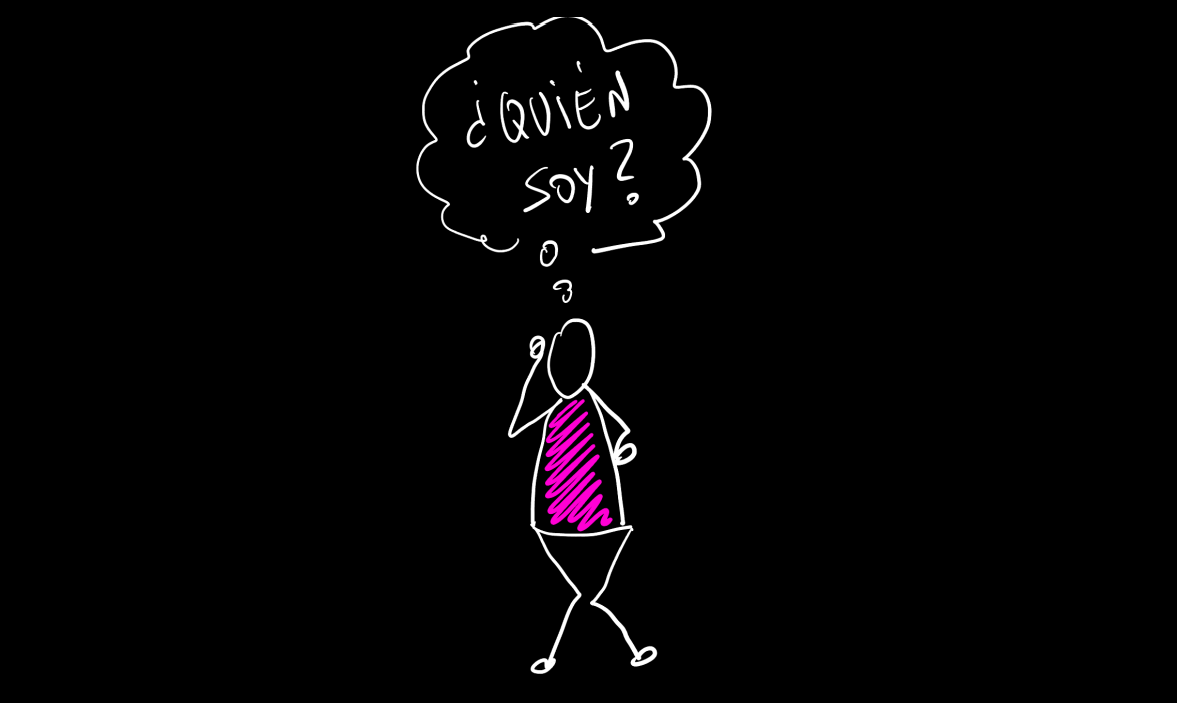
Empathy is usually understood as the art of imagining ourselves in someone else's shoes to understand their emotions and perspectives. But it's something deeper than that. It's a kind of estrangement: you make an effort to stop being yourself, in a way, to begin being another person. Either because you analyze things from that other perspective, or because you try to reproduce a set of emotions that aren't yours. That estrangement matters in product because it allows us to orient our actions. Without it, we would make worse decisions.
Forces working against it
If we understand empathy as a muscle, it's important to exercise it every day. Mainly because there are many forces within an organization that work against it.
Prejudice. The tendency to project our own experiences and preferences onto others. When a product team says "I would never use that," they're substituting understanding with assumption.
Authority. In many organizations, the boss's opinion weighs more than evidence. The person with the most hierarchy is rarely the one with the most contact with the real user.
Inside/outside separation. Product teams build walls between the internal — what we know, what we control — and the external — what the user experiences, what the market says. That separation is comfortable but toxic. And it's the most widespread: the screen protects us from the discomfort of engaging with real people, with their nuances, their contradictions, and their silences.
Denial. Rejecting information that contradicts our beliefs or our strategy. "That's an isolated case," "the data isn't representative," "the user doesn't know what they want." All are forms of empathic denial.
These forces don't act independently. They usually compound. And they can't be eliminated — they're part of who we are as social animals — but we can work to educate them.
Forces working in its favor
All accumulated evidence suggests we are wired empathically. The discovery of mirror neurons by Giacomo Rizzolatti and his team at the University of Parma (1996) showed that our brain activates both when we perform an action and when we observe someone else performing it. Later research nuances the relationship, but the central idea remains: our brain is plastic and we are a kind of social animal that needs to develop empathically.
You can easily verify this by watching how your empathic capacity activates when you watch a film, or when you read a novel.
Ways to practice it
A first way to practice empathy is to prove to ourselves that we are wrong. Forcing ourselves to find evidence that what we believe isn't so. This requires an active disposition toward discomfort: seeking the information that contradicts your hypothesis rather than the information that confirms it.
We can also practice it through experiences that allow us to live other lives:
Immersion. Temporarily living the reality of another person. A hotel executive who spends a day cleaning rooms discovers frictions that no report would reveal. A designer who uses a wheelchair for a day understands accessibility in a way that no technical standard can convey.
Exploration. Going out to observe, without an agenda or hypothesis, how people interact with products and services in their real context. Filmmaker Chantal Akerman took this idea to the extreme in Jeanne Dielman (1975): three and a half hours observing the domestic routines of a woman, without dramatization, without shortcuts. The act of looking with sustained attention generates an understanding that speed prevents.
Cooperation. Working side by side with the people you're trying to serve. Not as an external observer, but as a participant. This is the deepest level of practical empathy, because it forces you to abandon your position of authority and expose yourself to the productive incompetence of someone who doesn't master a craft.
Jobs To Be Done
The JTBD framework is structured around a simple but transformative idea: people don't buy products, they "hire" them to do a job in their lives. This job has a functional component (what they need to solve), an emotional component (how they want to feel), and a social component (how they want to be perceived).
Beyond identifying people as the result of attributes — age, gender, location — we can understand them by their action: what they're trying to do.
In Theodore Levitt's famous formulation: people don't want a quarter-inch drill, they want a quarter-inch hole.
The wall between demand and supply
There is a wall between demand and supply. Demand is the world of people: their problems, their moments, their habits, the candidates they consider, their context, and the outcome they expect. Supply is the world of the product: strategy, functionality, attributes, requirements, and promised benefits.
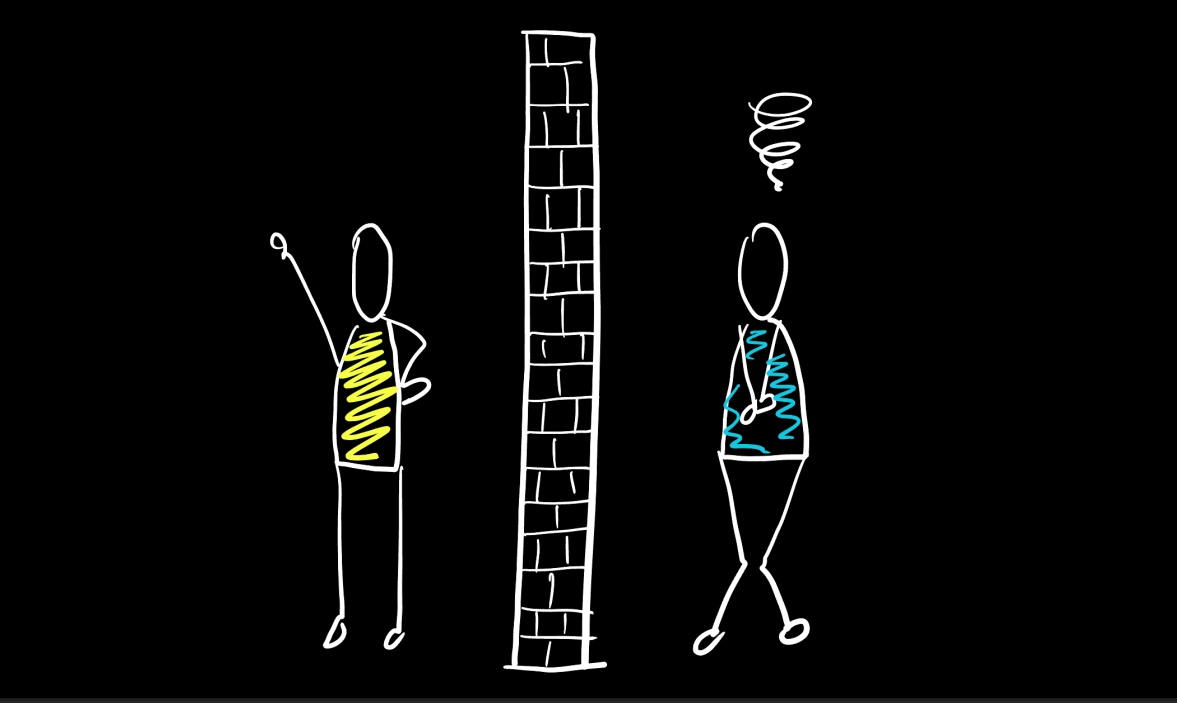
Most innovation is done from the supply side. And it's no coincidence: supply is where we're comfortable. It's our terrain, our language, our tools. Crossing the wall toward demand means exposing yourself to the uncertainty of real people, with their contexts that don't fit our categories and their motivations that don't fit in a Jira ticket.
JTBD proposes inverting the direction: always start from demand. The two main approaches to innovation are the one that starts with solutions and looks for people, and the one that starts with people and looks for solutions. Both would like to have a higher percentage of technique and less of luck, but the complexity of execution means the second still remains dominated by the luck factor.
The forces diagram
To understand why someone switches from one solution to another, the forces diagram is an essential tool. There are four forces at play: dissatisfaction with the current solution pushes toward change; the attraction of a new solution pulls toward it; but the habit of the familiar slows the change, and uncertainty about the new generates resistance.
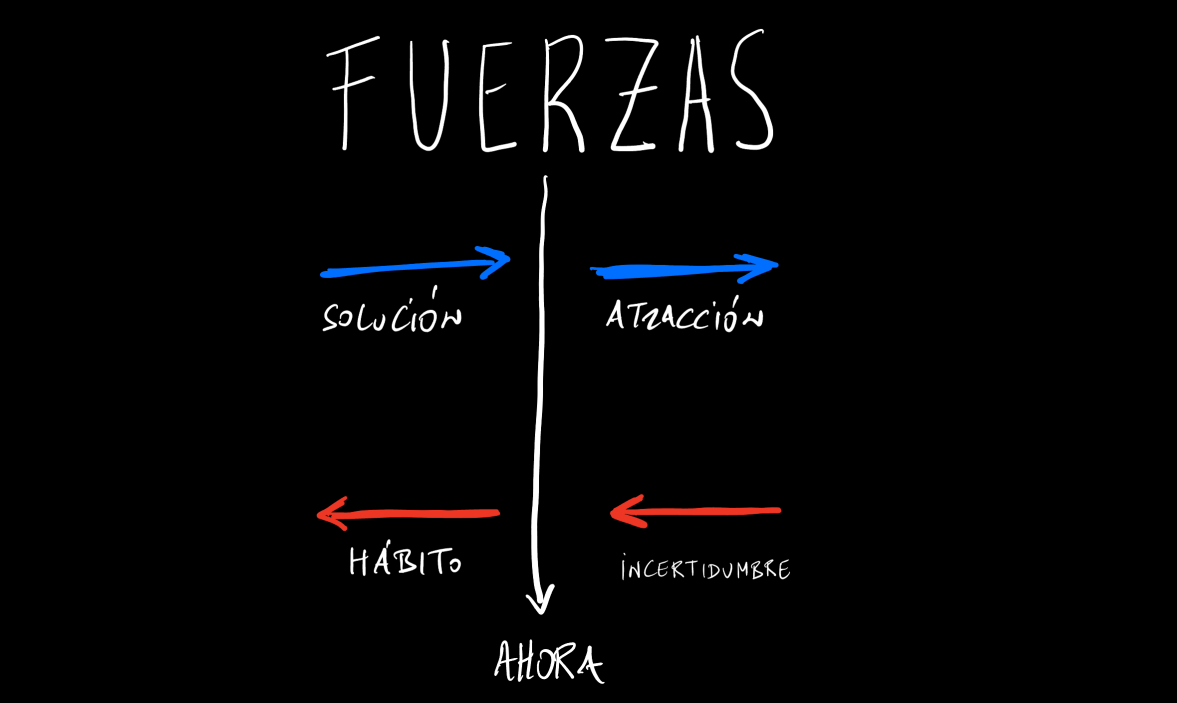
Only when the sum of the forces pushing forward exceeds the sum of those holding back does change occur. This explains why objectively superior products sometimes fail to get people to adopt them.
What this perspective changes
When you understand the job someone is trying to do, several things transform.
Competition is redefined. If the job is "help me recover from a horrible day and relax," then Coca-Cola, Xbox, and Nike are competing with each other, even though they belong to completely different industries. Competition isn't defined by the industry, but by the job.
Stories are rewritten. The Job Story format — "When [situation], I want to [motivation], So I can [expected outcome]" — allows you to articulate people's motivations in a way that traditional user stories cannot. You don't describe a role or a feature; you describe a moment, an intention, and a desired progress.
The mission endures. The fundamental job people are trying to do tends to be surprisingly stable over time. What changes is how it gets solved. The evolution from the gramophone to vinyl, from vinyl to CD, from CD to iPod, and from iPod to Spotify illustrates how the job — "I want to listen to music" — remains while the solutions mutate generation after generation. If you define yourself by the solution, you're fragile; if you define yourself by the job, you're resilient.
Sacrifices become clear. "Better half a product than a half-baked product." An excellent product in a few things is infinitely better than a mediocre product in many. When you understand the job people are trying to do, you know what you can sacrifice without betraying your value proposition.

Listening sessions
If the screen is the refuge, the listening session is the open air. It's the moment you leave your controlled environment and sit in front of another person, without a script, without a product in between, without the protection of your metrics. Fostering conversation helps us put ourselves in other people's place. Dialogue is something that can be practiced. Listening sessions are that space: you focus on people, regardless of their category in relation to the product, since the product is not the center of the conversation — the progress people seek is.
Listening sessions are driven primarily by curiosity. You're not seeking to colonize but to create a relationship. It's important to note that most people in positions of authority, and many product teams oriented toward supply, tend to distrust listening as a way of gathering data.
In a listening session you should be concerned with being present for someone. You shouldn't approach it with preconceptions or prejudices. You make an effort to understand the other person's emotions. You make an effort to understand their needs.
A very useful way to approach the other person's perspective is by paraphrasing what they've said: repeat in your own words and ask a question to see if your reformulation creates consensus. The goal is to create an atmosphere of trust so that rhythm can emerge, handing the conversation over to the other person and seeking to let them unfold.
The four keys to a listening session: ask the obvious, hand over the conversation, create an atmosphere, and don't script it.
Daring not to feel embarrassed is often the best way to break through what seems like it can't be asked or said. Asking the obvious opens the door to discussing motivations that aren't on the surface.
With all of this, the goal is to look for patterns, to find the purpose that moves that person. There is a germinal question that orients the conversation: can you tell me how it all started?
Qualitative research is not a listening session
Qualitative research is usually done from the supply perspective, not demand. This means that most of the time it looks for answers within the product's perimeter. Often, using a concept like "Personas" as a statistical average, which precisely distances itself from the specific.
Indi Young, in Practical Empathy (2015), deliberately distinguishes "listening session" from "interview" because the word interview carries the inertia of predetermined questions and extraction. The listening session, in contrast, begins with curiosity and without a script.
Literature as training
Among the ideal sources for developing empathic capacity, beyond essays or methodologies, is literature.
A study published in Science in 2013 by David Comer Kidd and Emanuele Castano demonstrated that reading literary fiction significantly improves the ability to infer mental states, beliefs, and intentions of others — what psychology calls Theory of Mind. Not popular fiction, not non-fiction: literary fiction specifically.
Psychologist Keith Oatley, from the University of Toronto, proposes that fiction works as a "social interaction simulator": just as a flight simulator trains pilots without real risk, fiction allows us to inhabit other lives and exercise empathic understanding in a safe space. Every novel is a laboratory of human intentions.
This has a direct implication for those working in product: reading fiction is not a luxury or a pastime. It's training. The question "what's the last novel you read?" is not rhetorical.
A territory of our own
We live in a moment when LLMs and generative artificial intelligence can amplify us in extraordinary ways. They can help us analyze data, generate hypotheses, write code, summarize research, explore scenarios. In many of the areas we've worked on in this program — from understanding software to experimenting with metrics — AI is already a powerful tool and will become increasingly so.
But there is something it cannot do: understand another person. Not the way a statistical model understands patterns, but the way a human being understands another human being. The nuances of a conversation, the silence that says more than words, the tension in someone's voice when they don't know how to explain what they need, the contradiction between what a person says they want and what they're actually trying to do with their life. That is a human game.
And precisely because of that, at a moment when so many capabilities can be delegated or amplified with technology, the ability to approach another person and understand them becomes a territory of our own. It's not a remnant of the past; it's a competitive advantage of the future. Organizations that cultivate that capacity — that leave the screen, that sit down with real people, that practice listening — will be better positioned than those that limit themselves to optimizing from a distance.
Empathy is not what's left when the machine falls short. It's what makes us capable of knowing where the machine should go.
Session practice
Case study: Put on your detective suit. In teams of three, the exercise consisted of choosing a digital product and investigating its hidden intentions. First, identify the main frustration connected with that product and draft it in JTBD form. Then, trace the perimeter of possible competitors from two perspectives: by Job and by industry. Next, choose something from the product's changelog and conjecture the motivations and progress it connects with, writing a brief narrative about the customer's journey. Finally, draft questions you would ask in a listening session. An exercise in thinking freely before deciding on a solution, gathering evidence, traces, testimonies, and signals.
Homework: Empathy practice. We've seen different ways of practicing empathy. Immersion, exploration, and cooperation are especially fertile, because they allow us to estrange ourselves, incorporating other perspectives. They are different approaches to common techniques like user testing or observation, where the aim is to reduce the distance between the position from which you invented something and the position from which that invention is used. In this case, the emphasis is on the specific situation and the specific people. We seek precisely what doesn't scale, because we pursue enriching our humanistic education in its fullest sense: expanding our experience of life to make better decisions.
Seeking continuity with the JTBD exercise, this week's practice consists of approaching someone else's perspective on a topic you don't know but about which you have a formed opinion or a special interest. Choose the technique that best suits you — immersion, exploration, or cooperation — and document the exercise with some type of material: a photo, a video, a sound recording, or something written with those other people. Relationships with strangers are the ones that cost us the most and, therefore, the ones that can contribute the most. Listening sessions usually play an important role in our empathic education; try to put them into play and leave some record of how the dialogue unfolded.