Breaking tablets
Sumerian scribes broke thousands of tablets learning to write. The anxiety about wasting tokens misunderstands what inhabiting a new medium costs.
I hear a lot lately a concern that repeats itself in conversations about artificial intelligence: "we're burning too many tokens." Too much output, too little outcome. Too much interaction for too little measurable result. The complaint usually comes with an implicit demand: every prompt should produce something usable, every session with a language model should justify its cost.
It's a reasonable concern on the surface, but it hides a deep misunderstanding about how one learns to inhabit a new medium.
Broken tablets
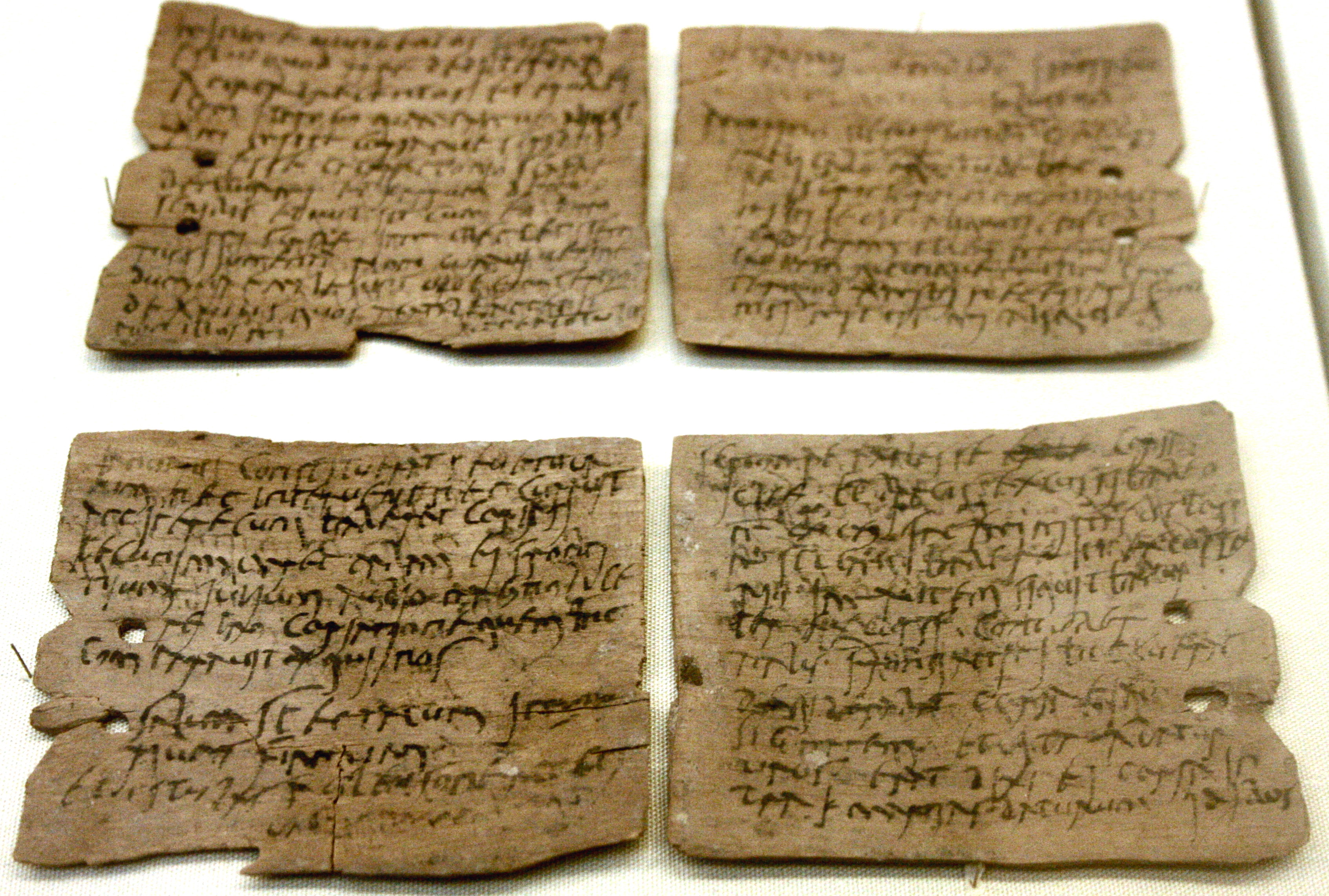 Letter from Octavius to Candidus about the supply of wheat, hides, and sinews
In the scribal schools of ancient Sumeria, apprentices spent years writing on tablets of wet clay. They copied word lists, names of gods, livestock inventories. The tablets were broken, recycled, discarded. Thousands of them. We know they were learning exercises precisely because they're full of mistakes, repetitions, strokes that gain steadiness as they progress across the surface.
No one would have looked at a young scribe and said: "you've gone through twenty tablets and you still haven't produced a useful administrative document." Because the purpose of those tablets wasn't the document. It was the scribe. The material was broken so that the person could be formed.
The same happened afterwards with every medium that followed. Practice papyri in Egypt, where apprentices copied literary texts over and over until they internalized not just the calligraphy but the structure of written thought. Parchments made from sheepskin, a costly material that was nevertheless used generously in the training of medieval copyists, because without that repeated practice there was no way to develop the hand or the eye that distinguishes a well-composed text from a mediocre one.
In every case the pattern is the same: becoming familiar with a medium requires what from the outside looks like waste, but from the inside is formation. You cannot arrive at judgment without passing through repetition. You cannot develop sensitivity toward a material without having touched it many times without apparent purpose.
The ostrakon
Among all the ancient writing supports, there is one I find especially revealing: the ostrakon. A fragment of broken pottery — a piece of a vessel that no longer served any purpose — on which people wrote. Ostraka were used in classical Athens for all sorts of minor annotations: receipts, notes, school exercises. The humblest support imaginable.
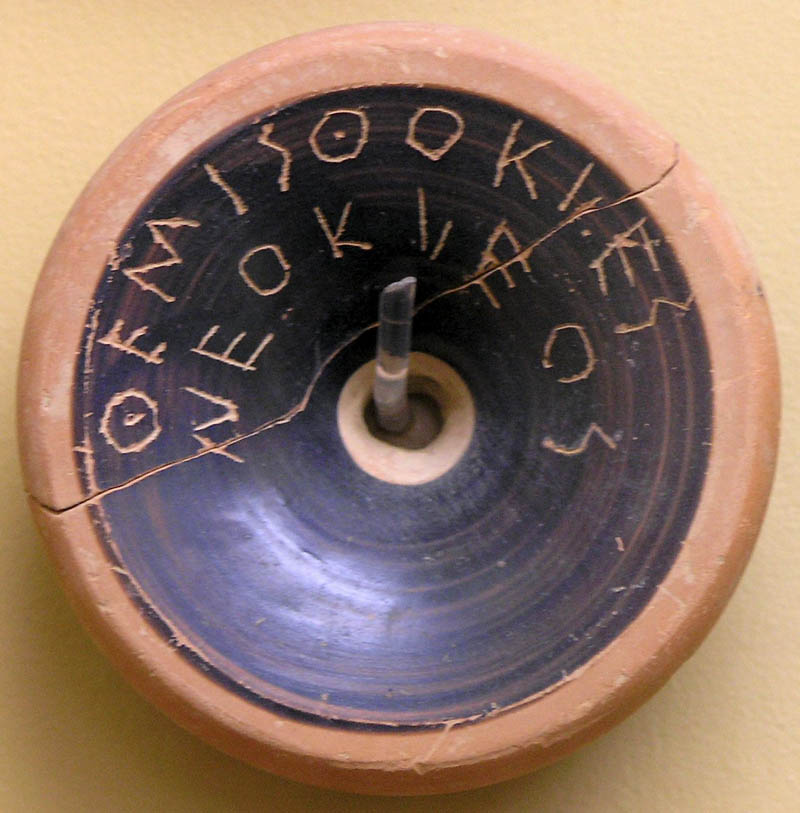 Ostrakon bearing the name of Themistocles
But that same humble support also served for the most severe political act of Athenian democracy. When the assembly decided that someone represented a danger to the city, each citizen wrote a name on a fragment of pottery. If enough votes accumulated, that person was banished for ten years. From ostrakon comes our word ostracism: expulsion decided on a broken piece of clay.
The image has a force worth pausing on. The apparently disposable — a piece of pottery worth nothing — carries the most significant decision: who stays and who goes.
The new ostracism
Every time a new medium for thinking, making, or deciding appears, a new form of ostracism also appears. Not always explicit, not always formalized, but real. Those who don't familiarize themselves with the medium risk being left out of the conversations that matter, the decisions that count, the spaces where the next thing is being built.
With language models there is a lot of noise around this. Headlines about professions that will disappear, predictions about who is surplus and who is not, a diffuse anxiety that pushes people to use the technology but without quite knowing what for or how. And here is where the two anxieties feed each other in a way that deserves attention: the fear of being left out pushes you to interact with the model, but the obsession with not wasting — with making every token count, with every session producing a tangible result — prevents you from doing the one thing that would allow you to develop judgment: practicing without the pressure of immediate results.
It's a paradox that repeats throughout the history of any medium. The rush to avoid exclusion prevents the slow and apparently unproductive process that is precisely the one that truly includes you. Counting tokens is like counting broken tablets: technically correct, strategically blind.
Educating sensitivity
I've seen this same pattern many times outside the realm of AI, in something as basic as encouraging a product team to talk to its customers. Truly listening, asking without a closed script, requesting open feedback. The reaction is usually the same: what's this for? What comes out of it? What's the deliverable?
No deliverable comes out. Something harder to measure and more valuable does: a sensitivity toward the problem that cannot be acquired any other way. Someone who has listened to fifty customers doesn't have fifty reports; they have a trained ear, an ability to detect what matters amid the noise that no executive summary can replace. But that ability is only built by going through conversations that seem to lead nowhere, through feedback sessions where no clean data is extracted, through repeated contact with a material — people, their contexts, their frustrations — that doesn't allow itself to be reduced to immediate metrics.
The practice that forms judgment rarely looks productive while it's happening. That's precisely what makes it vulnerable: it's easy to cut it, easy to demand it justify itself, easy to replace it with something that produces a number. And yet, without it there is no judgment. Only procedure.
Inhabiting, not using
There is something deeper worth naming, even if only to leave it open. We tend to think of LLMs as tools: something we pick up, use, and set down. But research on how we relate to technology has long been suggesting something else to us. We are not beings who use media; we are, to a large extent, beings who are formed by the media we use. The support is not neutral. The medium in which you think shapes how you think.
The Sumerian scribe didn't "use" clay. He became a scribe with clay, through clay. His sensitivity to language, his ability to organize information, his perception of space on a surface — all of that was formed through repeated contact with the material. The same can be said of the typographer with movable type, the programmer with the terminal, the designer with the digital canvas.
When someone interacts intensely with a language model — testing, erring, reformulating, discovering the limits of what the model can and cannot do — they are not wasting tokens. They are forming a new sensitivity. They are developing a judgment that didn't exist before and that cannot be acquired by reading a manual or following a five-step course. They are inhabiting a medium, not using a tool.
The tablets that matter
The problem has never been the cost of practice material. The problem has always been confusing practice with waste, and production with learning. Sumerian scribes needed to break tablets. Medieval copyists needed to spend parchment. We need to burn tokens.
Not all of them, not without sense, not as an excuse for intellectual laziness. But with the awareness that familiarity with a new medium is not achieved by optimizing every interaction, but by allowing oneself the kind of disorderly, repetitive, and apparently unproductive exploration in which the judgment is formed that later allows you to distinguish what's worth something from what's not.
The next time someone worries about the tokens being burned, it might be worth asking what's being formed in that process. Because what looks like a broken piece of pottery — useless, disposable — may be exactly what decides who stays in and who stays out.