Leadership in digital products
Management handles complexity, leadership drives change: what software's ill-defined problems demand from whoever leads a digital product organization.

I write this post with a tear or two on the keyboard. Last Friday we held our penultimate session of the Instituto Tramontana product management programme.
The announcement of a farewell is always also the celebration of a bond.
Si de pronto caminas sobre hierba hecha piedra,
más brillante en el mármol, mejor que la real,
o distingues a un fauno persiguiendo a una ninfa,
más felices en bronce que en esa ensoñación,
deja caer el báculo de tus manos cansadas:
has llegado al Imperio.El aire, el fuego, el agua, faunos, leones, náyades,
paridos por Natura o la imaginación,
lo que Dios inventó y la razón humana
se hartó de prolongar en piedra o en metal.
Este es el desenlace. Al final del camino,
espejo en el que entrar.— Torso, Joseph Brodsky
I like entering that mirror by debating leadership, because only when you have completed the entire journey can you see yourself with the maturity and desire to face something so demanding.
In that sense, Tramontana is a good school: there is leadership in the vision of its creator, Javier Cañada, but also in that of people as significant as Saleiva and Jorge Gómez Sancha, who accompanied him from the very beginning.
There is leadership too, combined with the untameable energy of pure conviction, in its director Mónica Meika and in Alfonso Gutiérrez, who measures everything in centuries; and in Isa, David, Silvia, Felipe, and Miguel, who are the ones that keep making it possible for the anomaly to have its place in the world. The anomalous also needs daily care: water, joy, and light. Thank you for seeing.
New organisations, new leaderships
The aspects we have been exploring throughout the programme, regarding the nature of digital products, are also necessary ingredients for rethinking what we understand by leadership.
If software is a special material, one we still handle rather clumsily; if the problems we work with are less well-defined than we would often like, constantly challenging us with their weak contours and lack of definition; if, in short, the very people for whom we invent are often an unknown to which we assign a value by barely scratching the surface — then the leadership of digital companies cannot be exercised with its back turned to all these new challenges.
In the session we separated management from leadership based on a distinction that has long been common currency in the literature: while the former deals with complexity, the latter concerns the impulse toward change and transformation.
Only three things happen naturally in organizations: friction, confusion, and underperformance. Everything else requires leadership.
— Managing Oneself, Peter Drucker
Leadership styles, proportions
The way you develop your leadership is composed of styles. The literature has synthesised six main styles that, depending on objectives, contexts, and your own character, combine in different proportions.
We took a tour through each one. We extracted a phrase, a context, and a negative aspect (that is, something to bear in mind) to characterise them. It was easy, during the conversation, to recognise that the one we called coercive is quite dominant in any organisation. And it was equally easy to offer reasons why this style is especially counterproductive in organisations whose core activity revolves around digital: it is the heir of assembly-line and factory ways of working. Of course, the digital product industry is largely under that paradigm, which is why it fails so often. Recognising it is the first step toward reducing it.
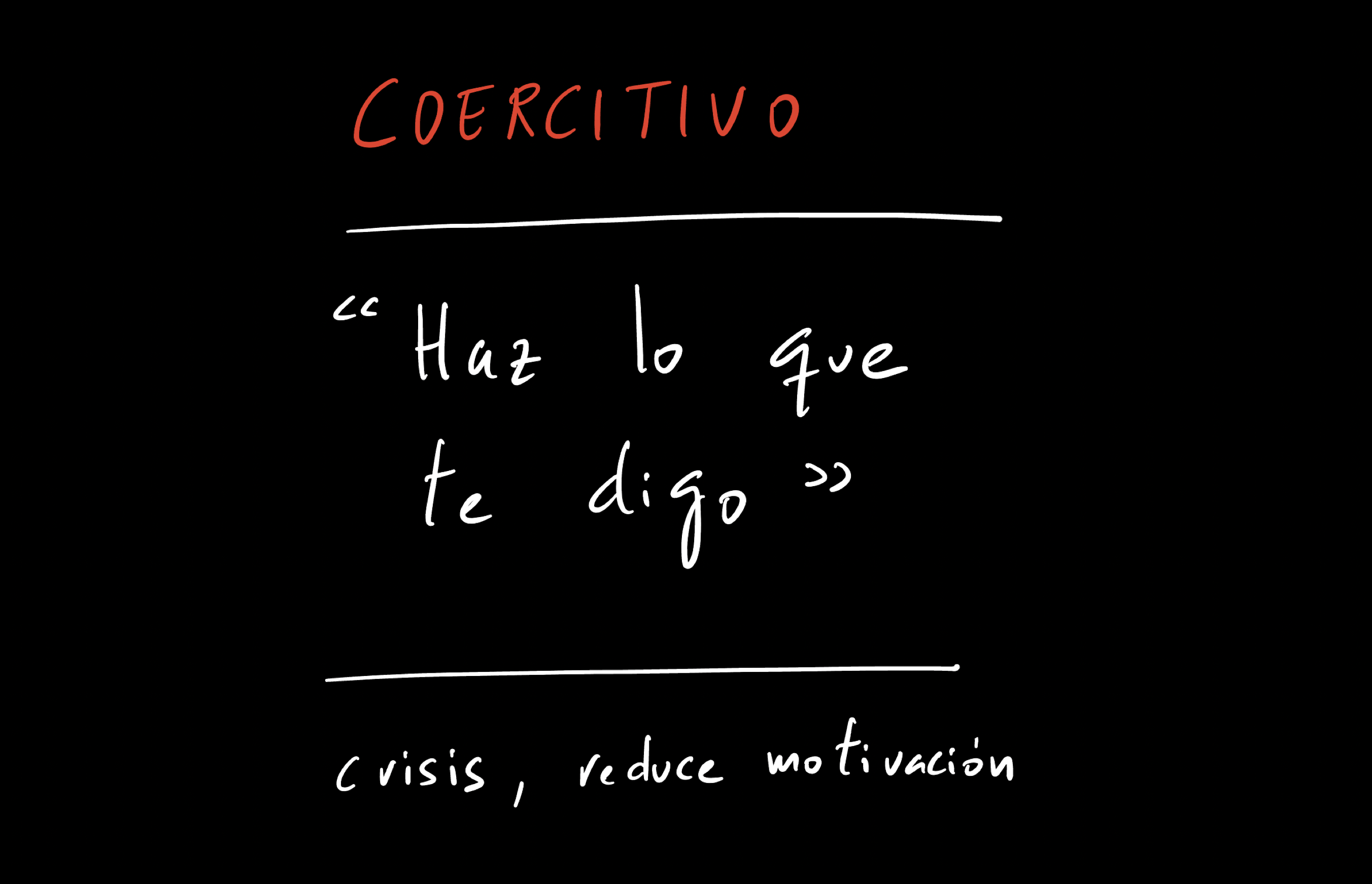
We revisited some references we had seen in earlier sessions, such as Eric Schmidt's smart creatives at Google, to try to understand through them why other styles very different from the coercive one are what often produce the best results. The affiliative ("people first"), pacesetting ("do as I do"), and coaching ("try this") styles have been gaining weight in organisations, placing the focus on creating good chemistry as the necessary condition for results and performance to follow. In this sense, they align with the line Bill Walsh popularised with his famous title the score takes care of itself, bringing a sports perspective to teams that moves them away from industrialisation and factories and closer — as we have seen at other points in the programme — to the creativity and entertainment industries.
We asked ourselves several interesting questions to confront the factors that shape our own styles: who do you work for? What must a leader have? What is your dominant style? Who inspires you? Written on the whiteboard were the names of people who brought emotions back to life, playing the role of a lighthouse when you need something to lean on amid so much uncertainty, complexity, and insecurity. We returned, in this way, to the classical manner of answering the question of leadership with people rather than with definitions.