The Shape That Repeats: Networks, Fractals, and the Geometry of Decentralisation
Annotated bibliography
In 1999, the network researchers Bill Cheswick and Hal Burch at Bell Labs published the first large-scale visual map of the internet's topology. The image looked nothing like an engineering diagram. It looked like a river delta, a vascular system, a lung — a structure that branches and reconnects at every scale, with no centre and no edge. Mandelbrot would have recognised the geometry instantly. Deleuze and Guattari had already named it.
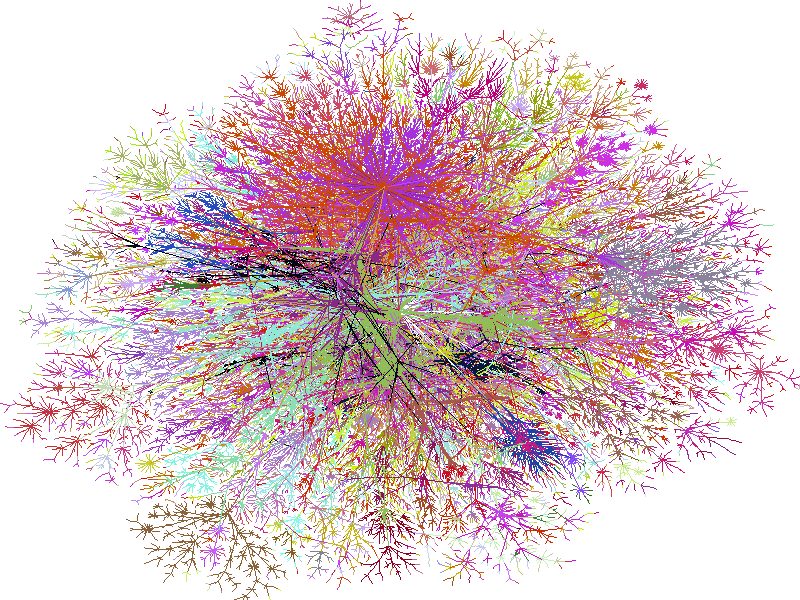
This collection traces the convergence. Across mathematics, philosophy, biology, cybernetics, computer science and political theory, a sequence of thinkers arrived independently at the same structural intuition: that the most robust, adaptive and generative systems are not hierarchical trees but acentred networks — self-similar, scale-free, growing from local rules rather than central plans. The itinerary runs from Shannon's formalisation of information and Wiener's feedback loops, through Mandelbrot's fractal geometry and Deleuze's rhizome, to the network science of Barabási and the political theory of protocol. It is not a history of one idea but a map of how the same shape kept surfacing in different soils.
The question underneath is simple and still open: why does this pattern repeat? Is fractal geometry the signature of self-organisation wherever it occurs — in cells, in cities, in code? And if so, what does that mean for anyone trying to design systems that must grow, adapt and survive?
Information as a measure of the world
A Mathematical Theory of Communication
Shannon's 1948 paper is the founding document of information theory and one of the most consequential scientific publications of the twentieth century.
It demonstrated that information could be quantified in bits, measured independently of meaning, and transmitted reliably over noisy channels through proper encoding.
The paper drew on thermodynamics, probability theory, and Boolean algebra to establish a rigorous mathematical framework for communication systems.
Its implications reached far beyond telephony: Shannon's entropy became central to cryptography, linguistics, genetics, and eventually computer science itself.
The work is remarkable for its clarity and completeness — the entire field emerged essentially whole from a single paper.
Three years later Shannon aimed the same framework straight at language in Prediction and Entropy of Printed English (1951), measuring the entropy of English by predicting the next letter — the direct ancestor of how language models are trained and scored today.
Feedback as a form of thought
The Human Use of Human Beings
Cybernetics as a philosophy of society, not just engineering.
Wiener saw that feedback loops govern organisations, economies, and minds decades before anyone used the word "systems thinking." This is the most readable entry point to the tradition that produced Bateson, Beer, and Meadows — the intellectual lineage behind every serious discussion of complex adaptive systems.
For product people the central argument still lands: automation without understanding the human in the loop is not just inefficient but dangerous.
Wiener wrote this in 1950 and the warning has only grown more urgent with every generation of tooling.
Reading it today is not nostalgia; it is recovering first principles that the industry rediscovers under new names every decade.
The pattern that connects
Steps to an Ecology of Mind
The most influential essay collection of the second half of the twentieth century in systems thinking.
Bateson moved between anthropology, psychiatry, cybernetics, and ecology, finding the same patterns of communication and learning everywhere he looked.
His concept of "double bind" — contradictory requirements imposed on agents who cannot step outside the system — describes most organisational dysfunction better than any management framework ever written.
For product people this book reframes familiar problems: why teams freeze under conflicting mandates, why adding metrics can distort the behaviour they claim to measure, why context shapes meaning more than content does.
Every essay is older than most of its readers and more accurate than most contemporary writing about the same problems.
The architecture of near-decomposability
The Architecture of Complexity
The companion paper to Simon's books already in the library.
Here Simon argues that complex systems evolve faster when they are hierarchically modular — "nearly decomposable" — because subsystems can evolve independently without destroying the whole.
This is the theoretical foundation for microservices, team topologies, and every modern argument about loose coupling, written three decades before any of those terms existed.
Forty pages that explain more about organisational design than most contemporary books on the subject.
For product people the paper settles a recurring debate: modularity is not an architectural preference but an evolutionary necessity — systems that lack it do not survive long enough to matter.
Freedom as a design problem
Designing Freedom
Beer applied cybernetics to the design of real organisations — most famously Project Cybersyn in Allende's Chile, an attempt to manage an entire national economy through real-time feedback.
These six lectures are short, brilliant, and still ahead of most contemporary writing about organisational design.
The argument: freedom is a design problem, and viable systems require requisite variety, not more control.
Every chapter dismantles the assumption that centralised command improves outcomes, replacing it with a model where regulation emerges from the structure of communication itself.
For anyone directing product in a growing organisation, Beer's law of requisite variety explains why adding process rarely fixes coordination problems — and what does.
The geometry of roughness
The Fractal Geometry of Nature
The foundational text on fractals.
Mandelbrot demonstrated that the irregular forms of nature — coastlines, clouds, river deltas, vascular networks — follow self-similar patterns across scales, and that classical Euclidean geometry was the wrong tool to describe them.
The book introduced fractional dimensions as a way to measure roughness and showed that phenomena dismissed as noise or pathology by mainstream mathematics were in fact the dominant geometry of the real world.
For product and technology work, the relevance is structural: the internet's topology, visualised by Cheswick and Lumeta, is a fractal; organisational complexity is self-similar at every level of zoom; and the assumption that systems can be decomposed into clean, separable modules breaks down precisely where fractal geometry begins.
This is the mathematical companion to what Deleuze and Guattari described philosophically and Barabási confirmed empirically — the same rough, scale-invariant structure appearing wherever complex systems self-organise.
A life between disciplines
The Fractalist: Memoir of a Scientific Maverick
Mandelbrot's autobiography traces a life spent between disciplines — from a childhood fleeing Nazi-occupied Warsaw, through the French mathematical establishment dominated by Bourbaki, to IBM Research and eventually Yale.
He describes how his refusal to specialise led him to notice the same rough, self-similar patterns in coastlines, cotton price fluctuations, noise in telephone lines, and galaxy distributions, eventually coining the term "fractal" to name what he saw.
The memoir is candid about the institutional resistance he faced: too applied for pure mathematicians, too theoretical for engineers, too visual for an era that prized abstraction.
Mandelbrot's career is a case study in how genuinely new ideas require not just insight but decades of persistence against disciplinary boundaries.
The book, published posthumously, gives the personal dimension behind one of the twentieth century's most consequential acts of pattern recognition.
Strange loops and tangled hierarchies
Gödel, Escher, Bach: An Eternal Golden Braid
Pulitzer Prize winner.
Hofstadter's thesis is that consciousness emerges from "strange loops" — self-referential structures where a system can represent and reason about itself.
He builds this argument through an extraordinary weave of formal logic (Gödel's incompleteness theorems), visual art (Escher's impossible drawings), and music (Bach's fugues and canons), showing that the same pattern of tangled hierarchy appears in all three domains.
The book is at once a work of philosophy of mind, an introduction to mathematical logic, and a piece of literary invention, with dialogues between Achilles and a Tortoise interleaved throughout.
Playful, profound, and unlike anything else ever written.
Essential for almost any of the library's intellectual lines — complexity, cognition, self-reference, the nature of formal systems, and the question of what it means for a pattern to be "about" something.
The rhizome against the tree
A Thousand Plateaus: Capitalism and Schizophrenia
The introduction to this book — titled simply "Rhizome" — is one of the most consequential metaphors in twentieth-century thought.
Deleuze and Guattari describe a system with no centre, no hierarchy, where any point can connect to any other, and where the structure grows laterally rather than branching from a trunk.
They wrote it before the public internet existed, yet the description reads as an almost exact specification of distributed network architecture.
The deeper contribution is the opposition they draw between the tree (hierarchical, rooted, binary) and the rhizome (acentred, connective, heterogeneous).
That tension — tree versus rhizome — maps directly onto the organisational problem of digital product: the org chart wants to be a tree, the product wants to be a rhizome, and Conway's Law sits at the junction.
For anyone working in networked systems, this is the philosophical source code that later theorists like Galloway, DeLanda and Barabási operationalised in their own domains.
A language of patterns
A Pattern Language
The origin of design patterns in software, though Alexander himself was writing about towns and buildings.
His argument is that good design emerges from a shared language of proven solutions — 253 patterns ranging from the distribution of towns to the placement of windows — and that this language allows ordinary people to participate in design decisions that professionals have monopolised.
The Gang of Four adapted the idea for object-oriented programming in 1994, and the concept has since colonised every domain from interaction design to organisational structure.
The companion to Notes on the Synthesis of Form already in this library, A Pattern Language is the constructive half of Alexander's project: where the earlier book analysed the problem of fit, this one proposes a method for achieving it.
For product directors, the deeper lesson is that design quality scales only when the vocabulary is shared.
Mind as a society of agents
The Society of Mind
The mind as a society of simple agents — none of them intelligent on their own, but collectively producing what we call thought.
Minsky's book is hard to classify: part science, part philosophy, part manifesto, structured as 270 interconnected one-page essays that can be read in almost any order.
The central insight — that intelligence emerges from the interaction of many specialised, unintelligent processes — anticipated multi-agent architectures, ensemble methods, and much of how we now think about complex adaptive systems.
The book influenced a generation of engineers, cognitive scientists, and AI researchers, and its core metaphor remains one of the most productive ways to think about how simple components produce complex behaviour.
The computer and the sciences of complexity
The Dreams of Reason: The Computer and the Rise of the Sciences of Complexity
Pagels, a theoretical physicist, wrote this book just before his death in a mountaineering accident, and it stands as one of the earliest and most lucid accounts of the transition from reductionist physics to the sciences of complexity.
He traces the lineage from Shannon, Wiener, and von Neumann through to the cellular automata of Wolfram, the genetic algorithms of Holland, and the self-organisation models of Kauffman, arguing that the computer was not merely a tool but a new way of thinking about natural systems.
The book appeared four years before Waldrop's Complexity and covers much of the same intellectual territory from a physicist's perspective rather than a journalist's.
Pagels is unusually clear about what complexity science can and cannot explain, and his writing carries the authority of someone who understood both the mathematics and the philosophical stakes.
It remains an underappreciated bridge between the information theory era and the complexity era.
The edge of order and chaos
Complexity: The Emerging Science at the Edge of Order and Chaos
Waldrop tells the founding story of the Santa Fe Institute, where physicists, biologists, economists, and computer scientists converged in the late 1980s to build a science of complex adaptive systems.
The narrative centres on figures like Brian Arthur (increasing returns in economics), Stuart Kauffman (self-organisation in biology), John Holland (genetic algorithms), and Murray Gell-Mann (quarks turned complexity).
Each brought problems from their own discipline that classical reductionism could not solve, and the institute became the place where those problems found a shared language.
The book is a sister work to Waldrop's later The Dream Machine — same method of intellectual biography woven into institutional history, applied here to the birth of complexity science rather than computing.
It remains the best account of how a discipline was invented by people who did not yet know what to call it.
Order for free
At Home in the Universe: The Search for the Laws of Self-Organization and Complexity
Kauffman, a theoretical biologist at the Santa Fe Institute, argues that self-organisation is a fundamental force in nature alongside natural selection — that order emerges for free in complex systems and that evolution works with that order rather than producing it from scratch.
The book extends the argument from biology to economics and technology, with implications for how we think about innovation and the structure of organisations.
For product direction the idea of "order for free" is a useful counterweight to the assumption that all organisation must be designed — some of the most robust structures in a product or a team emerged without anyone planning them.
Read alongside Meadows for the accessible systems primer and Taleb for the complementary argument about disorder.
Dense, ambitious, Santa Fe Institute science at its best.
Meshworks and hierarchies in history
A Thousand Years of Nonlinear History
DeLanda applies Deleuze and Guattari's philosophical machinery to a thousand years of actual history — geological, biological and linguistic — and produces a model where meshworks generate innovation and hierarchies standardise it.
The meshwork/hierarchy dichotomy is structurally identical to the tension between self-organising teams and command structures that defines product organisations.
DeLanda shows that neither form is inherently superior: meshworks produce novelty but are fragile; hierarchies consolidate gains but resist change.
The two constantly convert into each other.
The book is dense but rewarding, and its core insight — that the same material dynamics govern rock formations, urban growth, language evolution and institutional design — gives product directors a vocabulary for recognising when their organisation is behaving like a crystallising mineral versus a turbulent flow.
Read alongside Deleuze/Guattari for the philosophy and Barabási for the empirical network science.
The ants, the brain, the city, the software
Emergence: The Connected Lives of Ants, Brains, Cities, and Software
Johnson maps emergence — the phenomenon where agents following simple local rules produce complex global behaviour — across ant colonies, brain neurons, urban neighbourhoods and software systems.
The book is popular science, not academic theory, but it performs a valuable synthesis: it takes ideas from complexity science (Kauffman, Holland, the Santa Fe Institute tradition) and makes them legible to a general audience.
The strongest chapters show how cities self-organise without central planning and how pattern recognition arises from the interaction of billions of neurons, none of which individually "understands" anything.
For product directors, the book articulates why bottom-up organisation often outperforms top-down design in complex environments — and why the instinct to impose order from above is both natural and frequently counterproductive.
Read alongside Waldrop's Complexity for the historical context and Barabási's Linked for the network mathematics.
The idea that augments itself
Augmenting Human Intellect: A Conceptual Framework
The conceptual framework behind the "Mother of All Demos." Engelbart's insight was that tools, knowledge, methods, and training form a co-evolving system — you cannot improve human capability by changing just one element.
This is the origin of the idea that product work is systems work, not feature work.
The machine that dreams in hypertext
Computer Lib / Dream Machines
The most radical manifesto of personal computing — a book printed back-to-back, readable from either end.
Nelson coined "hypertext" and argued that computers are too important to be left to computer scientists.
Wild, uncompromising, and more prescient than polished. The counterpoint to every corporate vision of technology.
Literary Machines
Nelson's self-published, endlessly revised manifesto describes Project Xanadu — a hypertext system conceived in the 1960s that envisioned two-way links, version tracking, micropayments for authors, and transclusion as alternatives to copying.
The book is essential for understanding the road not taken: when Berners-Lee designed the World Wide Web a decade later, he deliberately chose one-way links and simplicity over Nelson's richer but more complex architecture.
Nelson's writing is passionate, eccentric, and sometimes maddening, but his critique of hierarchical file systems and his vision of interconnected documents were decades ahead of their time.
Many problems the web still struggles with — broken links, content ownership, attribution — are precisely the ones Xanadu was designed to solve.
Reading Nelson today is a reminder that the systems we use are not inevitable but the product of specific tradeoffs made by specific people.
An architecture with no centre
Inventing the Internet
Abbate's history of the internet focuses on the institutional, organizational, and political dimensions that most popular accounts omit.
Rather than telling a heroic story of visionary individuals, she traces how ARPANET emerged from Cold War defense funding, how its design reflected the values of the academic research community that built it, and how the transition to a commercial internet involved deliberate policy choices with lasting consequences.
The book is especially strong on the design of TCP/IP and the social process by which technical standards were negotiated through RFCs and working groups.
Abbate shows that the internet's open, decentralized architecture was not an inevitable technical outcome but the product of specific organizational cultures and specific moments of institutional decision-making.
It is the corrective to every origin story that begins with a garage.
The topology of the new science
Linked: The New Science of Networks
Barabási's book introduced the science of networks to a popular audience: scale-free networks, preferential attachment, hubs, the small-world property, and the mathematics that explains why the internet, social networks, disease transmission and cellular metabolism share the same structural patterns.
The book is the accessible version of research that reshaped how we understand interconnected systems.
For product direction the frameworks are directly applicable — platform dynamics, viral growth, network effects, and the vulnerability of systems with concentrated hubs are all applied network science.
Read alongside Castells for the sociological layer and Shapiro and Varian for the economic implications.
Barabási writes clearly; the science has aged well.
Writing space, reading rhizome
Writing Space: Computers, Hypertext, and the Remediation of Print
Bolter argues that each writing technology — from the papyrus scroll to the printed book to the computer screen — creates its own "writing space" that shapes not just how we write but what we think is worth writing.
The central claim is that electronic writing, and hypertext in particular, is best understood as a remediation of print: it refashions the older medium rather than replacing it.
Bolter introduces "topographic writing" — a mode of composition that is spatial, networked and non-sequential, as opposed to the hierarchical, linear structure of the printed page.
He explicitly connects this to Deleuze and Guattari's rhizome: a horizontally branching structure with no centre and no fixed reading order.
For anyone building digital products, this is a reminder that the interface is never neutral — every layout, every navigation pattern, every information hierarchy is a theory of how knowledge should be structured, whether its designers know it or not.
Hypertext 3.0: Critical Theory and New Media in an Era of Globalization
Landow was among the first to bridge literary theory and computing, arguing that hypertext realised what Derrida, Barthes and Deleuze/Guattari had theorised about the death of the author, the open text and the rhizome.
The book traces how giving readers instant access to a web of interconnected sources fundamentally changes the acts of reading and writing — dissolving the boundaries between author and reader, centre and margin, text and commentary.
Through three editions (1992, 1997, 2006), Landow updated his argument to account for the World Wide Web, blogs and globalisation, making this the most sustained attempt to connect poststructuralist philosophy with the concrete experience of navigating digital text.
For product people, the value lies in understanding that hypertext is not merely a technology but a way of organising thought — and that the design decisions embedded in links, navigation and information architecture carry philosophical weight.
The cathedral and the bazaar
The Cathedral and the Bazaar
The founding essay of the open-source movement.
The thesis: the decentralised, seemingly chaotic model (the bazaar) produces better software than the planned, controlled one (the cathedral).
Raymond codifies what Linux proved empirically — that coordination without formal hierarchy can work when there are clear protocols, intrinsic motivation and fast feedback cycles.
It anticipates the logic of autonomous teams working with AI: less central planning, more distributed iteration.
How control persists after decentralisation
Protocol: How Control Exists After Decentralization
Galloway's thesis is that the internet is not, in any politically meaningful sense, a space of freedom — it is a space of protocol.
He argues that TCP/IP and DNS constitute a new form of control that operates not through hierarchy or centralized authority but through the voluntary adoption of shared technical standards.
The book draws directly on Deleuze's concept of "societies of control" and on Foucault's analysis of distributed power, applying both to the actual engineering of network architecture.
Galloway reads RFCs as political documents and routing tables as instruments of governance.
The result is a theory of power that takes the OSI model seriously as a diagram of how authority is exercised in distributed systems.
It remains the sharpest political reading of the internet's technical infrastructure.
The exploit: networks as political form
The Exploit: A Theory of Networks
An extension of Galloway's Protocol into a general political theory of networks.
Galloway and Thacker argue that networks are not inherently egalitarian — they produce their own native forms of control, exploitation, and asymmetry.
The "exploit" of the title is borrowed from hacker terminology: a technique that takes advantage of a flaw in a system's design.
The authors contend that resistance to network power must itself be networked, and that a new topology is needed to understand how sovereignty operates in distributed systems.
The book draws on biology, computer science and political philosophy to show that the network form — far from being a neutral infrastructure — actively shapes what kinds of agency are possible within it.
For product leaders, this is a corrective to the naive assumption that decentralisation equals democratisation.
Read after Galloway's Protocol for the theoretical foundation.
Complementary readings
Thinking in Systems: A Primer
The basic grammar of systems: stocks, flows, feedback loops, leverage points.
Meadows teaches you to stop asking "who caused this" and start asking "what structure produces this behaviour" — the single most useful shift a product director can make.
Every product is a system embedded in other systems (the team that builds it, the market it serves, the attention economy that places it), and most decisions that feel local turn out to have long tails downstream.
The book is short and generous. It is the closest thing to a required reading on how not to mistake symptoms for causes.
The Information: A History, a Theory, a Flood
Gleick traces the idea of information from African talking drums encoding tonal language across distances, through the telegraph, telephone, and Shannon's mathematical framework, to the contemporary flood of data.
The book's central argument is that information is not merely a technical concept but a lens through which to understand biology, physics, and culture — that the universe itself computes.
Gleick writes with unusual clarity about difficult ideas, making Shannon's entropy, Kolmogorov complexity, and Chaitin's incompleteness accessible without trivializing them.
The historical chapters on Charles Babbage, Ada Lovelace, and the early telegraphers are as vivid as any narrative history.
It is one of the best syntheses of the intellectual history of computing and communication published in the last twenty years.
Why Information Grows: The Evolution of Order, from Atoms to Economies
Hidalgo, a physicist working at the MIT Media Lab, proposes that economic development is fundamentally the accumulation of information embodied in physical products and the networks of people who know how to make them.
He calls this "economic complexity" and measures it by analysing which countries export which products, revealing that the structure of an economy's knowledge network predicts its growth better than traditional macroeconomic indicators.
The argument connects thermodynamics (why information is rare in the universe), biology (how organisms accumulate information), and economics (why some countries are rich and others are not) into a single framework.
Hidalgo draws on the work of Schrödinger, Prigogine, and Romer but goes further by making the information-economy connection empirically measurable.
The book bridges the Brynjolfsson digital-economy axis and the Castells network-society axis in a genuinely new way, grounded in physics rather than sociology.
Antifragile: Things That Gain from Disorder
Taleb's central concept: some things are not merely robust (they resist shocks) but antifragile (they improve from shocks, volatility and disorder).
The distinction is not semantic — it changes how you design systems, organisations and careers.
The book argues for optionality over prediction, via negativa (improving by removing) over via positiva (improving by adding), and barbell strategies (extremely safe plus extremely risky, never the middle).
For product direction the argument is structural: most product organisations are designed for fragility (long plans, tight dependencies, optimised for the expected case) and could be redesigned for antifragility (short cycles, loose coupling, designed for the unexpected).
Read alongside Meadows for the systems complement and The Black Swan for the probability argument.
Taleb is polemical; the ideas outlast the tone.
How Buildings Learn: What Happens After They're Built
Brand's argument is that buildings are not static objects but processes that adapt over time, and that the best buildings are those designed to accommodate change rather than resist it.
His "shearing layers" model — site, structure, skin, services, space plan, stuff — each changing at a different rate, became one of the most productive metaphors in software architecture, adopted by people who never read the original.
The book is filled with before-and-after photographs spanning decades, showing how buildings actually evolve through use, and Brand is merciless about architectural vanity that sacrifices adaptability for appearance.
Not a technology book, but essential reading for anyone who builds systems intended to last.
The core insight — that the forces of change operate at different speeds and the design must respect all of them — applies to any complex artifact.
The Major Transitions in Evolution
Maynard Smith and Szathmáry identify the handful of moments in the history of life when the fundamental unit of biological organisation changed: the origin of replicating molecules, the emergence of chromosomes, the transition from RNA to DNA, the eukaryotic cell, sexual reproduction, multicellularity, animal societies, and human language.
Their unifying argument is that each transition involved a change in how information is stored, transmitted, or interpreted — making evolutionary history fundamentally an information-processing story.
The book is technically demanding, drawing on genetics, game theory, and molecular biology, but the framework it establishes is extraordinarily powerful: it connects the origin of the genetic code to the origin of language through a single explanatory lens.
It reshaped how evolutionary biologists think about the hierarchy of life and remains essential for anyone interested in the deep relationship between information and biological complexity.
Symbiotic Planet
Margulis spent decades arguing -- against near-universal resistance from the biological establishment -- that the eukaryotic cell arose not through gradual mutation but through the merging of distinct organisms.
She was right: mitochondria and chloroplasts were once free-living bacteria that became permanent symbionts.
Symbiotic Planet is the accessible version of this work, presenting symbiogenesis as a major evolutionary engine alongside competition and natural selection.
The implication is profound: cooperation at the cellular level is not peripheral but foundational to complex life.
For anyone who has internalised competition as the sole driver of innovation, Margulis is a necessary corrective.
The Demon in the Machine: How Hidden Webs of Information Are Solving the Mystery of Life
Davies, a theoretical physicist and astrobiologist, synthesises the most current thinking on the relationship between information and life.
He argues that understanding living systems requires a new concept of information that goes beyond Shannon's mathematical formalism — one that accounts for meaning, context, and causal power.
The book connects Maxwell's demon and thermodynamics to epigenetics, quantum biology, and the search for a definition of life that could guide astrobiology.
Davies engages seriously with the work of Walker, Cronin, and other researchers attempting to formalise the difference between living and non-living matter in informational terms.
Written two decades after Loewenstein's Touchstone of Life, it represents the most updated and accessible treatment of the information-life connection, incorporating developments in systems biology and the physics of information that have emerged since the turn of the century.
Seeing Like a State: How Certain Schemes to Improve the Human Condition Have Failed
Scott's central concept is legibility: states simplify complex local realities into standardised categories (surnames, cadastral maps, planned cities) in order to govern them, and most large-scale failures of planning follow from this simplification — the map replaces the territory, and the territory suffers.
The cases range from Prussian forestry to Brasilia to Soviet collectivisation, and the pattern is consistent.
For product direction the transfer is immediate: every dashboard, every metric, every OKR is an act of legibility that simplifies a complex reality in order to manage it, and Scott's book is the clearest warning about what that simplification destroys.
Read alongside Meadows for the systems complement and Hayek for the dispersed-knowledge argument. A book that changes how you read a spreadsheet.
Where Good Ideas Come From: The Natural History of Innovation
Johnson synthesises his earlier case studies into a general theory of how ideas emerge, organised around seven patterns: the adjacent possible, liquid networks, the slow hunch, serendipity, error, exaptation, and platforms.
Each pattern is illustrated with examples from coral reefs to GPS to YouTube, but the underlying argument is consistent — innovation is a network phenomenon, not an individual one, and it thrives in environments that maximise the collision of partial ideas.
The concept of the "adjacent possible," borrowed from Stuart Kauffman's complexity theory, is the book's most durable contribution: at any moment, only certain next steps are reachable, and the explorer's job is to expand the boundaries of what is adjacent.
The framework is genuinely useful for thinking about product development, organisational design, and why some environments produce more breakthroughs than others.
The Extended Phenotype
Dawkins considered this his most important book, yet it is far less read than The Selfish Gene.
The central argument: an organism's phenotype does not end at its skin.
The beaver's dam, the caddisfly's case, the snail's shell modified by a parasite -- all are expressions of genes reaching outward into the environment.
This insight connects directly to niche construction theory, which Laland, Odling-Smee, and Feldman would formalise two decades later.
For anyone thinking about how organisms reshape the conditions of their own selection, Extended Phenotype is where the thread begins.
It is also a harder, more philosophical book than its predecessor, and rewards the effort.
The Nature of Technology: What It Is and How It Evolves
Technologies are not invented from scratch; they evolve by combining with one another.
Every technology is an assemblage of earlier technologies, and innovations arise from recombinations, not isolated inspirations.
Arthur offers a framework for understanding why AI is not a one-off invention but a layer that combines with everything else — and why its effects are unpredictable and emergent, not plannable.
Read after Coase and before trying to forecast anything about AI's impact on your organisation.
Code: And Other Laws of Cyberspace, Version 2.0
Lessig's central argument — "code is law" — holds that the architecture of software regulates behavior as effectively as any statute, and that choices made by engineers are therefore political choices whether they recognize it or not.
The book systematically examines how technical design decisions about identity, authentication, encryption, and intellectual property create or foreclose possibilities for freedom in digital spaces.
Version 2.0, released under Creative Commons and freely available online, updated the original 1999 edition with the experience of the post-9/11 surveillance expansion and the rise of platforms.
Lessig writes as a constitutional scholar who understands code, which gives the analysis a rigor that most technology criticism lacks.
The framework remains the essential starting point for anyone thinking about regulation, platform power, or the politics of technical standards.
Designing an Internet
Clark served as the IETF's chief protocol architect for fifteen years and helped shape the design principles that became the internet's foundation.
This book is his retrospective: not a memoir but a systematic analysis of which architectural decisions were inevitable given the constraints and which could have gone differently.
He distinguishes between designing "the Internet" — the specific artifact we have — and designing "an internet" — the broader class of possible large-scale networks.
The framework forces the reader to separate contingent choices from structural necessities, a discipline directly transferable to product architecture.
Clark is unusually honest about the tradeoffs embedded in end-to-end design, layering, and the tussle between stakeholders with incompatible goals.
Available as free open access from MIT Press, making it one of the most valuable no-cost readings on network design available.
The Future of the Internet—And How to Stop It
Zittrain's core concept is "generativity" — the capacity of a system to produce unanticipated change through unfiltered contributions from broad and varied audiences.
The open PC and the early internet were generative; the iPhone and Facebook are not.
He argued that the security problems of open systems would push users toward locked-down appliances, and that this trade of freedom for safety would quietly destroy the conditions that made digital innovation possible.
Written in 2008, the book predicted the trajectory from open web to walled gardens with uncomfortable accuracy.
Zittrain made the full text freely available through Harvard, consistent with his argument that knowledge infrastructure should remain open.
The book is essential for understanding why the internet we have is not the internet that was built.