The Place That Was Named Before It Was Built: Literature, Philosophy, and the Invention of Digital Space
Annotated bibliography
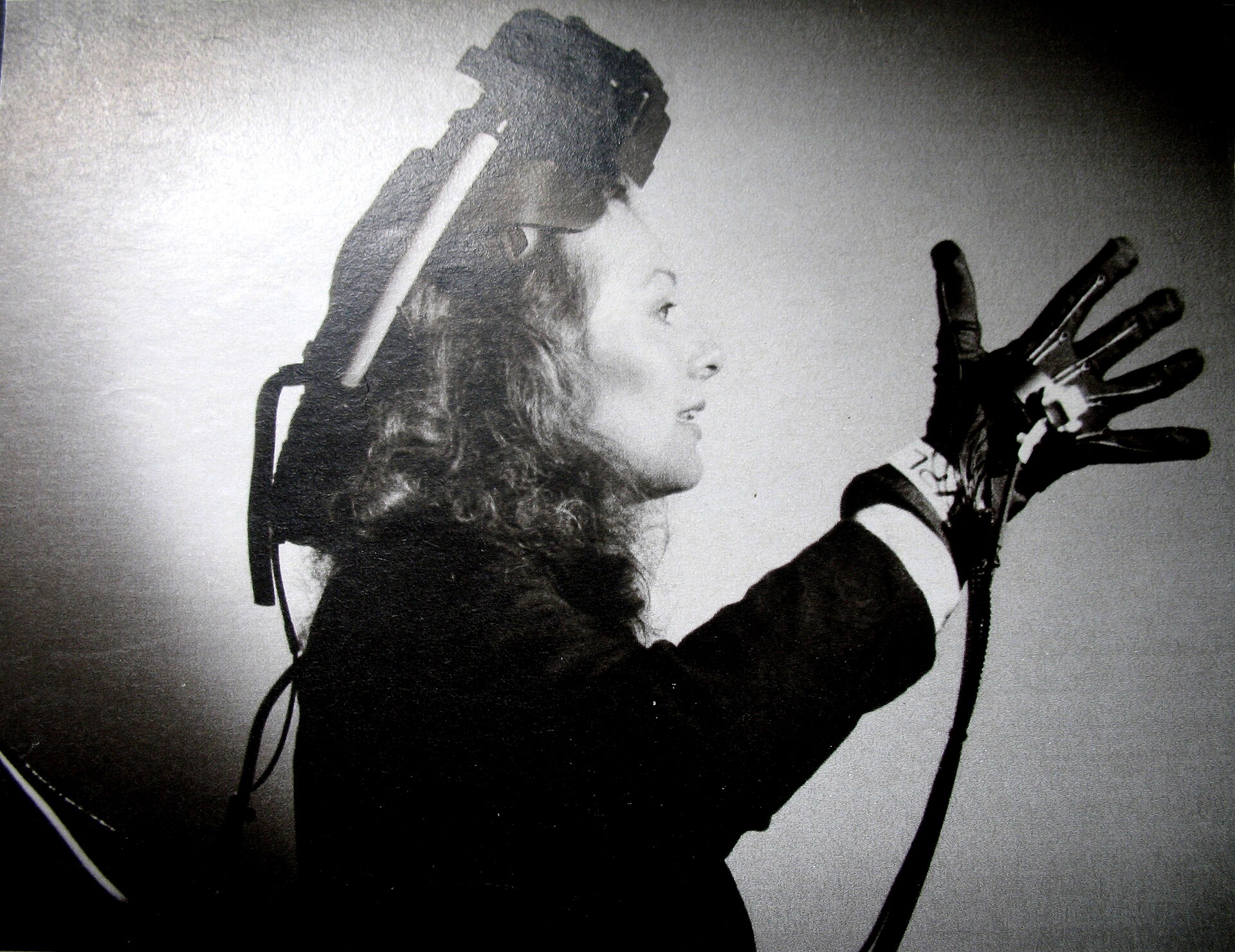
The most consequential "place" of the late twentieth century was named in a science fiction novel. In 1984, William Gibson — writing on a manual typewriter, with no experience of computer networks — described a "consensual hallucination" called cyberspace: a graphical representation of data abstracted from the banks of every computer in the human system, a space you could enter, navigate, and get lost in. Twelve years later, John Perry Barlow borrowed the word to write his Declaration of the Independence of Cyberspace. Between the naming and the declaration, engineers built it. Between the declaration and now, billions moved in.
But the intuitions ran deeper than Gibson. Borges had imagined infinite libraries and forking paths in the 1940s — spaces made of links rather than walls, where meaning depends on the path taken and the whole is ungraspable by any single reader. Bush described associative trails in 1945. Nelson coined "hypertext" in the 1960s. Baudrillard argued that the map precedes the territory. Turkle documented what happened psychologically when people began to live inside digital personae. Castells mapped the network as social structure. Across decades and disciplines — literature, engineering, philosophy, psychology, political theory — a convergence took shape: the idea that a new kind of space was possible, one made of navigation rather than location, of protocol rather than walls, of identity rather than geography.
This itinerary runs from Borges's labyrinths to Carr's warnings about what the screen does to attention, passing through cyberpunk prophecy, French philosophy, MIT psychology labs, and the architecture of the web itself. It is the story of a place that was imagined before it was built, named before it was inhabited, and critiqued almost as soon as it became real.
The library without walls
Ficciones
Before anyone had built a computer network, Borges had already imagined its topology. "The Garden of Forking Paths" (1941) describes a novel that is also a labyrinth — a structure in which every decision branches into all its possible outcomes simultaneously, so that the narrative contains all narratives. "The Library of Babel" imagines a universe made entirely of interconnected rooms containing every possible combination of text: an architecture of total information where the problem is not scarcity but navigation.
These stories, written decades before hypertext was coined as a term, describe with uncanny precision the experience of moving through a space made of links rather than walls — where every node connects to every other, where meaning depends on the path taken, and where the whole is ungraspable by any single reader.
Ted Nelson and the early hypertext theorists acknowledged Borges explicitly.
He did not predict the internet; he imagined the phenomenology of inhabiting it.
The reader as navigator
If on a Winter's Night a Traveler
Calvino wrote what may be the first novel that behaves like a hypertext system.
The book is structured as a series of interrupted beginnings: the reader starts one novel, is diverted to another, begins that one, is diverted again — ten incipits nested inside a frame story about the act of reading itself.
The second person ("You are about to begin reading Italo Calvino's new novel") turns the reader into a character navigating a branching structure, making choices, following links that lead to other texts rather than deeper into one.
Published five years before Neuromancer and two decades before the World Wide Web, the book enacts the experience of browsing — the pleasure and frustration of a medium where every text points to another text, where completion is structurally impossible, and where the reader's trajectory through the network is the story.
Calvino arrived at the architecture of the web through literary experiment, not engineering — which may be why the diagnosis remains sharper than most technical descriptions.
Trails of association
As We May Think
Point zero. Bush imagined the Memex in 1945 — a machine for augmenting human memory through associative trails.
Every hyperlink, every wiki, every recommendation system is a partial realisation of this essay.
Read it not as prediction but as the clearest statement of what personal computing was supposed to be for.
The partnership
Man-Computer Symbiosis
Licklider's argument is not that computers will replace human thinking but that the interesting future is in the partnership — humans setting goals, computers handling the mechanical.
He funded ARPANET to make this vision real. This paper explains why the best product tools augment rather than automate.
Augmenting, not replacing
Augmenting Human Intellect: A Conceptual Framework
The conceptual framework behind the "Mother of All Demos." Engelbart's insight was that tools, knowledge, methods, and training form a co-evolving system — you cannot improve human capability by changing just one element.
This is the origin of the idea that product work is systems work, not feature work.
Hypertext as liberation
Computer Lib / Dream Machines
The most radical manifesto of personal computing — a book printed back-to-back, readable from either end.
Nelson coined "hypertext" and argued that computers are too important to be left to computer scientists.
Wild, uncompromising, and more prescient than polished. The counterpoint to every corporate vision of technology.
The Xanadu dream
Literary Machines
Nelson's self-published, endlessly revised manifesto describes Project Xanadu — a hypertext system conceived in the 1960s that envisioned two-way links, version tracking, micropayments for authors, and transclusion as alternatives to copying.
The book is essential for understanding the road not taken: when Berners-Lee designed the World Wide Web a decade later, he deliberately chose one-way links and simplicity over Nelson's richer but more complex architecture.
Nelson's writing is passionate, eccentric, and sometimes maddening, but his critique of hierarchical file systems and his vision of interconnected documents were decades ahead of their time.
Many problems the web still struggles with — broken links, content ownership, attribution — are precisely the ones Xanadu was designed to solve.
Reading Nelson today is a reminder that the systems we use are not inevitable but the product of specific tradeoffs made by specific people.
The galaxy after Gutenberg
The Gutenberg Galaxy
McLuhan's argument is that the invention of movable type created not just a new way of distributing text but a new way of thinking — linear, sequential, uniform, repeatable — and that this mode of consciousness shaped everything from nationalism to scientific method to the modern sense of individual identity.
The book is deliberately non-linear in its own structure, composed of short sections that McLuhan called a "mosaic," resisting the very literacy-based logic it describes.
It is the sister work to Understanding Media, more historical and more difficult, focused specifically on the transition from manuscript culture to print culture.
Reading it alongside Ong and Eisenstein gives the full picture.
McLuhan's insights are uneven but the central claim — that each dominant medium restructures thought itself — remains the most productive idea in media theory.
What changes when the medium changes
Orality and Literacy
Ong systematized what McLuhan had intuited: that the shift from oral to literate culture was not merely a change in technology but a transformation in the structure of consciousness.
He catalogued the cognitive characteristics of primary oral cultures — aggregative rather than analytic, redundant, conservative, participatory — and showed how writing made possible abstraction, categorization, and the separation of the knower from the known.
The book is compact, clearly argued, and avoids McLuhan's oracular style while extending his core insight with anthropological and linguistic evidence.
It is essential for thinking about what any new medium does to thought, because it establishes the baseline: what thinking was like before literacy reshaped it.
Anyone working on digital products who wonders what screens are doing to cognition should start here, with what print did first.
The end of alphanumeric code
Does Writing Have a Future?
Flusser asks whether alphanumeric code — and with it, the linear, historical, critical thinking that writing made possible — will survive the age of technical images.
His answer is not nostalgic but analytical: writing produced a specific mode of consciousness, and if technical images replace writing as the dominant code, that consciousness will be replaced too.
The book appeared in German in 1987 and in English translation only in 2011, which means its arguments arrived in the Anglophone world just as the shift Flusser described was becoming visible in the form of image-based social media and algorithmic feeds.
His framework — that codes shape thought, not merely transmit it — parallels Ong and McLuhan but pushes further into the consequences for political and scientific reasoning.
More relevant in 2026 than when written, precisely because the transition he diagnosed is now well underway.
The rhizome against the tree
A Thousand Plateaus: Capitalism and Schizophrenia
The introduction to this book — titled simply "Rhizome" — is one of the most consequential metaphors in twentieth-century thought.
Deleuze and Guattari describe a system with no centre, no hierarchy, where any point can connect to any other, and where the structure grows laterally rather than branching from a trunk.
They wrote it before the public internet existed, yet the description reads as an almost exact specification of distributed network architecture.
The deeper contribution is the opposition they draw between the tree (hierarchical, rooted, binary) and the rhizome (acentred, connective, heterogeneous).
That tension — tree versus rhizome — maps directly onto the organisational problem of digital product: the org chart wants to be a tree, the product wants to be a rhizome, and Conway's Law sits at the junction.
For anyone working in networked systems, this is the philosophical source code that later theorists like Galloway, DeLanda and Barabási operationalised in their own domains.
The map that precedes the territory
Simulacra and Simulation
Baudrillard's thesis is that the distinction between reality and representation has collapsed — not because representations have improved, but because the model now precedes and generates the thing it was supposed to represent.
The map precedes the territory; the simulation produces the real.
He traces a historical sequence: first, signs reflect a basic reality; then they mask it; then they mask its absence; finally, they bear no relation to reality at all — they are pure simulacra.
Written three years before Gibson coined "cyberspace," the book provides the philosophical infrastructure for understanding digital space as something other than a copy of physical space.
Cyberspace is not a simulation of the real world; it is a space where the distinction between original and copy has been dissolved from the start.
The Wachowskis famously required the cast of The Matrix to read this book; but its deeper relevance is for anyone designing or inhabiting digital environments, where every object is already a copy without an original and every experience is already mediated by layers of abstraction that have no ground floor.
The word that named the place
Neuromancer
Gibson coined the word "cyberspace" in a short story two years earlier, but Neuromancer gave it a geography.
The novel describes a "consensual hallucination" — a graphical representation of data abstracted from the banks of every computer in the human system, a space you could enter, navigate, and get lost in.
What makes the book remarkable is not the prediction but the phenomenology: Gibson wrote about what it would feel like to inhabit a digital space before any such space existed to be inhabited.
The hacker Case experiences cyberspace as a place with texture, distance, and danger — not as a screen but as an environment.
This intuition — that the digital would be experienced spatially, that people would feel inside rather than in front of — shaped everything that followed: the design language of virtual reality, the vocabulary of the early web, the metaphors that Barlow and Rheingold used to describe online community.
Gibson famously wrote the novel on a manual typewriter.
The most consequential space of the late twentieth century was imagined by someone who had never used the technology he was describing, which may be precisely why the description captured something that engineers, too close to the material, could not see.
The cyborg at the boundary
A Cyborg Manifesto: Science, Technology, and Socialist-Feminism in the Late Twentieth Century
Haraway's manifesto argues that the boundaries between human and machine, physical and non-physical, male and female, are not natural facts but political constructions — and that the figure of the cyborg, a hybrid of organism and technology, offers a way to think beyond them.
Published one year after Neuromancer, the essay provides the theoretical complement to Gibson's fiction: if cyberspace is a place where bodies dissolve into data, Haraway asks who gets to dissolve and on what terms.
She rejects both the technophobic nostalgia for a pre-digital "natural" body and the uncritical celebration of disembodiment that would later characterise much Silicon Valley discourse.
The cyborg is not a prediction but a diagnostic — a way of recognising that we already live in intimate entanglement with our technologies, and that the interesting question is not whether this is good or bad but what politics it makes possible.
The essay remains foundational for anyone thinking about identity, embodiment, and power in digital space.
The Metaverse
Snow Crash
If Gibson imagined cyberspace as an abstract datascape, Stephenson imagined it as an inhabited city.
The "Metaverse" in Snow Crash is a virtual boulevard with real estate, architecture, social stratification, and economic inequality — a digital space with all the spatial logic of a physical one.
People enter as avatars whose quality reflects their wealth and programming skill; they walk, build, buy, and loiter.
The novel anticipated with startling specificity the design language that would dominate virtual worlds for three decades: avatars, user-generated content, virtual property, the coexistence of corporate infrastructure and hacker subculture.
But its sharpest insight is sociological, not technical: the Metaverse reproduces the power structures of the physical world rather than escaping them.
Published at the moment the web was becoming public, the book provided an alternative vision to Barlow's libertarian utopia — a vision in which digital space is not free territory but contested ground, shaped by the same forces of capital, status, and exclusion that shape physical cities.
The word "metaverse" entered the technology industry's vocabulary directly from this novel, and most of what has been built under that name confirms Stephenson's intuition rather than Barlow's hope.
The virtual agora
The Virtual Community
Rheingold named online communities and wrote their first serious ethnography, centered on the WELL — Stewart Brand's BBS out of which half the early internet culture emerged.
The book documents what happened when people who had never met face to face began forming bonds, governing themselves, mourning their dead, and building social norms in text-only spaces.
Written before the web existed as a mass medium, it captures a moment when these experiments felt genuinely new and their political implications were still open questions.
Rheingold was honest about both the promise and the pathologies, which gives the book a weight that later techno-utopian accounts lack.
The full text is freely available online, as Rheingold intended.
Atoms and bits
Being Digital
The shift from atoms to bits as the fundamental decentralising force.
When information becomes digital, the costs of copying, distributing and transforming it fall to zero.
Industries built on the scarcity of physical carriers face a pressure they cannot resist.
Prophetic on many counts — media convergence, personalisation, the collapse of intermediaries. Accessible and visionary in tone.
Anticipates the logic that every digital wave compresses distance and decentralises capability.
Independence
A Declaration of the Independence of Cyberspace
Barlow wrote this in Davos in February 1996, the night the Telecommunications Act was signed, and it became the founding manifesto of internet libertarianism.
In four pages he declared that governments had no sovereignty over cyberspace, that the internet would create a civilization of the mind independent of the tyrannies of flesh, and that the old industrial world had nothing to offer the new digital one.
The rhetoric is magnificent, the prophecy was wrong, and the document remains essential because it crystallized an ideology that shaped the design decisions of an entire generation of technologists.
Read alongside Lessig and Zuboff, it becomes a primary source for understanding how the internet went from utopian promise to extraction economy.
Free, as it always was.
The computer as mirror
The Second Self: Computers and the Human Spirit
Turkle brought psychoanalytic method to computer culture in the early 1980s, interviewing children, hackers, hobbyists, and AI researchers about what they thought they were doing when they sat in front of a screen.
The result is an ethnography of human-machine intimacy written before anyone had a reason to take the subject seriously.
She found that computers functioned as "evocative objects" — things people used to think about thinking, identity, and control — and that different people projected radically different meanings onto the same technology.
The book prefigured the entire contemporary debate about AI and subjectivity by four decades.
It remains the sharpest account of what happens psychologically when people begin to treat machines as minds.
Life on the screen
Life on the Screen: Identity in the Age of the Internet
If The Second Self studied what people projected onto computers, Life on the Screen studied what they became inside them.
Turkle spent years observing and interviewing participants in MUDs — text-based virtual environments where users created characters, built rooms, and lived parallel social lives under constructed identities.
Her finding was that online spaces were not escapist fantasies but serious psychological laboratories: people used their digital identities to work through real problems of gender, authority, intimacy, and self-presentation.
The book arrived at the midpoint between Gibson's fiction and the social media era, documenting the moment when millions of people first experienced what it meant to exist simultaneously in a physical body and a digital persona.
Turkle drew on psychoanalytic and postmodern theory — Lacan, Deleuze — but kept the analysis grounded in ethnographic detail.
The result is the first rigorous psychological study of what it means to inhabit digital space, written at the precise historical moment when that experience was new enough to be visible and strange.
The network as social structure
The Rise of the Network Society
The network as an organisational form that replaces industrial hierarchy.
Castells argues that the informational technology revolution is building a new social structure where power and productivity depend on the ability to connect to information networks.
Hierarchical organisations lose their edge against networked ones. Dense and academic, but canonical.
Offers the sociological frame that complements the economic frame of Coase and Williamson.
Collective intelligence
Cyberculture
Lévy's project was to provide a philosophical framework for the emerging digital culture at a moment when most commentary oscillated between utopian celebration and dystopian panic.
He refused both.
Drawing on his earlier work on collective intelligence, Lévy argued that cyberspace was not merely a communication medium but a new kind of space for thought — one that enabled forms of knowledge production, social organisation, and cultural creation that had no precedent in print or broadcast culture.
The book is structured as a systematic mapping of the digital condition: its technologies (hypertext, simulation, virtual reality), its cultural forms (online communities, digital art, distance learning), its political implications (governance, access, inequality), and its philosophical stakes (what happens to universality when knowledge becomes navigable rather than fixed).
Published in the same year as Castells's The Rise of the Network Society, it offers a complementary and more philosophically ambitious reading of the same transformation — less interested in economic structure than in what the new medium does to the nature of knowledge itself.
Lévy was among the first to insist that the interesting question about digital space was not technological but anthropological: not what the machines can do, but what kind of collective human intelligence they make possible.
The architect describes the space
Weaving the Web
The story of the World Wide Web told by its creator.
The most relevant thing is not the technology but Berners-Lee's insistence that there was no grand plan — only a problem to solve (sharing information between CERN researchers) and a spirit of openness.
The web was not designed top-down; it was woven. Berners-Lee actively resisted centralising and privatising the protocol.
Essential reading for the narrative thread that the deepest transformations often arise without a plan, driven by necessity and curiosity — and that keeping them open is itself a design choice.
A grammar for new media
The Language of New Media
Manovich founded the academic study of software as a cultural form by doing something unexpected: applying the vocabulary of Soviet montage theory and cinema studies to the computer interface.
The book argues that new media objects follow identifiable principles — numerical representation, modularity, automation, variability, transcoding — and that these principles descend from older media traditions rather than emerging from nowhere.
His analysis of the database as a symbolic form, opposed to narrative, remains one of the most productive ideas in digital humanities two decades later.
Manovich reads Vertov, Eisenstein, and the avant-garde not as historical curiosities but as the direct ancestors of the HCI paradigm.
The result is a theoretical framework that treats the screen, the menu, and the loop as cultural artifacts deserving the same scrutiny once reserved for the novel or the photograph.
Code is law
Code: And Other Laws of Cyberspace, Version 2.0
Lessig's central argument — "code is law" — holds that the architecture of software regulates behavior as effectively as any statute, and that choices made by engineers are therefore political choices whether they recognize it or not.
The book systematically examines how technical design decisions about identity, authentication, encryption, and intellectual property create or foreclose possibilities for freedom in digital spaces.
Version 2.0, released under Creative Commons and freely available online, updated the original 1999 edition with the experience of the post-9/11 surveillance expansion and the rise of platforms.
Lessig writes as a constitutional scholar who understands code, which gives the analysis a rigor that most technology criticism lacks.
The framework remains the essential starting point for anyone thinking about regulation, platform power, or the politics of technical standards.
How control persists in networks
Protocol: How Control Exists After Decentralization
Galloway's thesis is that the internet is not, in any politically meaningful sense, a space of freedom — it is a space of protocol.
He argues that TCP/IP and DNS constitute a new form of control that operates not through hierarchy or centralized authority but through the voluntary adoption of shared technical standards.
The book draws directly on Deleuze's concept of "societies of control" and on Foucault's analysis of distributed power, applying both to the actual engineering of network architecture.
Galloway reads RFCs as political documents and routing tables as instruments of governance.
The result is a theory of power that takes the OSI model seriously as a diagram of how authority is exercised in distributed systems.
It remains the sharpest political reading of the internet's technical infrastructure.
The erasure of embodiment
How We Became Posthuman: Virtual Bodies in Cybernetics, Literature, and Informatics
Hayles traced a single, consequential assumption through three waves of cybernetics, postwar science fiction, and contemporary information theory: the idea that information can be separated from the material substrate that carries it.
She argued that this assumption — that pattern is more essential than presence, that the message matters more than the medium — enabled the dream of disembodied consciousness that runs from Wiener through Moravec to the transhumanists, and that it is both technically productive and philosophically dangerous.
The book reads cybernetics, artificial life research, and novels by Philip K.
Dick, William Gibson, and others as parallel expressions of the same cultural negotiation: the gradual displacement of the liberal humanist subject by the posthuman, a figure defined by its entanglement with technology rather than its autonomy from it.
Hayles insisted that embodiment matters — that cognition is always situated in a body, that information always requires a material instantiation — and that the erasure of the body from digital discourse was not liberation but ideology.
The book remains the most rigorous account of what is lost when digital space is theorised as if bodies do not exist.
What the medium does to attention
The Shallows: What the Internet Is Doing to Our Brains
Carr expanded his 2008 Atlantic essay "Is Google Making Us Stupid?" into a full argument that the internet is reshaping the neural circuits responsible for sustained attention and deep reading.
Drawing on neuroscience research into brain plasticity, he argues that the medium's design — hyperlinks, notifications, constant context-switching — trains the brain for skimming and weakens the capacity for the kind of linear, concentrated thought that books made possible.
The argument is McLuhan updated with neuroscience: the medium restructures the mind that uses it, regardless of the content it carries.
Carr writes the pessimistic line about the internet with seriousness and rigour, avoiding both technophobia and nostalgia.
The book is most useful not as prophecy but as a framework for thinking about the cognitive costs of any medium, including whatever comes after the web.
Complementary readings
There Is No Software
In five pages, Kittler mounts a provocation that has shaped two decades of debate: "software" as a distinct category does not exist.
What we call software, he argues, is a marketing abstraction layered over voltage differences in silicon — a convenient fiction that obscures the material reality of hardware operations.
The essay traces how each layer of abstraction, from high-level languages to operating systems, progressively distances users from the machine while claiming to bring them closer to meaning.
Kittler draws on his broader media-archaeological method, insisting that scholars attend to the physical substrate rather than the symbolic surface.
The argument is deliberately extreme and not entirely fair, but its usefulness lies precisely in the discomfort it produces: it forces anyone who works with software to justify the category they take for granted.
Available as a free PDF.
Gramophone, Film, Typewriter
Kittler — the German McLuhan, darker and more technically precise — argued that the media technologies of the late nineteenth century broke the monopoly of print over the storage and transmission of human experience.
The gramophone captured sound, film captured motion, the typewriter standardized the production of text, and together they disaggregated what the book had unified.
His method is to read literature, philosophy, and psychoanalysis as effects of their underlying media infrastructure, reversing the usual humanistic assumption that ideas drive technology.
The English translation appeared in 1999 and brought Kittler's work to an Anglophone audience that was just beginning to take "media archaeology" seriously.
The prose is dense and allusive, drawing on Lacan, Shannon, and Turing in the same paragraph.
It is not easy reading, but it is the most rigorous account of how nineteenth-century media technologies made the twentieth-century subject possible.
Programmed Visions: Software and Memory
Chun examines the paradox at the heart of software: it promises permanence through storage yet operates through constant execution, repetition, and decay.
She argues that the ideology of software — the belief that code is inherently reliable, logical, and transparent — obscures how it actually functions as a technology of memory that is always degrading, always requiring regeneration.
The book connects the history of programming to broader histories of eugenics, race, and governance, tracing how the concept of "programmability" migrated from genetics to computing.
Chun's reading of source code as a fetish object — visible yet not what actually runs on the machine — challenges the common assumption that open source equals transparency.
Dense and theoretically demanding, it rewards readers willing to sit with its discomfort about what it means to delegate memory and decision-making to machines.
Writing Space: Computers, Hypertext, and the Remediation of Print
Bolter argues that each writing technology — from the papyrus scroll to the printed book to the computer screen — creates its own "writing space" that shapes not just how we write but what we think is worth writing.
The central claim is that electronic writing, and hypertext in particular, is best understood as a remediation of print: it refashions the older medium rather than replacing it.
Bolter introduces "topographic writing" — a mode of composition that is spatial, networked and non-sequential, as opposed to the hierarchical, linear structure of the printed page.
He explicitly connects this to Deleuze and Guattari's rhizome: a horizontally branching structure with no centre and no fixed reading order.
For anyone building digital products, this is a reminder that the interface is never neutral — every layout, every navigation pattern, every information hierarchy is a theory of how knowledge should be structured, whether its designers know it or not.
Hypertext 3.0: Critical Theory and New Media in an Era of Globalization
Landow was among the first to bridge literary theory and computing, arguing that hypertext realised what Derrida, Barthes and Deleuze/Guattari had theorised about the death of the author, the open text and the rhizome.
The book traces how giving readers instant access to a web of interconnected sources fundamentally changes the acts of reading and writing — dissolving the boundaries between author and reader, centre and margin, text and commentary.
Through three editions (1992, 1997, 2006), Landow updated his argument to account for the World Wide Web, blogs and globalisation, making this the most sustained attempt to connect poststructuralist philosophy with the concrete experience of navigating digital text.
For product people, the value lies in understanding that hypertext is not merely a technology but a way of organising thought — and that the design decisions embedded in links, navigation and information architecture carry philosophical weight.
Tubes: A Journey to the Center of the Internet
Blum is a journalist who began investigating the physical internet after a squirrel chewed through his cable connection.
The book follows him from that hole in his garden to submarine cable landing stations in Portugal, internet exchange points in Frankfurt, and data centers in Oregon.
It is narrative journalism at its best — concrete, sensory, and stubbornly material about an infrastructure most people experience as pure abstraction.
Blum shows that the internet has a geography, and that geography reflects economics, history, and power in ways that matter for anyone building products on top of it.
The writing makes visible what engineers take for granted and what users never see.
For product people accustomed to thinking in APIs and dashboards, it is a necessary correction toward the physical substrate underneath.
The Undersea Network
Ninety-nine percent of intercontinental internet traffic travels through submarine cables, yet almost no one outside the telecommunications industry writes seriously about them.
Starosielski combines ethnography, media theory, and geopolitical analysis to trace the routes these cables follow — routes that often repeat the paths laid by telegraph companies in the nineteenth century.
The book examines how landing sites are chosen, how local communities negotiate with global infrastructure, and how the physical vulnerability of a cable on an ocean floor shapes the politics of connectivity.
Her argument is that networks are not abstract topologies but material systems embedded in specific landscapes, economies, and power relations.
For product leaders, the book makes vivid the infrastructure dependency chain that sits beneath every cloud service and every global user base.
It is a reminder that distribution is always, in the end, a physical problem.
The Dream Machine: J.C.R. Licklider and the Revolution That Made Computing Personal
Waldrop's biography of J.C.R.
Licklider is also the most complete single-volume history of how personal computing came to be — from Vannevar Bush's "As We May Think" through ARPA funding, Xerox PARC, and the early internet.
Licklider is the connecting figure because he funded, inspired or directly enabled almost every major development, often by placing bets on people rather than on specific technologies.
For product direction the book is essential history: the computing environment we ship products into was shaped by specific people making specific decisions under specific institutional constraints, and understanding those decisions clarifies what "technology" actually is.
Long, detailed, written with a biographer's patience. The Stripe Press reissue is the edition to find.
Inventing the Internet
Abbate's history of the internet focuses on the institutional, organizational, and political dimensions that most popular accounts omit.
Rather than telling a heroic story of visionary individuals, she traces how ARPANET emerged from Cold War defense funding, how its design reflected the values of the academic research community that built it, and how the transition to a commercial internet involved deliberate policy choices with lasting consequences.
The book is especially strong on the design of TCP/IP and the social process by which technical standards were negotiated through RFCs and working groups.
Abbate shows that the internet's open, decentralized architecture was not an inevitable technical outcome but the product of specific organizational cultures and specific moments of institutional decision-making.
It is the corrective to every origin story that begins with a garage.
The Age of Surveillance Capitalism
Zuboff names and anatomizes a new economic logic: the unilateral claiming of private human experience as free raw material for translation into behavioral data, which is then fabricated into prediction products and sold in behavioral futures markets.
The book is dense, repetitive by design, and builds its own vocabulary — "behavioral surplus," "instrumentarian power," "Big Other" — because Zuboff argues that existing frameworks cannot describe what is actually happening.
It functions as the counter-manifesto to Barlow's 1996 declaration of cyberspace independence, written thirty years later by someone who watched the utopia become an extraction economy.
Whatever one thinks of its rhetorical excess, the analytical framework has become inescapable for anyone working in digital products who wants to understand the business model they operate within.
It's Complicated: The Social Lives of Networked Teens
A decade of ethnographic research with American teenagers, dismantling the moral panics that adults project onto young people's use of social media. boyd demonstrates that teens are not addicted, naive, or reckless — they are navigating a social environment where physical spaces for unsupervised socialisation have been systematically eliminated, and networked publics are what remains.
The book is a corrective to the shallow technodeterminism that dominates discourse about screens and children, grounding every claim in what teenagers themselves actually say and do.
For product people it is a lesson in humility: the users you think you understand may be solving problems you have not even noticed.
Free online from the author.
The Media Lab: Inventing the Future at MIT
Brand documented the MIT Media Lab in its founding years, when Nicholas Negroponte was assembling a research culture that treated the convergence of broadcasting, publishing, and computing as inevitable.
The book captures a specific institutional style — corporate-funded academic research oriented toward demonstration and spectacle — and a specific vision of the digital future that was partly right and partly a projection of 1980s optimism.
Brand, who understood institutional design from his Whole Earth Catalog work, was the right observer for this subject: sympathetic but precise about how the Lab's funding model shaped what it could imagine.
Many of the technologies described here — personal digital assistants, electronic ink, immersive media — arrived decades later in forms the Lab did not predict.
The gap between the prediction and the outcome is itself instructive.
The Victorian Internet
Standage tells the history of the electric telegraph as the first global communications network — and in doing so provides an almost uncanny mirror for every claim made about the internet since the 1990s.
The telegraph produced its own hype cycles, its own utopian predictions about world peace through connectivity, its own concerns about information overload, its own online romances, and its own financial bubbles.
The parallels are not accidental; they reflect something structural about what happens when a new technology compresses the time and space of human communication.
Standage is a journalist, not a historian of technology, and the book benefits from that: it reads as narrative rather than thesis.
For anyone writing or thinking about digital networks today, this is the genealogy that prevents you from treating the present as unprecedented.
The Digital Sublime
Mosco, working from the political economy of communication tradition, dissects the myths that have accompanied every major technological wave — the telegraph would bring world peace, electricity would eliminate poverty, the internet would create perfect democracy — and shows that the same narrative structure repeats with each new medium.
The central concept is the "digital sublime": the quasi-religious awe that new technologies inspire, which serves to suspend critical judgment precisely when it is most needed.
Mosco traces how the dot-com bubble was inflated not by technology alone but by a mythology of the end of history, the end of geography, and the end of politics that made speculative excess feel like rational investment.
The book argues that myths do not simply deceive — they perform real ideological work by framing technological change as inevitable, natural, and beyond political contestation.
For anyone working in technology who has lived through multiple hype cycles, Mosco provides the analytical vocabulary to understand why the pattern repeats and whose interests the repetition serves.
Designing an Internet
Clark served as the IETF's chief protocol architect for fifteen years and helped shape the design principles that became the internet's foundation.
This book is his retrospective: not a memoir but a systematic analysis of which architectural decisions were inevitable given the constraints and which could have gone differently.
He distinguishes between designing "the Internet" — the specific artifact we have — and designing "an internet" — the broader class of possible large-scale networks.
The framework forces the reader to separate contingent choices from structural necessities, a discipline directly transferable to product architecture.
Clark is unusually honest about the tradeoffs embedded in end-to-end design, layering, and the tussle between stakeholders with incompatible goals.
Available as free open access from MIT Press, making it one of the most valuable no-cost readings on network design available.