The Theory in the Code: A History of the Practice of Building Software
Annotated bibliography
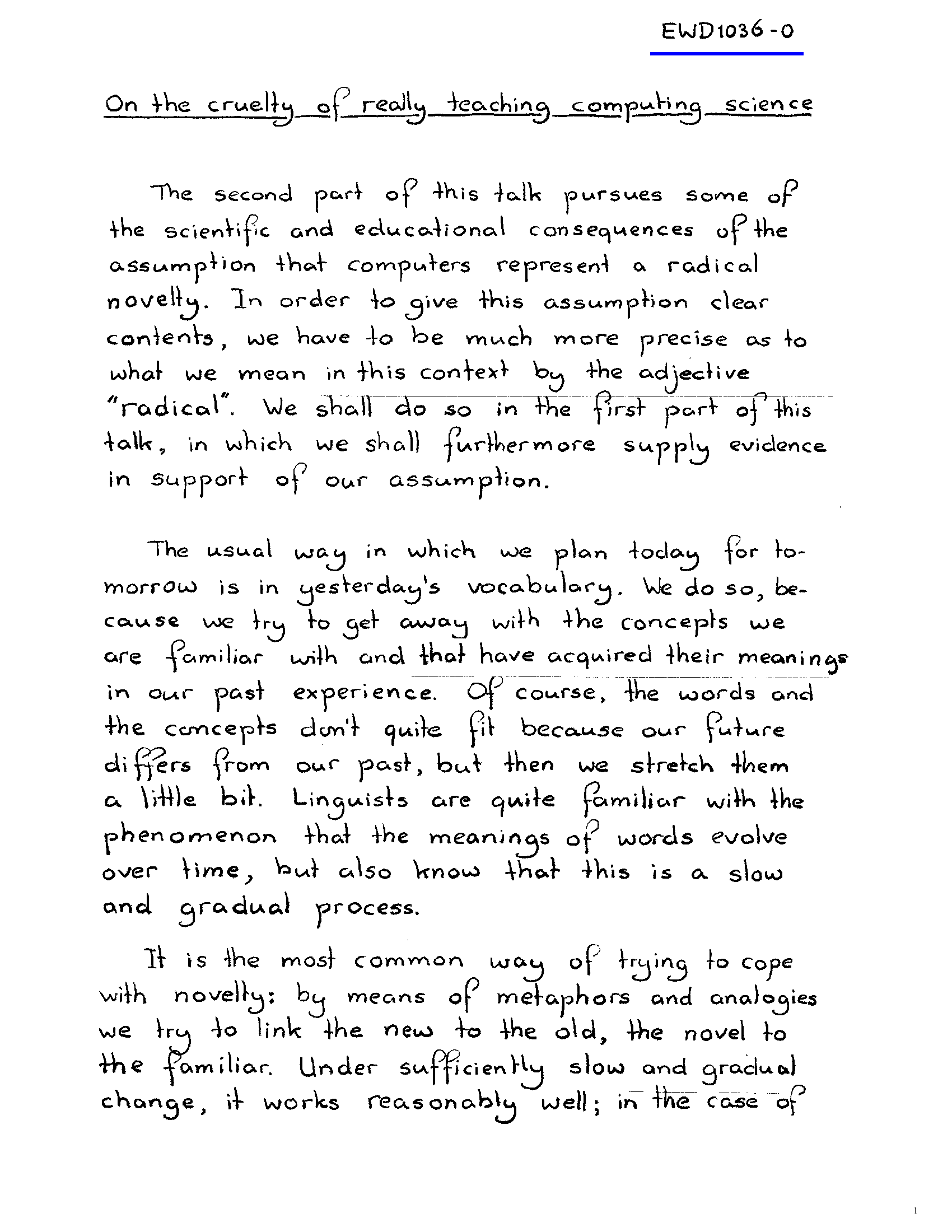
In 1988, Edsger Dijkstra stood before an audience of computer scientists and argued that the field they all worked in was fundamentally misunderstood — not by outsiders, but by its own practitioners. "On the cruelty of really teaching computing science" was his title, and the cruelty he meant was this: computing is a radical novelty that cannot be taught through analogies to the past, because the analogies invariably domesticate what should remain strange. The manuscript, written in the handwriting that became his signature, opens with a deceptively simple claim: "The usual way in which we plan today for tomorrow is in yesterday's vocabulary."
This collection traces the history of the practice of building software — not as a catalogue of techniques but as an itinerary through the question that has silently shaped every debate about how software should be built: is the essential act of programming something that can be made legible to organisations, or is it irreducibly a craft — a form of theory building that lives in human heads and dies when those heads leave?
The tension runs through every chapter. Dijkstra argued that constraints enable rather than limit. Brooks showed that the complexity is irreducible. Naur proposed that the program is the theory, not the code. The Unix tradition answered with taste as a technical concept. The agile movement tried to codify iteration and watched the codification consumed by the industry it was meant to correct. Open source created an alternative political economy and discovered that the bazaar has maintenance costs the romantic narrative conceals. And through it all, the builders kept building — with the emotional reality that process methodologies never capture and the craft that organisations persistently try to manage as if it were factory work.
The itinerary moves in four arcs. The first traces what programming is, as understood by the people who first thought carefully about it. The second follows how a specific tradition — Unix, Bell Labs, and its descendants — turned that understanding into a coherent aesthetic. The third asks what happens when the craft scales beyond individuals: how work is organised, how open source rewrites the rules, and how the tension between legibility and discretion plays out in teams and institutions. The fourth turns inward, to the human cost and the ongoing practice of keeping both the theory and the code alive.
Design as the problem of fit
Notes on the Synthesis of Form
Alexander's first book, written as his Harvard PhD, is the foundational text of design theory and the predecessor of his later work on pattern languages.
The central argument is that design is the problem of achieving fit between form and its context — and that in traditional cultures this fit emerged unconsciously, while in modern design it has to be constructed explicitly.
For product direction the book is difficult and worth the effort: most product decisions are attempts to produce fit between a form (the product) and a context (users, market, organisation) that nobody has described carefully enough.
Alexander's thinking shaped object-oriented programming, wiki culture and every contemporary use of the word "pattern". A book that repays rereading.
Constraints that enable
Go To Statement Considered Harmful
One page that changed how software is written.
Dijkstra argued that unstructured jumps make programs impossible to reason about — and that the quality of a programmer's thinking is bounded by the control structures available.
The paper launched structured programming and established the principle that intellectual manageability is the primary constraint on software quality.
For product people: the earliest and most elegant example of the principle that constraints enable rather than limit creative work.
Every time a team adopts a convention that restricts freedom in order to gain clarity, they are applying Dijkstra's insight.
The shape of the organisation is the shape of the system
How Do Committees Invent? (Conway's Law)
Conway's 1968 paper states a law that has turned out to apply to software, hardware, and almost every other designed system: "organisations which design systems are constrained to produce designs which are copies of the communication structures of these organisations." The paper is short and the claim is empirical — Conway studied committees and their outputs.
For product direction it is foundational: the shape of the team determines the shape of the product, and any attempt to produce a product shape that does not match the team shape is fighting the system.
Pair with Skelton and Pais's Team Topologies for the modern operational treatment.
The original is short; read it in the original because the paraphrases omit context.
On the Criteria To Be Used in Decomposing Systems into Modules
The most influential paper ever written on software architecture, and it fits in five pages.
Parnas demonstrated with a concrete example that the obvious way to decompose a system — along the steps of its processing — produces brittle designs, while decomposing along likely changes produces resilient ones.
This is the origin of information hiding: each module conceals a design decision that might change.
Every conversation about microservices, APIs, or team boundaries is a conversation about Parnas's criteria whether participants know it or not.
For product directors who shape how teams are organised around systems, this paper is not optional reading — it is the intellectual foundation of the decisions they make daily.
The first human question
The Psychology of Computer Programming
The first book that treated programmers as psychological subjects rather than interchangeable resources, and programming teams as the primary variable of software quality.
Weinberg introduced the concept of "egoless programming" — the idea that code review and collective ownership work only when developers detach their identity from their code.
Written in 1971, it reads as if it were written about your current team.
Every chapter is older than most of its readers and more accurate than most contemporary writing about the same problems.
For product directors who manage engineering organisations, Weinberg's observations about motivation, communication, and group dynamics remain the most empirically honest account of why some teams build well and others do not.
The irreducible complexity
The Mythical Man-Month: Essays on Software Engineering
Brooks's 1975 book is famous for one idea — "adding manpower to a late software project makes it later" — but the larger argument is more interesting: software projects have an irreducible complexity and a conceptual integrity that no amount of staffing can shortcut.
The essays cover the programmer's optimism, the second-system effect, the tar pit of accumulating complexity, the inevitable politics of large teams.
Every chapter is older than most of its readers and more accurate than most contemporary writing about the same problems.
For product direction this is the founding text on why software timelines are not primarily a staffing problem.
The anniversary edition adds reflective essays; read them too.
No Silver Bullet: Essence and Accidents of Software Engineering
The companion to The Mythical Man-Month.
Brooks distinguishes essential complexity (inherent in the problem) from accidental complexity (introduced by our tools and processes).
His prediction — that no single technology would deliver an order-of-magnitude improvement in software productivity — has held for four decades.
For product directors who are told that AI, low-code, or the next framework will "10x" their teams: this paper explains why the bottleneck is always in the thinking, not the typing.
Brooks's distinction between essence and accident remains the clearest framework for deciding where to invest engineering effort and where not to.
Questioning your own paradigm
Can Programming Be Liberated from the von Neumann Style?
The father of Fortran, the first widely used programming language, used his Turing Award lecture to question everything he had built.
Backus argued that conventional programming languages were prisoners of the von Neumann architecture — one instruction at a time, one word at a time — and that this "word-at-a-time bottleneck" infected not just performance but the way programmers think.
He proposed functional programming as the escape route.
The paper is remarkable as an act of intellectual honesty: the man who defined an era of programming stood up and said the paradigm was wrong.
For anyone in product or technology leadership, it is a masterclass in the discipline of questioning your own most successful work.
Communicating Sequential Processes
The paper that originated the concurrency model behind Go, Erlang, and large parts of Rust.
Hoare proposed that parallel processes should communicate by passing messages through channels rather than sharing memory — an idea so good that the industry took forty years to adopt it widely.
The formalism is precise but the core insight is intuitive: coordinating independent agents is safer when they talk to each other than when they reach into each other's state.
Every modern distributed system, every microservice boundary, every event-driven architecture traces back to this paper.
For product leaders managing teams that build concurrent systems, CSP explains why some architectural decisions make failures catastrophic and others make them recoverable.
Code as literature
Literate Programming
Knuth's argument is radical and still undigested: a program should be written as an essay addressed to human readers, with the machine-executable parts woven in.
Documentation and code are not two artefacts but one.
The paper introduced the WEB system, where the programmer writes prose that explains the reasoning and the compiler extracts the instructions.
This connects directly to Peter Naur's idea that programming is theory building — if the theory dies when the original developers leave, no amount of inline comments will resurrect it.
For anyone directing product teams, the implication is that code quality is fundamentally a communication problem, not a tooling problem.
Programming as Theory Building
Probably the most profound essay on what programming actually is.
Naur argues that a program is not the code but the theory in the programmers' heads — the understanding of how the code maps to the real-world problem.
When the original programmers leave, the theory dies even if the code survives.
This explains why rewrites are so costly, why documentation never suffices, and why Conway's law is not a joke but a theorem.
For anyone managing a codebase or a team, Naur makes visible the invisible asset that determines whether software can evolve or only decay.
Abstraction as the central act
Structure and Interpretation of Computer Programs
SICP shaped how an entire generation of MIT graduates thought about computation — not as a vocational skill but as a new way of expressing ideas.
The book teaches programming through Scheme, a minimal Lisp dialect, and uses it to build interpreters, simulators, and compilers from first principles.
Every chapter demonstrates that abstraction is the central intellectual activity of computing, not syntax or frameworks.
The full text is legally free online, which makes ignoring it a choice.
For product people who want to understand what their engineers actually do when they are doing it well, SICP remains the clearest window into the craft.
Do one thing well
UNIX Time-Sharing System: Foreword
McIlroy's foreword to the Bell System Technical Journal's special issue on Unix contains the most quoted formulation of the Unix philosophy: "Write programs that do one thing and do it well.
Write programs to work together.
Write programs to handle text streams, because that is a universal interface." McIlroy invented Unix pipes, and the foreword is the clearest primary-source statement of the design philosophy that made them possible.
For product direction the three sentences are a compressed operating manual for modular systems design — any product architecture that violates all three will eventually pay for it.
Read alongside Kernighan and Pike for the full environment and Gancarz for the extended principles. Two pages; worth memorising.
The UNIX Programming Environment
The Unix philosophy in one volume.
Kernighan and Pike teach a way of thinking, not a tool: build small programs that do one thing well, and combine them through plain text.
The whole discipline of modular systems — APIs, microservices, every composable architecture a product director has ever read about — descends from this.
Reading it today is not nostalgia; it is recovering the first principles that the industry has been quietly reinventing under new names for forty years.
And Kernighan's prose itself is a lesson: economy as intellectual honesty.
The quality without a name
The Timeless Way of Building
The philosophical companion to A Pattern Language, and arguably the deeper of the two books.
Alexander's central argument is that buildings — and by extension, all designed things — possess a quality that cannot be named but can be recognised: a quality of aliveness, of wholeness, of being at peace with itself.
He calls it "the quality without a name" and spends the first half of the book circling it through approximations — alive, whole, comfortable, free, exact, egoless — before arguing that this quality emerges only when the people who inhabit a space participate in its design using a shared pattern language.
The book is written in an unusual, almost incantatory style that many software engineers find either profound or maddening.
For those who build digital products, it poses the hardest question in design: whether good design can be systematised without killing the very quality that makes it good.
The tradition of rigour
The Art of Computer Programming
Not a book to read cover-to-cover — a book to know exists.
Knuth began writing it in 1962 and is still at it, because he refused to publish anything he had not understood completely.
The result is the definitive reference on algorithms treated as intellectual craft: not recipes to copy but structures to think with.
Every volume demonstrates that rigour and beauty are the same thing when applied to computation.
For product directors the lesson is indirect but deep: the material your engineers work with has a density and history that no sprint planning tool will ever capture.
Knowing TAOCP exists is knowing that software has a tradition as serious as any other discipline.
Hints for Computer System Design
The most useful collection of heuristics for designing systems — from the architect of the Alto at Xerox PARC and a Turing Award laureate.
Lampson's hints ("do one thing at a time, and do it well," "use brute force," "keep secrets") are not principles derived from theory but wisdom distilled from decades of building things that had to work.
The paper bridges the gap between abstract design principles and the messy reality of systems that must perform under real constraints.
For anyone directing the architecture of a product: read it as a field guide, not a textbook. The lessons apply far beyond operating systems.
Computing as medium
The Early History of Smalltalk
The other half of the software history that Brooks and the Unix tradition represent.
Kay and the Xerox PARC team invented objects, GUIs, and the idea that computing should be a medium for human expression — not a tool for data processing.
For product people: the argument that the interface is not a layer on top of the system but the system itself.
The philosophy extracted
The Art of UNIX Programming
Raymond gathers and articulates the design principles that made Unix what it is — modularity, clarity, composition, transparency — and argues they are not Unix trivia but a general ethics of engineering.
Read it alongside Kernighan and Pike: where they show you the environment, Raymond extracts the philosophy.
For a product director this is the clearest written account of why software written in a certain tradition ages well and software written against it does not.
It is also a rare book that takes taste seriously as a technical concept.
A caveat: Raymond has strong opinions outside the technical material — read him for the architecture, not the politics.
The Practice of Programming
Kernighan and Pike distil four decades of craft into a small book about what it actually means to program well: not writing clever code but writing code another person can read, debug and keep alive.
Each chapter — style, algorithms, design, interfaces, debugging, testing, performance, portability, notation — reads like the counsel of an artisan who has seen too many programs turn into dead weight and wants to name what separates the ones that survive.
The elegance is in the economy: no advice without an example, no example without consequence.
For product direction it is a reminder that the internal quality of software is not a technical detail detached from the product — it is what decides whether the product can keep evolving when reality shifts.
The Unix tradition at its clearest: do the simple things well before aspiring to the complex.
The most consequential misreading
Managing the Development of Large Software Systems
The paper usually cited as the birth of waterfall, and almost always misread.
Royce diagrams the linear sequence — requirements, design, code, test, deploy — and immediately writes that this approach is "risky and invites failure." The rest of the paper argues for iteration, feedback, and doing each step twice.
It is one of the most consequential misreadings in the history of software: the industry built careers on a straw man of a paper that was warning against the straw man.
Worth reading in the original to understand how ideas travel, and how often they arrive at their destination inverted.
The problem before the solution
Are Your Lights On? How to Figure Out What the Problem Really Is
A short, funny book that is mostly a sequence of anecdotes making a single argument: most problems people try to solve are not the problems they actually have, and the work of defining the problem is usually harder and more important than the work of solving it.
The authors — Weinberg in particular — write with the light touch of experienced consultants, and the book reads as a collection of cautionary tales disguised as riddles.
For product direction it is essential training in the first skill of the job: noticing when a team is about to spend six weeks solving the wrong problem.
Short, re-readable, and one of the few books in this library you can finish in an afternoon and return to for years.
Why Software Fails
Charette compiles a catalogue of the largest software disasters in history — Denver's airport baggage system, the IRS modernisation, the FBI Virtual Case File — and extracts the structural reasons behind them.
Most failures are not technical: they are failures of scope, communication, governance and the political will to stop when stopping is the right answer.
For product direction the piece is diagnostic training; reading it next to any project plan changes which questions you ask first.
A useful complement to Royce's paper: Royce warned against linear development, Charette shows what happens when the warning goes unheeded.
The reporting is dry, the conclusions are not.
The iteration turn
The New New Product Development Game
The HBR article that introduced the "rugby" metaphor for product development — overlapping phases, shared responsibility, the whole team moving down the field together — which Jeff Sutherland and Ken Schwaber would later crystallise as Scrum.
Takeuchi and Nonaka studied Japanese companies (Fuji-Xerox, Honda, Canon, NEC) and described a pattern that had emerged there: not the sequential relay of specifications handed off between departments, but overlapping self-organising teams with ambiguous goals and high autonomy.
Reading it today is illuminating for two reasons: the practice they describe is more demanding than the lightweight Scrum that inherited its label, and its roots in Japanese management culture explain why it often degrades in translation.
Required reading on how contemporary product organisations took their shape.
Extreme Programming Explained: Embrace Change
Kent Beck's argument is that the practices that make software reliable — pair programming, test-first, continuous integration, small releases, collective code ownership — are not independent techniques.
They reinforce each other, and each one is only robust when the others are present.
XP made some of the most consequential shifts in how software is actually built, even when teams never adopt its name: test-driven development is now mainstream, continuous integration is infrastructure, small releases are the default.
Read it to see how deeply the bet on short feedback cycles runs, and how much of today's "agile" discourse is a diluted version of the original.
Beck writes with discipline and conviction; it is a book about craft, not process.
Manifesto for Agile Software Development
Four values and twelve principles drafted in February 2001 by seventeen consultants who disagreed about almost everything except the importance of shipping working software.
The Manifesto is short, quotable and twenty-five years later still misread in every direction — as a decree rather than as the provocation it was.
Its worth for product direction is precisely that: it is a snapshot of a disagreement that had to be staged because the industry had drifted into process worship.
Read in the original it is more humble than its reputation — people and collaboration over tools and contracts, working software over documentation.
Everything written under "agile" since is an argument with or against this short text.
The economics underneath
The Principles of Product Development Flow: Second Generation Lean Product Development
Reinertsen writes the book most "lean" advocates should have written and didn't: a rigorous, economics-based account of why batches, queues and variability govern the speed of product development.
The argument is quantitative — cost of delay, WIP limits, capacity utilisation curves — and often counterintuitive.
Running teams at 100% utilisation destroys throughput; holding inventory has a measurable cost; smaller batches are almost always cheaper end-to-end than large ones.
It is the deepest book on the page about why shipping faster is not about working harder.
For a product director it clarifies the physics of the system you manage, not the psychology; dense, essential, worth re-reading every year.
Lean Software Development: An Agile Toolkit
The Poppendiecks translate Toyota's manufacturing principles into software terms: eliminate waste, amplify learning, decide as late as possible, deliver as fast as possible, respect people, see the whole.
The translation is literal enough to be rigorous and loose enough to be useful.
The seven wastes of software (partially done work, extra features, relearning, handoffs, task switching, delays, defects) are the single most portable diagnostic tool a product director can carry into any team.
Read alongside Reinertsen for the economic argument and Anderson for the implementation. It is not motivational literature; it is a manual.
Discovering your process
Kanban: Successful Evolutionary Change for Your Technology Business
Anderson's central claim is subtle: you do not adopt Kanban, you discover it by making your current work visible.
Start where you are, make WIP limits explicit, manage flow — and the process improves itself.
The virtue of the book is that it does not ask organisations to reorganise before they start; it asks them to look, which is much harder.
Reinertsen's queueing theory sits underneath, but Anderson gives you the operating manual.
For product direction it is a useful antidote to the cargo-cult of Scrum ceremonies — evolutionary change beats imposed change in most teams most of the time.
Shape Up: Stop Running in Circles and Ship Work that Matters
Shape Up is Basecamp's operating manual for product development, written by Ryan Singer after a decade of practice: six-week cycles, two-week cool-downs, "appetite" instead of estimates, teams responsible for both shaping and building their own work.
The method is the clearest alternative to Scrum currently in circulation, and the book is unusual in being both opinionated and honestly bounded — Singer tells you what it works for (small, focused teams building product) and what it doesn't (anything at large scale with heavy dependencies).
For product direction the most portable concept is probably appetite: deciding upfront how much time a problem deserves, rather than estimating how long a solution will take.
Short, free online, and deserves the attention it still gets years later.
The Age of Agile Must End
Burnett's argument is the one many product directors have been quietly thinking but struggle to say out loud: the word "agile" has been consumed by the industry it was meant to correct, and what is sold today under its name is mostly ceremony detached from the practices that made it work.
The piece is short, controlled in its anger, and lands because Burnett does not romanticise what came before — he simply shows how practice has decayed into theatre.
Read it alongside the Agile Manifesto in its original form to see the distance travelled.
For product direction it is useful permission: the problem with your current process may not be that it is insufficiently agile, but that "agile" has stopped being a useful word.
The ethic turned mechanism
Free as in Freedom: Richard Stallman's Crusade for Free Software
Williams wrote this biography of Richard Stallman with Stallman's cooperation but without his editorial control, and the result is both sympathetic and clear-eyed.
The book traces Stallman's path from the MIT AI Lab's culture of shared code through the founding of the GNU Project and the Free Software Foundation to the creation of the GPL — the license that turned a personal ethic into an institutional mechanism.
Williams is especially good on the tension between Stallman's absolutism and the pragmatic needs of a movement that wanted to win adoption.
The book was published under the GNU Free Documentation License and is freely available on gnu.org, making it a primary document as well as a secondary one.
For product people, understanding Stallman is understanding the ideological bedrock beneath every open-source dependency in your stack.
You do not have to agree with him to recognize that his choices shaped the infrastructure you build on.
The Cathedral and the Bazaar
The founding essay of the open-source movement.
The thesis: the decentralised, seemingly chaotic model (the bazaar) produces better software than the planned, controlled one (the cathedral).
Raymond codifies what Linux proved empirically — that coordination without formal hierarchy can work when there are clear protocols, intrinsic motivation and fast feedback cycles.
It anticipates the logic of autonomous teams working with AI: less central planning, more distributed iteration.
The political economy of code
The Success of Open Source
Weber is a political scientist at Berkeley, and his question is deliberately provocative: why does open source work when standard economic theory predicts it should not? Voluntary collaboration on public goods, without strong intellectual property incentives, producing software that competes with corporate products — none of this fits the models.
Weber rejects both the altruism explanation and the signaling explanation as insufficient and instead analyzes open source as a distinct political economy with its own property regime, governance structures, and coordination mechanisms.
The book is rigorous in its social science and refuses to romanticize the phenomenon it studies.
Weber shows that the success of open source is not a refutation of institutional economics but an expansion of it — a case that reveals the limits of existing models rather than the irrelevance of institutions.
For product leaders, this is the most intellectually serious attempt to explain why a mode of production that shouldn't work does, and what conditions make it fragile.
Coding Freedom: The Ethics and Aesthetics of Hacking
The product of years of anthropological fieldwork inside the Debian community, tracing how free software developers construct an ethics of labour, meritocracy, and legal activism that challenges conventional intellectual property regimes.
Coleman shows that hacking is not merely a technical practice but a deeply political one, rooted in Enlightenment ideals of free speech and craftsman autonomy that developers re-enact through code review, licensing debates, and release rituals.
The book is one of the few serious ethnographies of open-source culture written by someone who earned the trust of the community she studied.
For anyone directing digital products, it reveals the moral economy that sustains the infrastructure most commercial software depends on.
Free PDF from the author.
Working in Public: The Making and Maintenance of Modern Open Source Software
Eghbal's book is the most important work on open source published in the last decade.
She argues that GitHub fundamentally changed the economics of open source by making contribution frictionless while leaving maintenance costs untouched, creating an asymmetry that burns out maintainers.
The book introduces a taxonomy of open-source communities — federations, clubs, toys, and stadiums — based on contributor growth versus user growth, replacing the romantic image of the bazaar with a more realistic map.
Eghbal draws on research into online communities, public goods economics, and her own extensive interviews with maintainers to show that the crisis of open source is structural, not motivational.
The analysis extends naturally to any platform where creators produce for an audience they cannot control.
For product leaders who depend on open-source infrastructure — which is nearly all of them — this book explains why the foundations beneath your product are more fragile than they appear.
The soul of the machine
The Soul of a New Machine
Pulitzer Prize.
The best narrative ethnography of what building a machine actually looks like from inside — the politics, the obsession, the midnight debugging sessions, the way a team becomes a tribe.
Kidder embedded with the Data General Eclipse MV/8000 team for a year. For product people: the reminder that shipping is always a human story first.
Close to the Machine: Technophilia and Its Discontents
Probably the most beautifully written book about what it feels like to program.
Ullman, a veteran software engineer in 1990s San Francisco, writes about the seduction of code — the way proximity to the machine narrows your world until the abstractions feel more real than the people they are supposed to serve.
It is literature about software, not a manual.
She captures the loneliness of debugging, the class dynamics of the tech industry before it called itself an industry, and the specific way that technical fluency can become a barrier to human understanding.
For product people, Ullman is essential because she articulates what engineers rarely say aloud: the emotional and cognitive cost of the work, and the distance that opens between builders and the world they build for.
The workmanship of risk
The Nature and Art of Workmanship
Pye, a professor of furniture design at the Royal College of Art, made a distinction that clarifies almost every tension in product development: the "workmanship of certainty" (where the outcome is predetermined by the jig or the machine) versus the "workmanship of risk" (where the outcome depends on the judgment and dexterity of the maker at every moment).
Software development lives almost entirely in the workmanship of risk, yet organizations persistently try to manage it as if it were the workmanship of certainty — with plans, specifications, and guaranteed outcomes.
The book is short, closely argued, and connects directly to the Sennett and William Morris tradition of thinking about what craft means and why it matters.
For product leaders trying to understand why their teams resist being managed like factories, Pye provides the conceptual vocabulary that explains the resistance.
The Craftsman
Not a technology book, but its central thesis resonates deeply: good work is born from making, not from planning.
The craftsman learns by doing, develops judgement through practice, and their knowledge is inseparable from their experience.
Sennett connects with Hayek (the tacit knowledge that cannot be centralised) and with the "just for fun" ethos (experimentation as method, not slogan).
When AI compresses the distance between idea and execution, the craftsman's ethos becomes more relevant, not less.
Choosing problems that matter
The Art of Doing Science and Engineering: Learning to Learn
Hamming's final lectures at the Naval Postgraduate School, delivered over many years and published here in the Stripe Press edition that brought the book to a new generation.
These are not technical lectures but a master class in thinking about thinking — how to choose problems worth working on, how to recognise when you are avoiding the important work, how to position yourself for luck, and why most capable people fail to do first-rate work.
The chapter "You and Your Research" is one of the best essays on intellectual ambition ever written and has been passed from hand to hand in research labs and engineering teams for decades.
Hamming's core question — "What are the important problems in your field, and why aren't you working on them?" — is as uncomfortable for a product director as it is for a scientist.
The book is simultaneously practical and philosophical, and it rewards rereading at different stages of a career because the same passages acquire different meanings as your context changes.
The Making of Prince of Persia: Journals 1985–1993
The unedited journals of a young programmer creating a game that defined a genre, covering the years from Mechner's time at Yale through the completion and release of Prince of Persia.
Because these are actual journal entries — not a retrospective memoir — the book captures what building something original actually feels like day by day: the doubt, the wasted months, the technical dead ends, the tension between commercial pressure and artistic ambition, and the long stretches where nothing seems to work.
Mechner was simultaneously trying to become a screenwriter and a game designer, and the journals document the creative process without the false clarity that hindsight imposes.
For product builders, this is a primary document about the emotional and practical reality of sustained creative work — far more honest than any success narrative.
The Stripe Press edition includes Mechner's original sketches and rotoscoping studies, making it also a visual record of craft in the pre-digital-tools era.
Working in the open
The Radiating Programmer
Manrubia describes a type of engineer who works in the open — sharing context as they go, not in reports but in the texture of how they think aloud.
The essay is short and deceptively simple: it names a behaviour that small teams depend on and that most organisations accidentally train out of people.
In 37signals terms it is a cousin of writing over meetings; in product direction terms it is a description of what distributed autonomy actually looks like when it works.
If your team is full of radiating programmers, you will know from the logs, not from the standups.
Maintenance: Of Everything, Part One
Stewart Brand — the man behind the Whole Earth Catalog, the Long Now Foundation, and How Buildings Learn — turns his attention to the vast, invisible labour of keeping things working.
His argument is that maintenance, not innovation, is what sustains civilisation, yet it receives almost no prestige, funding, or serious study.
Brand draws on examples from infrastructure, software, buildings, and biological systems to show that neglect compounds silently until failure becomes catastrophic.
For anyone directing a digital product, this is a direct confrontation with the tension between building new features and preserving what already exists.
The book extends the thesis of How Buildings Learn into every domain where human-made systems must endure.
It reframes technical debt, operational investment, and platform reliability as questions not of engineering trade-offs but of institutional values.
Empathy Driven Development: How Engineers Can Tap Into This Critical Skill
Goulet, an engineer and communications consultant, argues that empathy is an engineering practice — not a personality trait, but a set of disciplines that change how code reviews, pair programming, incident post-mortems and customer-feedback conversations are conducted.
The piece is a good companion to Manrubia's "Radiating Programmer" from the same tradition: both are about engineers working in the open with care for the humans on the other side.
For product direction the value is in the specific mechanisms — First Round Review pieces tend to be long on concrete practice, and this one delivers.
Goulet's broader work on communication for engineers is worth exploring.
Complementary readings
Hackers: Heroes of the Computer Revolution
The original hacker ethic: do it, try it, share it.
Levy documents how a culture that started in an MIT model-railroad club at night turned into the way the software industry actually works — by building in the open, by tinkering, by treating computers as instruments of freedom rather than institutions of control.
The book is essential to understand where Silicon Valley's ethos came from, and how many of the practices we now take for granted (open source, version control, the joy of making things work) are inherited cultural norms — not obvious engineering outcomes.
A direct precedent to Raymond's bazaar.
Just for Fun: The Story of an Accidental Revolutionary
The story of Linux told by its creator.
Torvalds started building an operating system as a personal project — no business plan, no ambition to change the world.
What began "just for fun" ended up as critical infrastructure worldwide.
The book captures the dynamics of emergent innovation perfectly: you start for fun, others join because they see value, and the effect compounds.
It is also a practical demonstration of Raymond's thesis: the bazaar works. A direct antidote to the idea that innovation needs a five-year plan.
Coders at Work
Fifteen long-form interviews with legendary programmers — Knuth, Norvig, Frances Allen, Crockford, Zawinski, Fitzpatrick, among others — conducted by a programmer who knows enough to ask the right follow-up questions.
The result is an ethnographic window into how great programmers actually think: how they debug, how they read code, how they decide when to rewrite and when to patch.
No two of them agree on methodology, which is itself the most important finding.
For product leaders, the book dissolves the illusion that engineering excellence follows from process; it shows that craft is personal, contextual, and built over decades.
Read it to understand the people who build the thing you are directing.
Revolution in the Valley
Hertzfeld was a core member of the original Macintosh team and wrote these anecdotes first as entries on folklore.org, a wiki he built to collect first-hand accounts from the people who were there.
The stories cover 1979 to 1984 and capture the daily texture of building a product under extreme pressure with a small team that believed it was changing the world.
What makes the book valuable beyond nostalgia is its granularity — Hertzfeld describes specific technical decisions, specific arguments about resource constraints, and specific moments where craft and compromise met.
The folklore.org site remains freely accessible and contains material not included in the printed edition.
It is one of the few primary-source accounts of product development from inside a team that actually shipped something that mattered.
The UNIX Philosophy
Gancarz codifies the Unix philosophy into nine tenets — small is beautiful, make each program do one thing well, build a prototype as soon as possible, choose portability over efficiency, among others.
Where Kernighan and Pike teach by example and Raymond by history, Gancarz works by principle: stating the rules, explaining their rationale, and showing what happens when they are broken.
For product direction the book is useful because the Unix philosophy is an operating system for thinking about systems — the same principles (modularity, composability, transparency, simplicity) apply to product architectures, team structures and organisational design.
Read alongside Kernighan and Pike's UNIX Programming Environment and Raymond's Art of UNIX Programming for the full trilogy of the tradition.
Short, principled, a reference more than a narrative.
37signals' original book, released free in 2006, that codified the early philosophy of the company: small teams, short cycles, simple products, no meetings, shipped software over polished presentations.
The book predates Shape Up and is less systematic, but several of its arguments were ahead of their time and became mainstream — the distinction between features and overhead, the critique of requirements documents, the emphasis on real software over mockups.
For product direction it is a short, opinionated read; much of it has been absorbed into common practice without attribution.
Use it as historical grounding for the contemporary 37signals output (Rework, Shape Up) that continues the argument in sharper form.
Organizational Patterns of Agile Software Development
Coplien's work on organisational patterns predates most of the agile movement and is in many ways deeper than the movement it foreshadowed.
The piece collects patterns observed in high-performing software organisations — patterns like Stable Teams, Patron, Unity of Purpose, Mercenary Analyst — and describes when each applies and when it does not.
For product direction the value is the granularity: instead of prescribing a methodology, Coplien offers a catalogue of patterns that are either present or absent in any team, and that absence is usually diagnostic.
Dense, pattern-oriented, in the tradition of Christopher Alexander. Read for the vocabulary, use the vocabulary afterwards.
Continuous Design
Shore's piece on continuous design argues that the architecture of a system should emerge through refactoring rather than through upfront design, and that this is not a licence for carelessness but a different kind of discipline.
The essay is rooted in XP practice but the argument generalises: any claim about what a system should look like five years from now is more brittle than a claim about the single next improvement that makes it better.
For product direction the useful lesson is epistemic — big architectural decisions are usually worse than a sequence of small ones, even when the sequence feels less heroic.
Shore's broader work on XP and the craft of software is worth exploring. A short, principled essay.
Program Development by Stepwise Refinement
Wirth's method is deceptively simple: start with a high-level statement of what the program should do, then refine it step by step into executable code, making one design decision at each level.
The paper walks through a single example — the eight queens problem — and in doing so demonstrates that program design is a sequence of deliberate choices, not a burst of inspiration followed by debugging.
Stepwise refinement is the intellectual ancestor of iterative development, top-down design, and every decomposition strategy used in modern engineering.
The elegance is in the discipline: each step is small enough to verify and reversible enough to reconsider.
For product people, it is a reminder that the best technical work proceeds by successive clarification, not by big-bang specification.
A Relational Model of Data for Large Shared Data Banks
Codd's 1970 paper proposed that data storage should be separated from its physical representation on disk and instead organized into relations — tables with rows and columns governed by mathematical set theory.
At the time, programmers navigated databases by following pointers through hierarchical or network structures, coupling every application to the internal layout of the data.
Codd's relational model eliminated that dependency in twelve pages, replacing navigational access with declarative queries that described what you wanted rather than how to get it.
The paper was initially dismissed by IBM's own IMS team, whose hierarchical database was a commercial success, but by the early 1980s relational systems had won.
Every SQL query written today descends directly from the algebra Codd formalized here.
It remains one of the clearest examples in computing history of a single theoretical insight reorganizing an entire industry.
Producing Open Source Software
Fogel wrote the operational manual for running open-source projects, drawing on his experience as a core Subversion developer and his years observing how projects succeed and fail.
The book covers everything from choosing a license and setting up version control to managing volunteers, handling difficult personalities, and making governance decisions that scale.
Now in its third edition and freely available at producingoss.com, it remains the most practical guide to the organizational side of open source — the side that determines whether good code survives contact with a community.
Fogel treats open-source management as a craft with learnable principles, not as a mystery or a matter of charisma.
For product leaders who interact with open-source communities or who want to open-source their own work, the book provides a framework grounded in decades of accumulated practice.
It is the rare management book that is both honest about human difficulty and genuinely useful.
Homesteading the Noosphere
Raymond's companion essay to The Cathedral and the Bazaar, this one about the social dynamics of the open-source world — a gift economy operating on reputation and ownership rules that parallel and invert the norms of commercial software.
Raymond argues the culture works because everyone understands its unwritten rules, and the essay is an attempt to write them down.
For product direction the piece is useful as a case study in how cultures regulate themselves without formal hierarchy — a question that matters in any organisation attempting distributed autonomy.
Read alongside his Cathedral essay as a pair. First Monday is open access; the essay is free.
Two Bits: The Cultural Significance of Free Software
Kelty is an anthropologist who spent years embedded in free software communities, and the result is the most intellectually serious treatment of open source as a cultural phenomenon.
His central concept is the "recursive public" — a community whose existence depends on its ability to modify the very technical infrastructure that makes its own communication possible.
This is not metaphor; it is a structural description of how Linux kernel developers, Apache contributors, and Debian maintainers actually operate.
The book traces the history from Richard Stallman's printer frustration through the open-source schism to Creative Commons, treating each episode as an instance of a deeper pattern.
Kelty shows that free software is not merely a licensing arrangement but a mode of political organization with its own logic of legitimacy.
The book is freely available online at twobits.net, which is itself a small enactment of the argument.
Democratizing Innovation
Von Hippel's argument that users — not manufacturers — are the primary source of commercially significant innovation, and that the internet has radically lowered the cost of user-to-user innovation diffusion.
Drawing on decades of empirical research across industries from scientific instruments to windsurfing equipment, he shows that lead users innovate because their needs outpace what manufacturers offer, and that companies which learn to harness user innovation outperform those that rely solely on internal R&D.
The book extends the framework established in The Sources of Innovation (1988) into the networked era, where open-source software serves as the paradigmatic example of user-driven innovation communities.
Free from MIT, as von Hippel releases all his books.
The Manager's Path
The standard book for the individual contributor-to-manager transition in technology companies, structured as a progression from mentoring an intern through managing a team, managing managers, and eventually running an engineering organisation.
Fournier, who was CTO of Rent the Runway, writes from direct experience and avoids the abstract leadership platitudes that plague most management books.
The chapter on managing managers is particularly valuable because it addresses a transition that most engineering organisations handle badly — the moment when your job stops being about technical decisions and becomes about building the system that makes good technical decisions possible.
It has become the de facto onboarding text for new engineering managers across the industry.
An Elegant Puzzle: Systems of Engineering Management
Larson codifies the engineering management knowledge that was previously tribal — how to size teams, how to run migrations without halting feature work, how to handle organizational debt, how to design career ladders that do not incentivise the wrong behaviour.
Written from his experience at Uber, Stripe, and later as CTO of Calm, the book treats engineering management as a systems design problem rather than a people skills problem, which makes it unusually rigorous for the genre.
The Stripe Press edition is itself a statement: beautifully produced, it signals that engineering management deserves the same seriousness as the technical disciplines it governs.
Pairs well with Fournier's The Manager's Path — where Fournier maps the career progression, Larson provides the operating manual for each level.
The Staff Engineer's Path
A book about what senior individual contributors actually do in large organisations — the work that creates value when you no longer write most of the code yourself.
Reilly, a principal engineer at Squarespace, describes three pillars of staff-level impact: big-picture thinking, execution of cross-team projects, and levelling up the engineers around you.
The book is valuable precisely because this role is poorly defined at most companies, leaving staff engineers to either become shadow managers or retreat into isolated technical work, neither of which justifies the title.
For product directors, it clarifies the engineering counterpart to their own role: the person whose job is to ensure that technical decisions across teams are coherent, even when no single team owns the problem.
The Second-System Pit of Failure
The second-system effect — where teams rebuilding a successful system add every feature they previously held back — remains one of the most persistent pathologies in product development.
If Coatta and Smith have identified new patterns or mechanisms beyond Brooks's original formulation, this could be valuable for the library's craft section.
The title suggests they frame it as a 'pit of failure' rather than just an effect, which may offer practical insights for product leaders about how second systems actually fail and how to avoid the trap.
Without the abstract, the evaluation depends on whether this updates Brooks with contemporary examples or offers new theoretical insight into why teams reliably make these mistakes.