Cultivate direct conversation
Digital product companies are communicative entities: why every intermediary you add to a conversation degrades the very signal you needed.
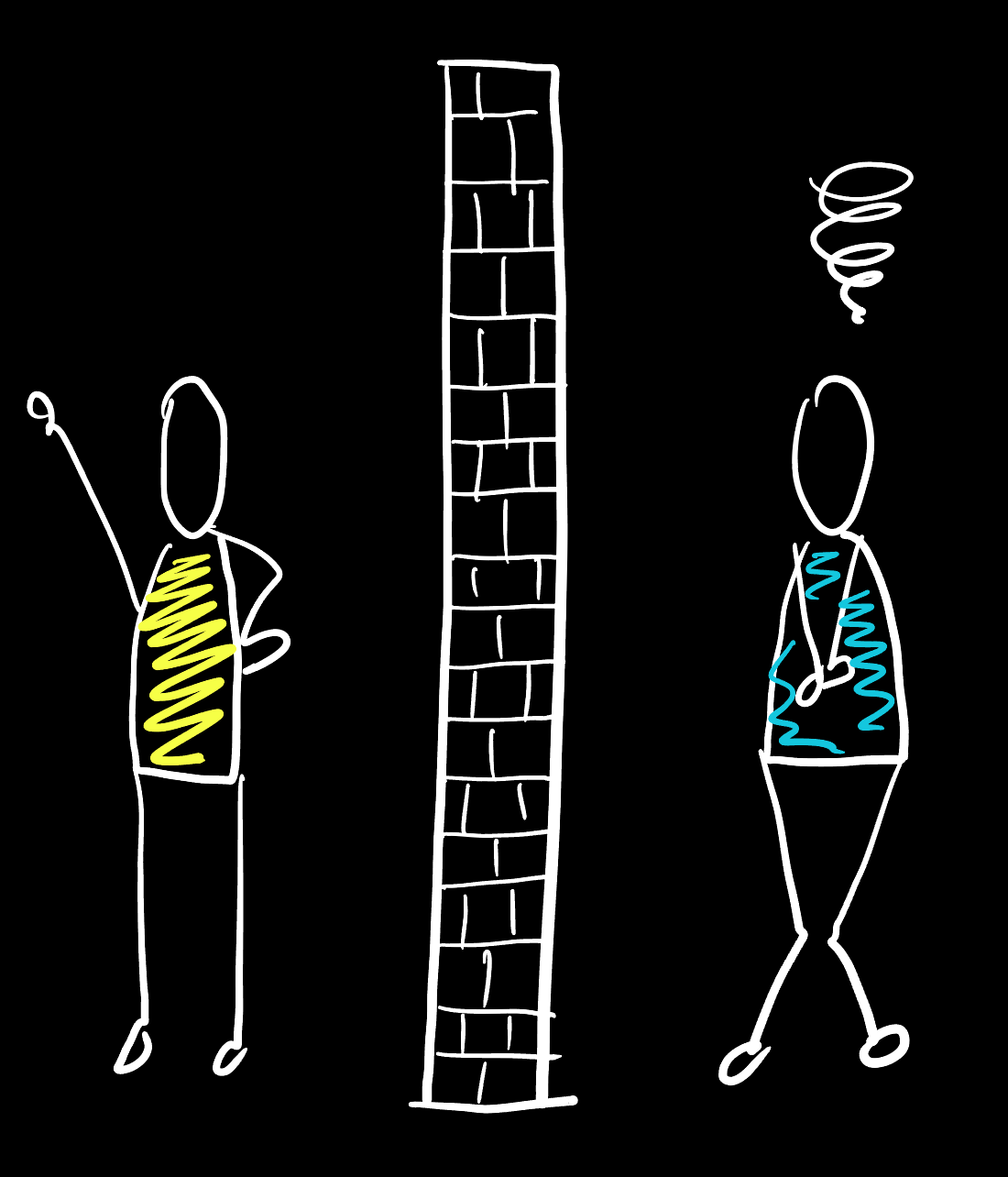
The paradox of talking to strangers: we need to talk to them. But we're terrible at it.
— Talking to Strangers: What We Should Know About the People We Don't Know, Malcolm Gladwell
The paradox Gladwell states is more uncomfortable than it looks, because it closes off the usual escape. If we were bad at talking to strangers and did not need to, avoiding it would suffice. If we needed to and were good at it, there would be no problem. The combination is what hurts: it is an indispensable skill at which we are systematically bad, and at which we also believe ourselves considerably better than we are.
Directing digital product consists, in a far greater proportion than is usually admitted, of talking to strangers. Customers you do not know, teams whose work you do not command, people in finance or legal whose vocabulary is not yours, whoever maintains an inherited system nobody documented. The list of conversations that must be held without shared context is long, and almost everything else depends on their quality.
A digital product company is a communicative entity
This is worth taking literally, because it sounds like a metaphor and is not. A company whose business runs through a digital product does not produce objects: it produces decisions made on incomplete and distributed information. The information each decision needs is spread across people who share neither vocabulary nor incentives, and the only mechanism by which it comes together is conversation.
Melvin Conway formulated this in 1968 with a precision that remains uncomfortable: the structure of a system ends up reproducing the communication structure of the organisation that builds it. It gets quoted mostly as a warning about architecture, but it has a harder reading in the other direction: the conversations that never happen also get recorded in the product, as fragile seams, duplications, and badly defined contracts between parts nobody negotiated because nobody sat down to talk. If two teams do not speak, the interface between their parts of the system will be exactly as bad as their relationship.
That makes "cultivate direct conversation" considerably less soft than it sounds. It is not a stylistic preference or a corporate-culture virtue. It is an architectural decision taken by other means.
What each intermediary costs
The natural impulse of a growing organisation is to replace conversations with representations of conversations. It is understandable: conversations do not scale, summaries do. The problem is what gets lost at each step of that substitution, and what gets lost is not random.
Summarising removes what does not fit. A weekly report keeps the trends and drops the odd case; a committee keeps the conclusions and drops the disagreement that produced them; a presentation keeps the number and drops the doubt about how it was calculated. In every case the operation improves legibility and degrades precisely the part that carried informational value, because new information always arrives disguised as an anomaly. What survives the cleaning process is what you already knew.
There is a second-order effect too. Once an organisation institutionalises intermediaries, people learn to communicate with the summary in mind rather than the interlocutor. Updates get written to look good in the report, problems get framed at the level of abstraction the committee tolerates, and the things that do not fit the format stop being mentioned. This is not dishonesty: it is adaptation. But the result is an organisation that talks a great deal and transmits very little.
Gerald Weinberg had already described this dynamic in the seventies while observing programming teams: the problems attributed to technique were almost always problems of what could be said out loud and to whom. Half a century of new tools has not altered the diagnosis.
Why we are bad at it and what can be done
The most-quoted part of Gladwell is the error of judgement — we treat the stranger as transparent, we assume their face and tone tell us the truth, and we are wrong with remarkable frequency. For our craft there is a fairly direct consequence: do not trust your reading of a conversation, trust what the conversation produced.
That is, direct conversation is not valuable for the human contact in itself. It is valuable when it generates something verifiable: a written agreement about who does what, a concrete question that did not exist before, a piece of data someone will go and find, a disagreement made explicit that was previously latent. A meeting that ends with a feeling of mutual understanding and none of those products is probably the worst possible outcome, because it consumed the time and disarmed the suspicion.
Hence the practices that work are unspectacular. Reduce the number of hands a piece of information passes through before reaching someone who can act on it. Keep decision-makers in contact with whoever receives the result, with no aggregation layer in between. Make explicit what most organisations leave implicit: who is allowed to talk to whom without asking permission. And accept that encouraging early disagreement is cheaper than administering late disagreement, even if it is less comfortable in the room.
Mary Parker Follett, writing about organisations a century ago, insisted that conflict was not a failure of the system but its raw material: what had to be avoided was not difference but its suppression. A good reminder that direct conversation is not about getting along. It is about being able to disagree early.
Digital product companies need to favour people who move comfortably in both the asynchronous and the synchronous register, and that requirement is constantly underestimated in hiring. Technical capability gets sought and communicative capability gets assumed, when in practice it is the second that determines how much of the first ever amounts to anything.
How many hands does bad news pass through in your organisation before it reaches someone who can act on it?