Let my conjectures die in my stead
Digital products connect risk and rhythm. On drawing consequences, building virtual realities out of language, and why conjectures should die before code does.

We closed the first block of the product management programme reflecting on how strongly digital products are connected to risk and rhythm.
The first block focuses on the themes I consider most specific and most determining for digital businesses: software, scarcity and risk. Around them we run individual exercises and group case studies that make their role legible, while putting them into play on subjects we will revisit throughout the programme. They are the oil stains that condition everything else.

Software, scarcity and risk: the three themes of the programme's first block.
Drawing consequences
Digital product organisations often lack any reflection on how they make decisions. This does not prevent the consequences of those decisions from mattering a great deal.
In the programme I propose a frame that avoids the situation. In a log dragged along by the water of a river, physical forces have consequences. In our case, we draw consequences, as an appropriate response to certain stimuli. And we are in good company: from a single cell up to the behaviour of a tree flowering when the moment is right.
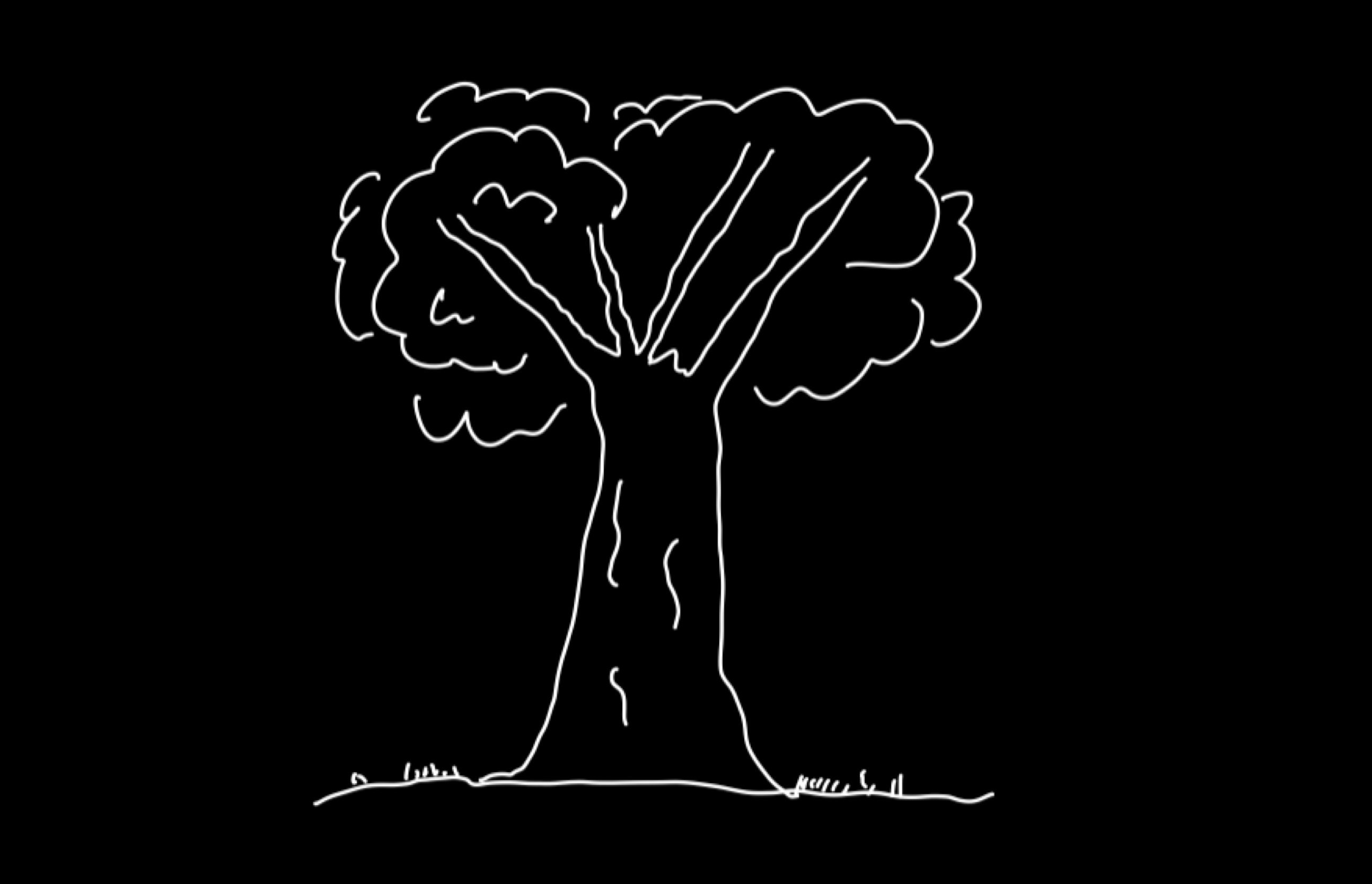
The tree is not dragged along: it flowers when the moment is right. Responding appropriately already means having options.
The distinction sounds abstract and is entirely practical. A log has no options. Anything that responds appropriately does, and having options means the response can be evaluated — which is where risk enters, and with it everything Frank Knight had to say about the difference between risk you can price and uncertainty you cannot.
Virtual realities
There is an important part of what we are that is the search for the appropriate as the result of thousands of years of responses. In these cases, we do what is appropriate on behalf of the gene pool.
There is another important part of what we are, which we share with a great many other animals — our domestic cats and dogs, for instance — that consists of doing what is appropriate by trial and error. We obtain information by learning.
Finally, there is another part, which we also share with some groups of organisms, that consists of doing what is appropriate through the selection of imagined behaviours. Through conjectures. We imagine possible responses to a situation, and we imagine the consequences that response would have, creating in this way a kind of virtual reality.
Dennett's tower of generate-and-test is the same ladder climbed from a different direction: creatures whose responses are fixed by their design, creatures that learn from consequences they have actually suffered, and creatures that can pre-select among candidates before suffering anything. Kim Sterelny's contribution is to insist the third rung is a response to a hostile world — imagination is expensive, and it only pays off where the environment is variable enough that fixed responses fail.
The first clear advantage, in evolutionary terms first of all, is that I, as an animal that makes conjectures, can let the conjectures die in my stead.

A conjecture that dies in a document costs a conversation.
The phrase is Popper's, and it is worth taking literally. A conjecture that dies in a document costs a conversation. The same conjecture, discovered after release, costs a quarter and a team's morale.
Language as the principal material of our conjectures
Although creating virtual realities is not something we hold exclusively, we do it in a way that distinguishes us from the rest: spoken and written language is the material with which we can generate more and better networks of inference, which let us reach more and better useful consequences.
With language we enter a kind of game of giving and asking for reasons. Analogy is an instrument we use constantly to connect points. Our decisions, when they are not by mere lineage or trial and error, feed on conjectures in which we try to move from what is obvious — a known fact, recognised by everyone — towards what is not so obvious. If the doorbell rings, we get up to open the door.
The problem is that the interconnection between facts is not remotely evident. We need to throw out conjectures in order to look for it. And normally we work with two types: causal and descriptive. The knowledge we can acquire moves in the tension between the two. The more causal, the greater the prediction we can achieve, but also the smaller the radius of action, since they connect narrower facts. The more descriptive and correlational, the greater the radius of action, but the less predictive capacity.
Conjectures also have a certain ergonomics, which is their capacity to give us a sensation of control, of comprehension. And this is the property to be most careful with, because it is the one that has no relationship to accuracy. A comfortable conjecture is not a good conjecture; it is a conjecture shaped to fit the hand.
Maturana and Varela's account of cognition sharpens the point: what an organism perceives is determined by its own structure, not by the world. We are not reading the situation. We are producing a version of it that our structure permits, and then acting on the version.
What to do on Monday
Do not jump quickly to building something, and do not grow your backlog with annotations that are mere reactions. Start by saving money and unpleasantness: create a flow that minimally qualifies your decisions, so that only the best candidates end up being built. That way you save waste, reducing the natural complexity of your product — remember software as an oil stain — and you improve the morale of your teams.
Michael Bratman's work on planning gives the reason this works at all. A plan's function is not prediction; it is the coordination of your own future actions and other people's expectations. Which means an unqualified plan does not simply risk being wrong. It commits other people to being wrong with you, and does so in writing.
Annie Duke's version of the same discipline is the operational one: record what you expected before you find out. Memory is a generous editor and it works for free.