The Conversation
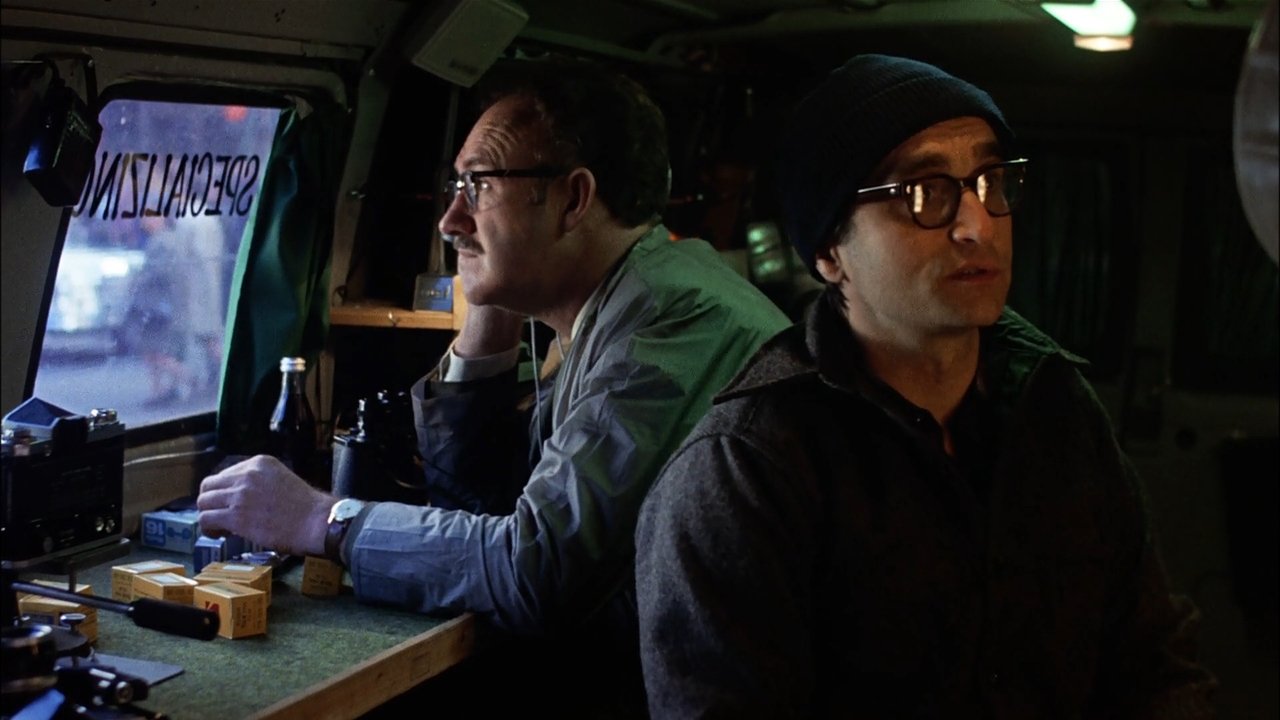
Writers: Francis Ford Coppola (written by)
Cast: Gene Hackman, John Cazale, Allen Garfield, Frederic Forrest, Cindy Williams, Harrison Ford
Screenplay: Read screenplay ↗
Harry Caul is the finest surveillance technician on the West Coast, a man who records other people's lives for money and refuses, on principle, to wonder what those recordings mean. Hired to capture a conversation between two people crossing a crowded San Francisco square, he produces a technically flawless tape — and then, against every rule he has built his professional life on, begins to listen to it. Convinced that the recording foretells a murder, the most private man in the business finds himself unable to stop interpreting, and unable to interpret correctly.
Harry Caul is one of cinema's great craftsmen, and like most great craftsmen he has drawn a very precise line around what his craft includes. He builds his own equipment. He knows which microphone to point at a moving target in a square full of noise, how to stitch three imperfect signals into one clean track, how to coax a syllable out of a wall of interference. What he does not do — what he insists, early and often, that he does not do — is wonder what any of it means. When Stan says it would be nice to know what the couple are talking about, Harry's answer is almost a professional creed: he wants a nice, fat recording. The content is somebody else's department. He is an artisan of signal, and he treats the conversation he has captured the way a foundry treats steel — as material to be brought to a specification, not as a message addressed to anyone.
The film's central irony is that this discipline offers no protection whatsoever. Harry's tape is, by any technical standard, excellent. He has every word. He filters, re-filters, isolates frequencies, plays the same seconds over until the room is saturated with them. And out of that near-perfect fidelity he extracts precisely the wrong conclusion, because the meaning of the recording does not live in the words at all. It lives in where the stress falls in a single sentence — in the difference between a couple who fear they will be killed and a couple talking themselves into killing. Every bit of the data is correct. The interpretation is inverted. Coppola and his editor Walter Murch built the film's ending on exactly this hinge, replaying the same line with the emphasis moved, and the effect is devastating not because new information arrives but because none does.
Anyone who has spent time instrumenting a product will recognise the shape of Harry's failure, even if they would prefer not to. We are extraordinarily good now at capture. We can log every event, record every session, retain every interaction, and render it all into a dashboard that refreshes faster than we can think. And the ease of that capture quietly encourages a belief that Harry holds explicitly: that fidelity is the hard part, and that meaning will follow from it more or less automatically. It does not. A funnel showing a drop-off is a perfect recording of behaviour and says nothing at all about intention. A satisfaction score is a real number attached to an unexamined question. The dangerous case is never the noisy dataset — noise announces itself. It is the clean one, the one whose evident quality makes us skip the step where we ask what emphasis we have assumed. Harry has the tape everyone else in his trade would envy, and it walks him straight into the wrong room.
What raises the film above a parable about measurement is what it does to Harry's ethics, which turn out to rest on the same foundation as his method. His moral position — it has nothing to do with him, he only turns in the tapes — is not laziness; it is the direct consequence of refusing interpretation. If the recording carries no meaning for him, he cannot be answerable for the meaning it carries for others. The film dismantles that arrangement piece by piece. It shows him haunted by an earlier job where three people died, unable to say he is not afraid of murder, then finally on the receiving end of his own trade: bugged, watched, and told by Martin Stett that they know that he knows. By the closing scene Harry has torn his apartment to pieces looking for the device and cannot find it, and the point has been made without a word of argument. You do not get to build a career on the premise that you are merely handling material. Sooner or later the material turns out to have been about somebody, and the person who captured it best is the person least able to claim he was not there.