The Imitation Game
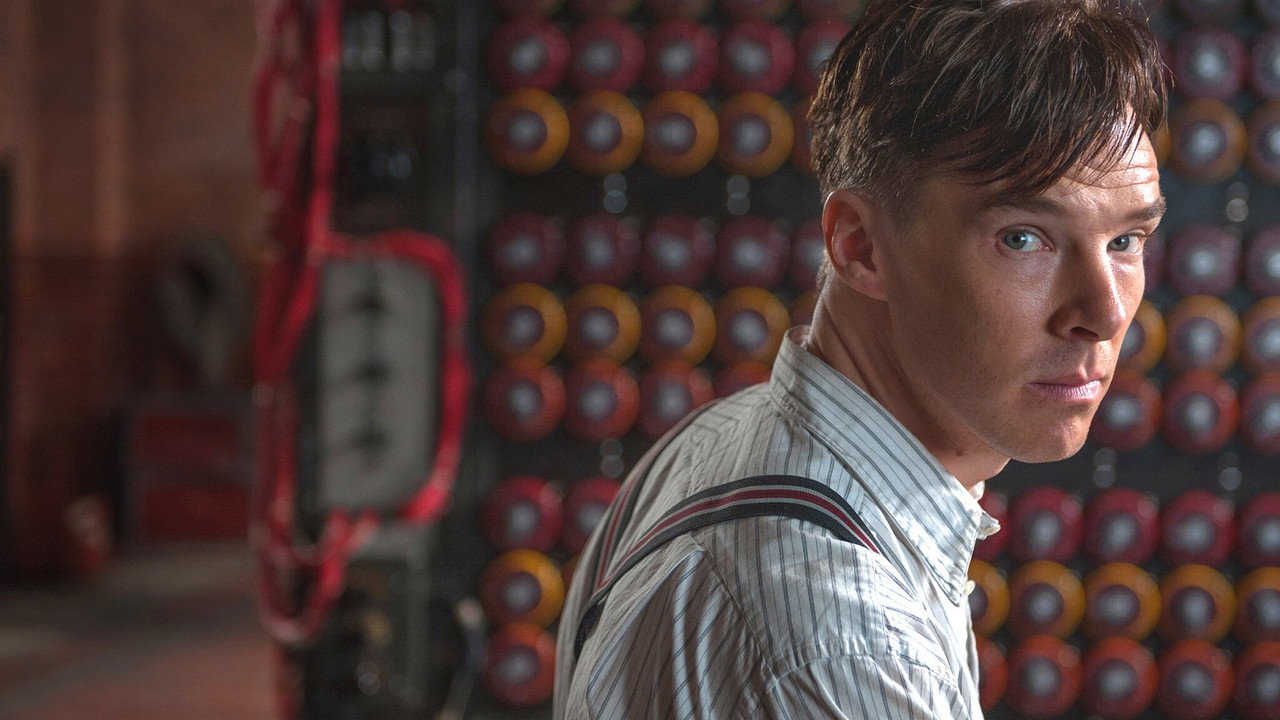
Writers: Graham Moore (screenplay), Andrew Hodges (based on the book "Alan Turing: The Enigma")
Cast: Benedict Cumberbatch, Keira Knightley, Matthew Goode, Mark Strong, Charles Dance
1939. Alan Turing joins a team of cryptanalysts at Bletchley Park tasked with breaking the German Enigma cipher, which resets its settings every day at midnight, giving the team eighteen hours to crack each day's code before it becomes worthless. Turing proposes building an electromechanical machine to test Enigma configurations faster than any human team can. The machine works — and the moment it does, the problem shifts from decryption to decision: which intercepted intelligence to act on and which to suppress, because acting on all of it would reveal that Enigma has been broken, and the Germans would change the system.
The machine works on a Tuesday, and by Wednesday the problem has changed completely. For months the Bletchley team has been consumed by a single question: can they build a device that tests Enigma configurations fast enough to break each day's cipher before midnight resets it? Turing builds the device. It runs. It cracks the day's settings. The room fills with decoded German transmissions and for one moment everyone in it believes the war has been shortened by years. Then someone reads a specific intercept — a U-boat attack on a convoy that includes the brother of one of the team members — and the real problem arrives. If they warn the convoy, the Germans will know Enigma is broken. If the Germans know Enigma is broken, they will change the cipher system, and every future intercept becomes unreadable, and the machine becomes an expensive piece of furniture. The engineering problem is solved. The decision problem is just beginning, and the decision problem is harder by orders of magnitude because it has no optimal solution, only a set of trade-offs measured in lives. The film compresses this transition into a single scene, and the compression is the point: the distance between building the thing that works and knowing what to do with the thing that works is the distance between craft and judgement, and most of the suffering in the story lives in that gap.
Turing's insistence that the secret be kept from everyone — from superiors, from colleagues, from the military commanders who would use the intelligence — is the film's most uncomfortable organisational claim, and the film does not flinch from it. The argument is that if a naval captain knows Enigma is broken, he will act on every intercept, because a captain's job is to save his ships, and a captain cannot be expected to sacrifice his ships for a strategic abstraction he cannot see. The information must be filtered through a layer that decides which intelligence to surface and which to bury, and the filtering must be invisible, because the moment the filter is visible, anyone on either side of it can work backwards to the source. What Turing is describing is an information architecture in which the people making tactical decisions are deliberately given an incomplete picture so that their natural responses do not compromise the strategic asset. He is arguing that the system works better when the people inside it do not fully understand the system, and he is right, and the rightness is corrosive. Every classification regime, every need-to-know structure, every executive decision withheld from the team that will implement it runs on the same logic: the people closest to the action cannot be trusted with the full context, not because they are untrustworthy, but because their local rationality will override the global strategy. The architecture requires ignorance, and the ignorance is a feature.
The resource allocation problem that follows is the one the film handles most carefully, and it is the one that earns the word "game" in the title. It requires a statistical model — enough actionable intelligence to affect the war's outcome, distributed in a pattern that is indistinguishable from lucky guesses, signals intercepts, and aerial reconnaissance. Too much action and the pattern reveals the source. Too little and you have a capability you are not using while people die. Turing, who understands probability better than anyone in the room, becomes the person who decides. He builds a second system on top of the first — not a machine this time, but a decision framework for rationing the machine's output.
The film shows him making these calculations, and it does not pretend they are clean. Some convoys are saved. Some are not. The ones that are not saved include people the team knows, and the team carries the knowledge that those people could have been warned and were not. This is the cost of operating at the strategic layer: you become a person who knows something that could save a life and chooses not to use it, and the choice is correct, and the correctness does not make it lighter. Was I God, Turing asks later. No, because God did not win the war. The answer is a refusal of the metaphor but not of the weight: he was not God, he was an engineer operating a system whose outputs included both saved lives and unsaved lives, and the system required both.
The film ends with Turing's prosecution for homosexuality, and the ending is not an epilogue tacked onto a war story. It is the final turn of the same argument. The organisation that built Bletchley Park — the British state — classified Turing's work so thoroughly that no one outside the intelligence community knew what he had done. The same state prosecuted him for a private act between consenting adults, subjected him to chemical castration, and watched him die. The machine that won the war and the law that destroyed its builder were both products of the same system, and the system saw no contradiction because the system did not connect those two files. Turing's secrecy about Enigma was imposed by the state for strategic reasons. His secrecy about his private life was imposed by the state for moral reasons. In both cases the state determined that certain truths were too dangerous to circulate. The Enigma secret protected the war effort. The prosecution protected nothing and cost the country the man who had done more than almost anyone to preserve it. The organisation around the machine is where the real decisions happen, and the organisation is capable of making decisions that are simultaneously rational and monstrous, because the people making them are operating on a model that does not contain all the relevant variables — and never does.