Wag the Dog
Writers: Hilary Henkin (screenplay), David Mamet (screenplay), Larry Beinhart (novel)
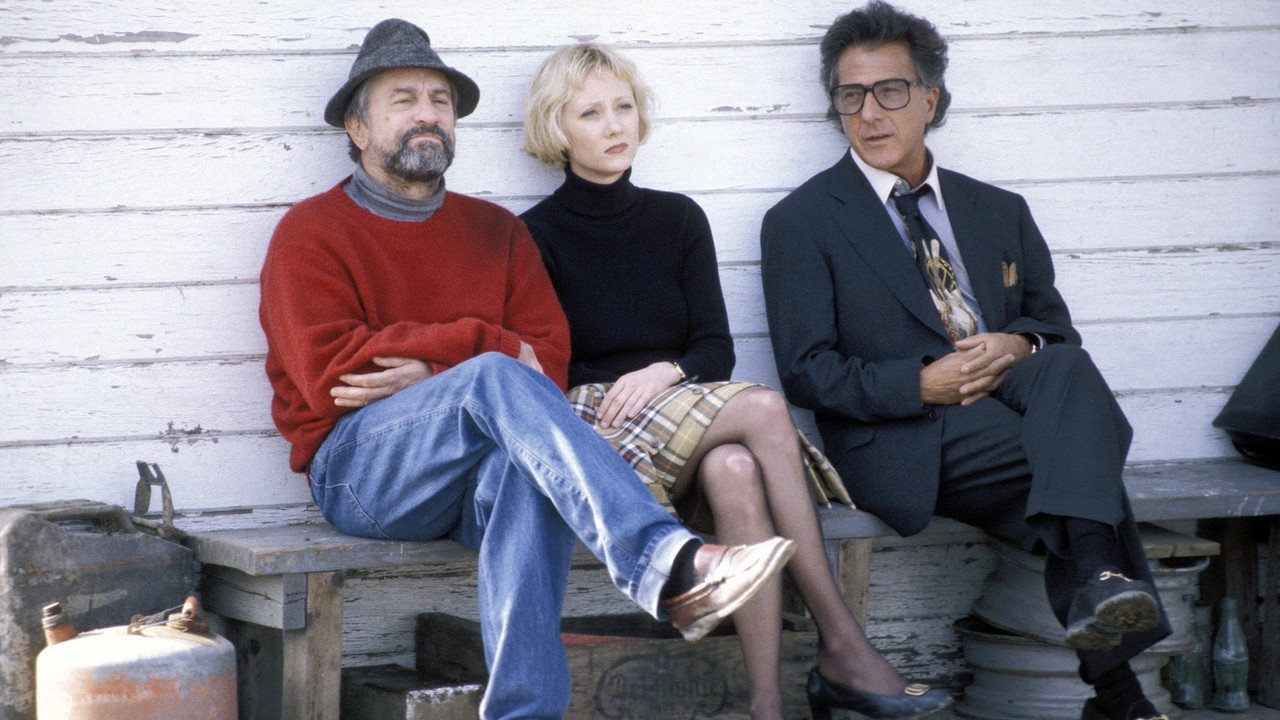
Cast: Dustin Hoffman, Robert De Niro, Anne Heche, Denis Leary, Willie Nelson, Woody Harrelson, Kirsten Dunst
Two weeks before a presidential election, a spin doctor and a Hollywood producer join forces to fabricate a war with Albania to distract the public from a sex scandal involving the President. As the fake war gains its own momentum — complete with a theme song, a merchandising campaign, and a returning war hero — the line between manufactured narrative and political reality dissolves entirely.
Two weeks before a presidential election, a fixer named Conrad Brean is brought in to manage a crisis: the President has been caught in a sexual indiscretion, and the story is about to break. Brean's solution is not to deny it, not to confess, not to spin — it is to produce a bigger story, one that occupies more bandwidth, one that has higher production value. He enlists Stanley Motss, a Hollywood producer, and together they fabricate a war with Albania. The fabrication is the entire substance of the film and Levinson directs it as a procedural, the way another director might film the production of an actual movie or the planning of an actual military campaign, because procedural accuracy is the point: Brean and Motss are not inventing a narrative in the way that someone tells a lie; they are producing one in the way that someone makes a film, and the distinction matters because a lie can be contradicted by facts while a production can only be contradicted by a better production.
The war has a theme song, written by Willie Nelson and performed with patriotic sincerity. It has a merchandising angle — old shoes thrown over telephone wires in solidarity, a spontaneous gesture that was scripted and seeded by Motss's team. It has a returning hero, Sergeant Schumann, selected from a military prison not because he is heroic but because he is available and photogenic. Every element of the war exists at a level of finish and emotional resolution that the actual presidency cannot match, because the actual presidency is messy and contested and the fabricated war was designed.
The film's thesis is that in the attention economy, the question of what happened has been permanently subordinated to the question of what plays. Truth does not fail because people are stupid or gullible. Truth fails because truth is low-resolution. A sex scandal involving the President is a claim about behaviour — contested, ambiguous, requiring investigation, dependent on evidence that can be challenged. A war is a production — it has imagery, music, a hero's journey, a satisfying arc. When the two compete for the same bandwidth, the war wins not because people believe it more but because believing it costs less cognitive effort. Disputing the war would require assembling a competing narrative of equal emotional resolution, and nobody has the budget for that. This is what Brean understands intuitively and what Mamet's script makes structural: the better story is the one with higher production value, faster emotional closure, fewer loose threads. The war is never contradicted because it is never engaged on its own terms. The press covers it because the press operates on the same logic that Brean is exploiting — they need a story, the war is a story, and the alternative is the sordid complexity of an investigated scandal, which does not package as well. What difference does it make if it is true, he asks. If it is a story and it breaks, they are going to run with it. The statement is not cynical. It is descriptive.
Motss is the film's most precise character because he is the one who understands the fabrication not as politics but as craft. He is a producer — someone who assembles the elements of a narrative into a coherent emotional experience — and the war is the best thing he has ever produced. When the CIA declares the war over by announcing a peace deal on television, Motss overrides them: the war is not over until he says it is over, and he produces a second act — the captured soldier, the homecoming — that makes the first act retroactively more compelling. His professional instincts are perfect. Every choice he makes serves the narrative.
The problem is the last professional instinct, the one that kills him: he wants credit. He has produced the most consequential media event of the decade and nobody knows it was him, and he cannot live with this. He starts telling people. He is found dead within the day, and the news reports that he suffered a heart attack beside his pool. Brean understood from the beginning what Motss could not: the product and its creator cannot both be visible, because the visibility of the creator destroys the product. The war requires the absence of a producer. The moment someone can point to a credit, the production becomes a fabrication, and fabrications can be investigated, and investigations are exactly what the production was designed to prevent. Motss is a craftsman destroyed by craftsmanship's deepest need, the need to be known as the person who made the thing, and the film treats his death with the flat indifference that the system treats everything it no longer needs.
The film was released in December 1997. One month later, the Clinton-Lewinsky scandal broke, and the President ordered missile strikes on a pharmaceutical factory in Sudan, and the press called it "Wag the Dog." Levinson and Mamet did not predict the future. They described a mechanism, and the mechanism was already operating, and anyone who watched closely enough could see it. What makes the film last is not the coincidence but the formal precision of the mechanism it describes: a closed loop in which events are created to be covered, coverage generates belief, belief generates consensus, and consensus retroactively validates the events. Once the loop is running, the question of whether the originating event was real is genuinely undecidable from inside the system, because every check you can perform — consult the press, ask an official, review the footage — routes through the same production pipeline that generated the event. We are not going to have a war, Brean says at the outset. We are going to have the appearance of a war. The film's quiet argument is that the distinction he is drawing no longer holds, because in a system where appearance is the primary medium of exchange, the appearance of a war and a war are functionally identical. The tail wags the dog, and the dog cannot distinguish the wagging from walking.