Good Night, and Good Luck.
Writers: George Clooney (screenplay), Grant Heslov (screenplay)
Cast: David Strathairn, George Clooney, Robert Downey Jr., Patricia Clarkson, Frank Langella, Jeff Daniels, Ray Wise
In 1953, CBS journalist Edward R. Murrow and his producer Fred Friendly decide to air a report challenging Senator Joseph McCarthy's anti-communist campaign. Facing pressure from sponsors, network executives, and the climate of fear that McCarthy has cultivated, the newsroom must weigh the cost of journalism against the cost of silence — while the institution they work for calculates a very different set of risks.
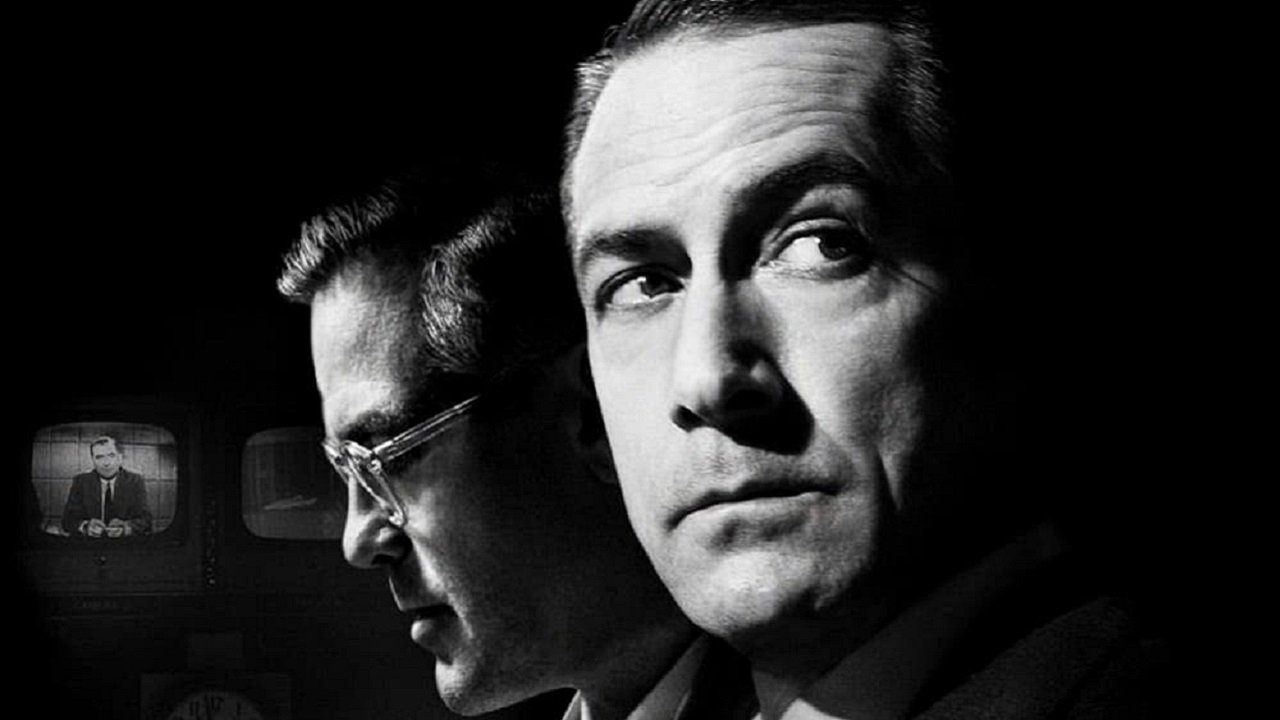
Clooney shoots the film in black and white and confines it almost entirely to the CBS newsroom, and both choices are structural. The black and white is not nostalgia; it allows the film to integrate actual footage of Senator McCarthy into the narrative without a visible seam, which means McCarthy plays himself — no actor, no interpretation, no dramatic licence. The man is present in the film as he was present in the living rooms of 1953: on a screen, performing, and the question the newsroom must answer is what to do when the screen they control is the only instrument powerful enough to respond to what another screen is doing. The confinement to the newsroom matters equally, because Clooney has made a film about institutional decision-making and institutional decisions are made in rooms. Murrow does not go to Washington. He does not confront McCarthy in person. He sits at a desk, selects footage, writes a script, and broadcasts it, and the entire moral weight of the act rests not on physical courage but on editorial judgement. The CBS newsroom in 1953 is a small, smoke-filled space where people who agree on what needs to be said must decide whether saying it is worth what it will cost the structure that gives them the microphone, and the film sits inside that decision for ninety minutes and never leaves it.
The broadcast itself is a masterpiece of method: Murrow uses McCarthy's own words, his own footage, his own testimony, and arranges them in sequence so that the contradictions do the work. He does not editorialise until the end, and when he does, the editorial is a statement of principle so plain that it sounds banal until you consider what it cost: we must not confuse dissent with disloyalty; we will not walk in fear, one of another; we cannot defend freedom abroad by deserting it at home. These are sentences a child could understand. The line between investigating and persecuting is a very fine one, and the junior senator from Wisconsin has stepped over it repeatedly. What makes the broadcast dangerous is not that it says anything new — McCarthy's methods were already questioned in print — but that it says it on the medium that McCarthy has been using as his primary weapon.
Television made McCarthy. Its visual immediacy, its capacity for accusation without rebuttal, its preference for drama over evidence — these were his instruments, and Murrow picks them up and turns them around. The act is not one of revelation but of appropriation: the same medium, the same format, the same audience, applied to the man who was counting on the medium never being used against him. And Murrow's method — letting the subject convict himself through his own words — is an editorial decision that functions as a structural argument: if the evidence is sufficient, the journalist's role is curation, not commentary. The craft is in the cut, not the voice.
The cost arrives immediately, and the film follows it with the same meticulous restraint it applies to everything else. Alcoa, the sponsor, pulls its advertising. William Paley, the head of CBS, supports Murrow verbally and begins distancing the network structurally — the show is moved to a less prominent time slot, the news division's budget is questioned, and the calculation that every media executive recognises is performed in real time: the audience applauds courage, but the business model requires predictability, and courage is the opposite of predictability. Don Hollenbeck, a CBS colleague who defended Murrow on air, is targeted by a right-wing columnist, called a communist sympathiser, and subjected to the same sustained pressure that the McCarthy apparatus applies to anyone who breaks ranks. Hollenbeck kills himself. The film does not dramatise his death; it reports it, in the newsroom, as news, and the restraint is devastating because it forces the institution to confront its own externality. Murrow's broadcast was an act of the institution. Hollenbeck's death was a cost of the act. The institution absorbed the former and externalised the latter, which is what institutions do with costs they cannot account for within their operating model — they are acknowledged, sincerely, in a corridor, and they do not appear in the budget. CBS's dilemma is every media organisation's dilemma, and it has not changed in seventy years: the institution will celebrate the journalist's courage right up to the moment the courage becomes more expensive than the silence.
Murrow's RTNDA speech, which closes the film, is the most damning thing anyone has ever said about a medium while standing inside it. This instrument can teach, it can illuminate, yes, and it can even inspire. But it can do so only to the extent that humans are determined to use it to those ends. Otherwise it is nothing but wires and lights in a box. He is describing a tool that has no inherent direction — television does not tend toward truth or deception, it tends toward whatever the institution that controls it tends toward, and the institution tends toward whatever its revenue model rewards. Murrow understood this earlier than most and said it more clearly than anyone, and the reward for understanding it was the progressive diminution of his platform until he was delivering his reports to a time slot no one watched. The film's argument is quiet and complete: the medium can be used for truth, the institution can support the use, the audience can respond, the sponsors can be survived. The system did not punish Murrow. It simply ceased to select for him. Good night, and good luck.