Tinker Tailor Soldier Spy
Writers: Bridget O'Connor (screenplay), Peter Straughan (screenplay)
Based on: "Tinker Tailor Soldier Spy" by John le Carré (1974) ↗
Cast: Gary Oldman, Colin Firth, Tom Hardy, John Hurt, Toby Jones, Mark Strong, Benedict Cumberbatch, Ciarán Hinds, David Dencik
After the head of British intelligence is forced out following a botched operation in Budapest, retired agent George Smiley is brought back to investigate a suspicion that has haunted the service for years: one of five senior officers is a Soviet mole. With no authority and no allies inside the building, Smiley works through old files, retired contacts, and the institutional memory of a bureaucracy that does not want to know what he is looking for.
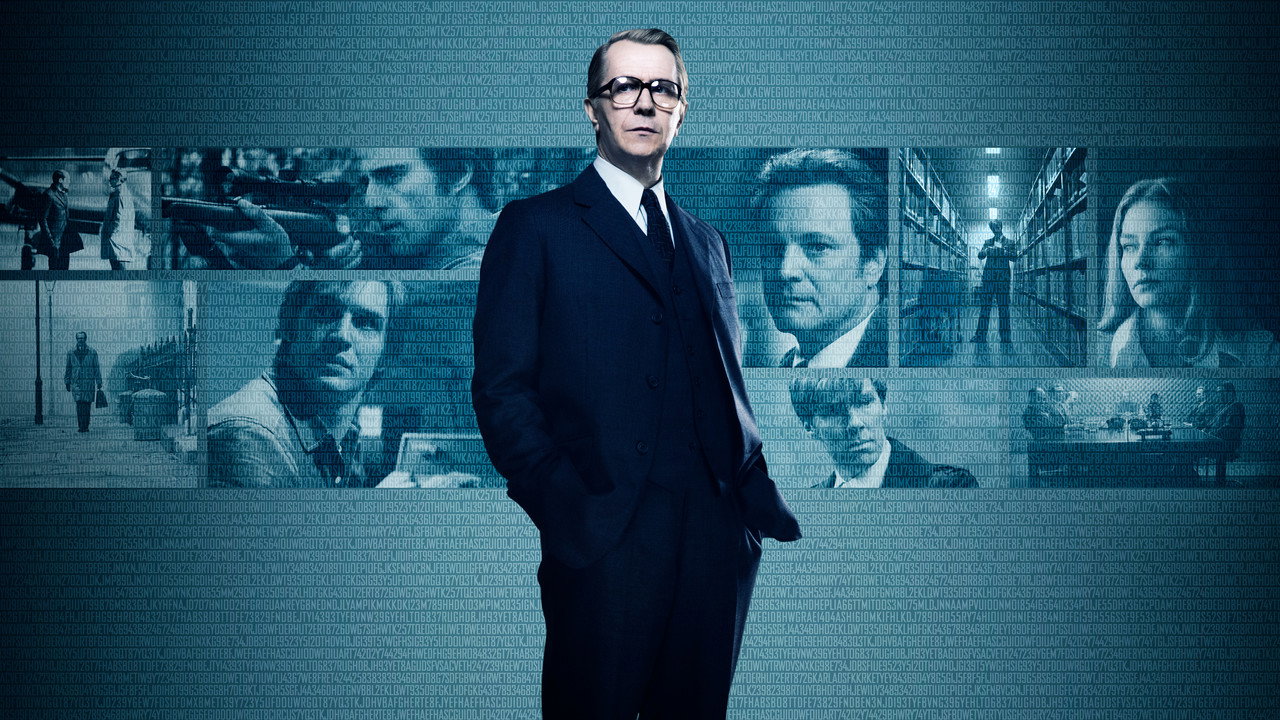
George Smiley does almost nothing in this film, and the almost-nothing is the method. He sits in chairs and listens. He reads files. He asks questions that are one sentence long and then waits, sometimes for a very long time, while the person across from him fills the silence with more than they intended to say. He wears the same glasses and the same coat in every scene, and his face performs a particular kind of stillness that is not calm but attention held so tightly that it has become invisible.
Gary Oldman, an actor famous for transformations, gives his most celebrated performance by doing less than any other actor in the frame, and the less he does the more evident it becomes that Smiley's power is not deduction but patience — the institutional patience of a man who understands that the truth about an organisation is not hidden in the sense of being locked away. It is hidden in the sense of being distributed across a hundred ordinary files and conversations and personnel decisions, none of which is suspicious on its own, all of which together form a shape that only becomes visible if someone is willing to sit with the material long enough to see it. This is not detection. It is archaeology. Smiley is reading the Circus's own records to find the outline of what has been buried in plain sight, and the burial was not an act of concealment but the natural sedimentation of an institution that produces more paper than any single person can hold in their head.
The film moves at the speed of bureaucracy because bureaucracy is the subject. The Circus — le Carré's name for the Secret Intelligence Service — is not a team of spies. It is a department, with a building, a canteen, a Christmas party, and a filing system. The mole has survived inside it for years not by being clever in the way thriller villains are clever but by being institutionally fluent — by understanding how the organisation processes information, where its attention falls and where it does not, which channels are watched and which are assumed to be inert. The Circus has gone rotten, top to bottom, Ricki Tarr says when he surfaces with the warning, and the sentence is accurate but imprecise. Rot implies decay, something breaking down. What has happened is not breakdown but capture: the institution's own decision-making apparatus has been turned to serve someone else's objectives, and it continues to function — budgets are approved, operations are mounted, reports are filed — with no visible malfunction. The mole does not disrupt the Circus. The mole uses the Circus. This is why nobody noticed. A system that has been compromised at the top looks exactly like a system that is working, because the outputs are still being produced; they are just being copied. The difference between a functioning institution and a compromised one is not in the operations but in who is reading the results, and that difference is invisible from inside.
Smiley's investigation is therefore not a search for a criminal but a reconstruction of a decision history. He traces the Budapest operation backward through the chain of authorisations, the allocation of resources, the selection of agents, the pattern of which intelligence was shared and which was held back, and from these traces he builds a picture not of what the mole did but of what the institution did differently from what it would have done if the mole were not there. The method requires an almost inhuman capacity to hold the institution's own logic in mind and then notice where the logic was not followed — not broken, not contradicted, but gently bent, redirected, given a nudge that produced an outcome marginally different from the one the system's own incentives would have generated. Bill Haydon's defence, when it finally comes, is not a defence at all but a statement of alignment: I had to pick a side, George. It was always the same. He does not claim to have been coerced or deceived. He claims to have been loyal — to a different principal. The betrayal is not that he broke faith with the institution; it is that he maintained faith with a different one while continuing to occupy a position of trust inside the first, and the first institution's own processes could not distinguish between the two loyalties because loyalty, in an organisation, looks like doing the work, and Haydon did the work.
The film's final register is not triumph but exhaustion. Smiley finds the mole, and the mole is removed, and the Circus continues. The Christmas party at the end is quieter than the one at the beginning, and Smiley is back in the building, back in the chair, wearing the same glasses. Nothing has been reformed. The institution that was penetrated has been cleaned, in the sense that the specific agent has been extracted, but the conditions that allowed the penetration — the insularity, the assumption that seniority equals trustworthiness, the filing systems that nobody reads comprehensively, the preference for operational momentum over structural scrutiny — remain entirely intact. Le Carré understood, and Alfredson's film preserves, a truth about organisations that is more uncomfortable than any betrayal: you can find the mole and remove the mole and still have exactly the institution that produced the mole, because the mole was not a defect in the system. The mole was a feature of the system's own architecture — its trust hierarchies, its information silos, its reluctance to audit itself — exploited by someone who understood that architecture better than the people who built it.