Nine to Five
Writers: Colin Higgins (screenplay), Patricia Resnick (story & screenplay)
Cast: Jane Fonda, Lily Tomlin, Dolly Parton, Dabney Coleman, Sterling Hayden, Elizabeth Wilson
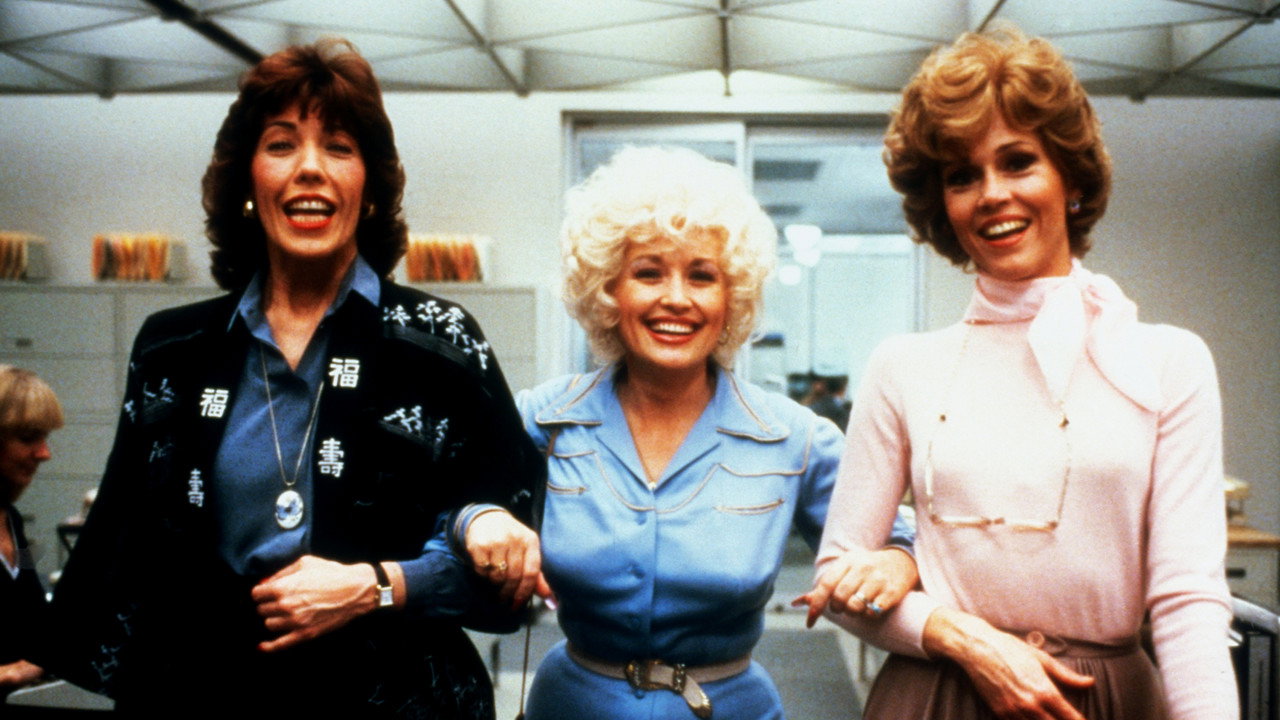
Three secretaries at a large corporation — Judy, Violet, and Doralee — work under a petty, manipulative, credit-stealing boss named Franklin Hart. After a series of accidental near-catastrophes, they kidnap him, install him in a harness in his own bedroom, and run the office in his absence. The changes they implement — flexible hours, job sharing, equal pay, on-site childcare — produce an immediate rise in productivity and morale. When the chairman of the board arrives to inspect the results, he is delighted. The boss is shipped off to a position where he can do no further harm.
The plot of 9 to 5 requires a kidnapping, three elaborate fantasy sequences, a near-poisoning, and a stolen corpse, but the management insight at its centre requires none of these. It is simply this: the three women who run the office already know exactly what is wrong with it and exactly what would fix it. They have known for years. Violet has redesigned the workflow in her head a dozen times. Doralee has watched Hart take credit for ideas she typed up and handed to him. Judy, the newest arrival, sees the dysfunction with the clarity of someone who has not yet learned to stop noticing. The obstacle to improvement is not ignorance and not incompetence; it is a hierarchy that routes all decision-making authority through a single point — Hart — who has no incentive to change anything because the current arrangement supplies him with power, credit, and a secretary he can harass. The comedy's first move is to remove that point, physically, by hanging the man from his bedroom ceiling in a garage-door opener harness. Its second and more interesting move is to show what happens next, which is that every change the women implement works immediately, because the changes were never in doubt. The information was always there. It was simply located in people the organisation had decided not to listen to.
What Violet, Doralee, and Judy enact in Hart's absence is, presented as farce, a precise catalogue of mid-twentieth-century management reforms: flexible scheduling, job rotation, equal pay for equal work, on-site childcare, ergonomic office redesign. None of these are exotic. Most had been written about extensively by the time the film was made, and several were already standard practice in companies that took productivity seriously. The joke — and it is a genuine joke, because the film is very funny — is that the reforms are treated as revolutionary only because the person who would have to approve them is the person whose authority depends on them not being approved. You're a sexist, egotistical, lying, hypocritical bigot. Judy says this to Hart toward the end, and it is accurate, and it is also incomplete. Hart's problem is not primarily moral. It is structural. He sits at the top of an information funnel where the people who see the problems have no authority and the person who has authority sees no problems, and the funnel is maintained not by malice alone but by an entire apparatus of meetings, memos, reports, and chains of command designed to ensure that information travels upward only in forms the top finds comfortable. The women do not fix Hart. They remove him and discover that the funnel was the whole disease.
The film is cleverer than it is usually given credit for about the relationship between proximity and knowledge. I've thought about poisoning, I've thought about hiring a hit man, I've thought about doing the job myself. Violet's fantasy is murder; the frustration underneath it is epistemological. Doralee's position is different and in some ways worse: she is not merely unheard but actively misrepresented, her proximity to Hart recast by the office as sexual rather than professional, so that whatever she knows is doubly inadmissible. The film understands that hierarchies do not just filter information; they determine what counts as information in the first place, and the closer a person is to the actual work, the less likely their observations are to be classified as expertise. The secretaries are not consulted because the system has already decided that what secretaries have is not knowledge. It is support.
The chairman's visit at the end is the sharpest scene in the film, sharper than the fantasies, sharper than the kidnapping, because it demonstrates the thing that makes organisational dysfunction so durable. I don't know what you girls have been doing, but keep it up. He sees the numbers. Productivity is up. Absenteeism is down. The division is running better than it has ever run. He is delighted. And he attributes the improvement to Hart, who has been tied to a bed for weeks. The scene is played for laughs, and it earns them, but the logic underneath is not funny at all: the hierarchy is so thoroughly the medium through which results are perceived that even when the hierarchy has been physically removed from the building, the credit still flows upward to the position it occupied. The system does not learn that the secretaries fixed it. The system cannot learn that, because the system's model of who produces value and who supports the production of value is not a conclusion it reached from evidence; it is an axiom the evidence is structured around. Hart is eventually shipped to Brazil and the women are not promoted so much as they are returned to a version of the office that now contains the policies they fought for. The film's final title cards report, matter-of-factly, what happened to each character. It does not report what happened to the organisational chart that made the kidnapping necessary. The chart, one suspects, survived.