天国と地獄
Writers: Akira Kurosawa (screenplay), Hideo Oguni (screenplay), Ryuzo Kikushima (screenplay), Eijiro Hisaita (screenplay)
Cast: Toshirō Mifune, Tatsuya Nakadai, Kyōko Kagawa, Tatsuya Mihashi, Isao Kimura, Kenjirō Ishiyama
A Yokohama shoe executive faces a wrenching choice when kidnappers mistakenly seize his chauffeur’s son but demand the ransom anyway.
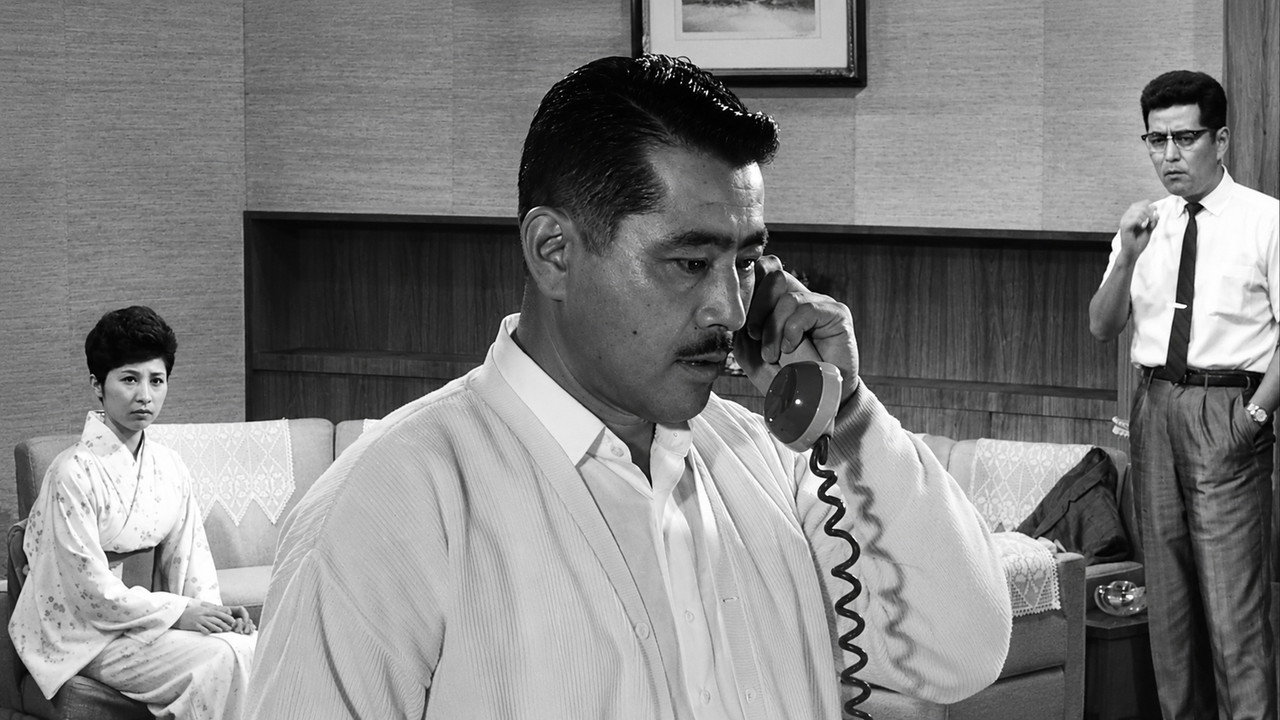
The film's Japanese title — Tengoku to Jigoku, Heaven and Hell — announces its architecture before a single frame. Kingo Gondo's apartment sits literally above the city of Yokohama, a glass-and-steel tower from which the poor can be seen but not heard. Kurosawa spends the entire first act in that apartment, and the confinement is deliberate: this is a film about a man who has arranged his world so that decisions happen at altitude, at a remove from consequence. The opening sequence is not a kidnapping story. It is a corporate boardroom story, a hostile takeover in miniature. Gondo has leveraged everything he owns to buy a controlling stake in the shoe company where he works, because he cannot tolerate what management is doing to the product. The ransom call arrives at the precise moment his financial position is most exposed. The decision — pay and be ruined, or refuse and let a child die — is not a thriller device. It is a stress test of what a man's stated values actually cost when the bill comes due.
The investigation that occupies the film's second half is one of cinema's great depictions of institutional methodology. Kurosawa shifts registers entirely: from the claustrophobic moral theatre of the apartment to the granular, procedural work of detection. The police operate as a collective intelligence, pooling observations, running controlled experiments, triangulating testimony. There are no genius detectives here, no inspired hunches that cut corners. There is only the patient accumulation of small data points — a colour anomaly in a black-and-white film, the smell of chemicals, a train timetable — assembled into a structure that can support action. For anyone who has managed teams working on complex problems with incomplete information, the second half reads as a near-perfect model of how rigorous process eventually closes on truth. The cost is time, and the cost of time is borne by others.
What makes High and Low essential rather than merely good is the way Kurosawa refuses to let the moral accounting close. Gondo pays the ransom and is destroyed financially. The kidnapper is caught. Justice, by any procedural measure, is served. But the final scene places Gondo and the condemned man face to face through prison glass, and what passes between them is not resolution but recognition. The kidnapper has spent his life looking up at Gondo's apartment from the slums below, and the rage that produced the crime is not irrational — it is a structural consequence of the same hierarchy that produced Gondo's wealth. Kurosawa is precise about this: the film is not arguing that the economic order is wrong, but that decisions made at altitude carry costs that are invisible from up there, and that the people who absorb those costs have not consented to absorb them.
Gondo can calculate his own ruin precisely and cannot calculate the weight of a child's life in the same currency, and the film offers him no exchange rate. The other argument, the one the kidnapping interrupts, is about what an organisation optimises for when its stated values are tested: the shoe company's executives want to cut quality to cut costs, Gondo wants to make something worth making. The kidnapping does not resolve that argument — it suspends it — and by the film's end Gondo has lost both battles simultaneously. The structure implies a connection that Kurosawa leaves unstated: that the compromises organisations make in the name of efficiency produce the conditions for the hells they eventually inhabit.