Norma Rae
Writers: Harriet Frank Jr. (screenplay), Irving Ravetch (screenplay)
Cast: Sally Field, Ron Leibman, Beau Bridges, Pat Hingle, Barbara Baxley
Norma Rae Webster works in a textile mill in a small Alabama town where her parents also work and where the noise, dust and pace have already cost her mother her hearing. When Reuben Warshowsky, a union organiser from New York, arrives to help the workers form a union, Norma Rae becomes his principal ally inside the plant. The mill's management responds not with open violence but with the administrative tools at its disposal: posting inflammatory notices, changing work schedules, isolating sympathisers and surveilling union activity within the letter of the law. The film follows Norma Rae through the organising campaign to the vote, and pays as much attention to what the campaign costs her — her marriage, her reputation, her standing in the town — as to what it achieves.
The mill is the first thing you hear. Ritt opens the film inside the noise — the looms running, the shuttles hammering, the sound that fills the building for every shift and has already taken Norma Rae's mother's hearing. Her mother works there. Her father works there. Norma Rae works there. The town works there, in the sense that the mill is the town's economic fact, the thing around which everything else is arranged. When a doctor tells Norma Rae her mother has gone deaf, the scene is played without melodrama: the doctor explains, the mother does not hear the explanation, Norma Rae translates. Nobody is surprised. The deafness is not an injury in the dramatic sense; it is what the job costs over time, and the cost is understood and absorbed and not questioned, because questioning it would mean questioning the only employment available. This is the condition the film starts from, and it is worth naming precisely: not exploitation in the sense of cruelty but extraction in the sense of a process that takes more from the worker than it returns, conducted within legal boundaries, sustained by the absence of an alternative, and invisible to everyone except the people inside it.
Reuben Warshowsky arrives from New York — Jewish, educated, urban, entirely foreign to the town — and Ritt is careful about what he represents. He is not a saviour. He is a technician. He knows labour law, knows how to file with the NLRB, knows which management tactics are legal and which are not, knows the procedural sequence for calling a vote. What he does not know is the town, the relationships, the specific texture of the fear that keeps people from signing cards. For that he needs Norma Rae, and what Norma Rae provides is not courage in the abstract but local knowledge — who is afraid of what, which supervisor can be talked to, where the pressure will come from.
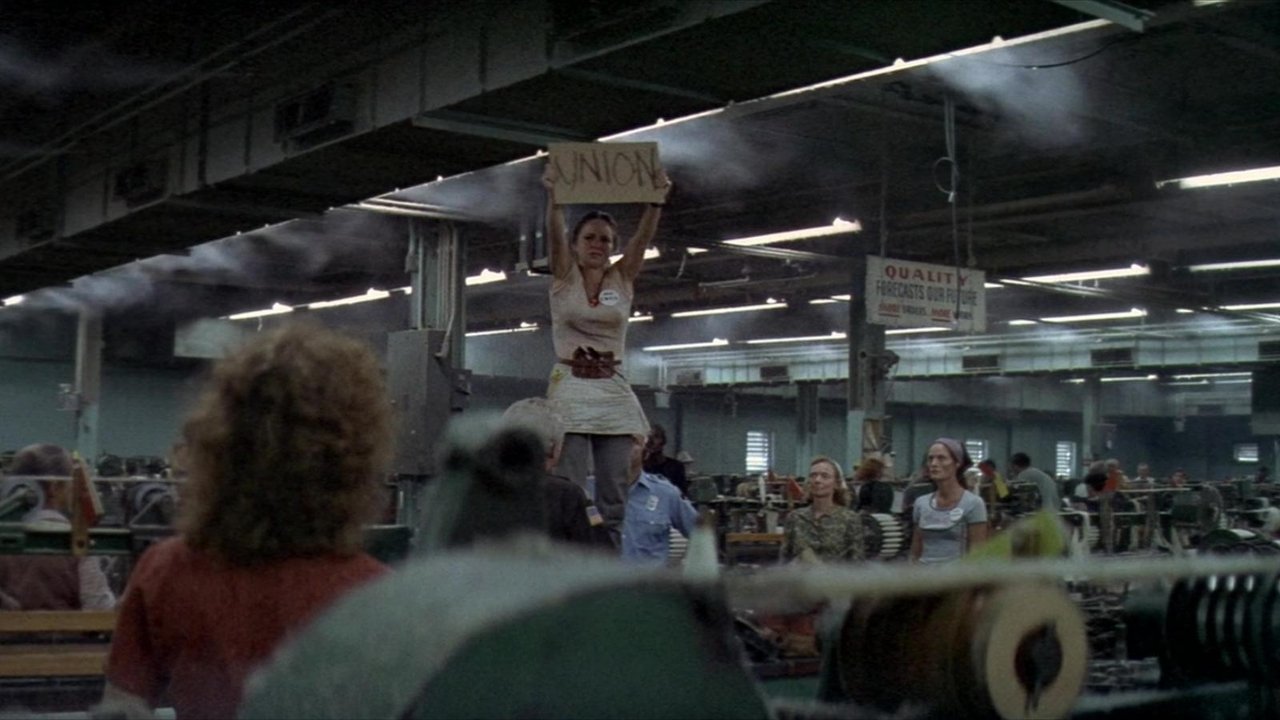
The organising campaign is presented as work, not as a movement: copying letters at night, approaching co-workers one at a time, arguing in kitchens, absorbing refusals. Ritt shoots the campaign the way he shoots the mill — as labour, with its own rhythms, its own fatigue, its own physical toll. The famous scene where Norma Rae stands on a table holding a sign that reads UNION is the film's most compressed image, and its power comes not from defiance but from the silence that follows. The machines stop. The workers look at her. Then they look at each other. The moment is not a speech; it is a signal — evidence that one person in the room is willing to be visible, which changes the calculation for everyone else about the cost of being visible themselves.
The mill's response to the organising effort is the part of the film that has aged best, because it is entirely administrative. Management does not send thugs. It posts a notice on the bulletin board suggesting that the union will create racial tension between Black and white workers. It changes shift schedules so that union sympathisers cannot meet. It calls Norma Rae into the office, repeatedly, for conversations that are not quite threats but that make clear the company is watching. When Norma Rae is fired, the pretext is insubordination — she was copying a notice from the company bulletin board, which she had a legal right to do, but the firing is framed as a disciplinary action unrelated to her union activity. The genius of the mill's response is that it uses the same administrative machinery to suppress the union that it uses to run the production line. This is how organisations defend themselves against internal challenges in any setting: not through exceptional measures but through the selective application of ordinary ones.
What makes Norma Rae more than a labour film is its refusal to pretend that winning is free. Norma Rae's marriage suffers because the campaign takes her time, her attention, and her willingness to be cautious. Her relationship with her children is strained. Her reputation in the town — a town where reputation is a form of currency — is damaged by rumours about her relationship with Reuben. The union vote succeeds, narrowly, and the final scene between Norma Rae and Reuben is not triumphant but quiet: he is leaving, the work is done, what they built together is now the workers' to maintain. The film's understanding is that organising is not an event but a cost, distributed across the life of the person who does it, and that the cost is borne disproportionately by the person closest to the work. Reuben goes back to New York. Norma Rae stays in the town, with the mill, with the people who voted yes and the people who voted no and the management that has not changed. The change happened. The cost did not go away.