野良犬
Writers: Akira Kurosawa (writer), Ryuzo Kikushima (writer)
Cast: Toshirō Mifune, Takashi Shimura, Keiko Awaji, Eiko Miyoshi, Noriko Sengoku, Noriko Honma
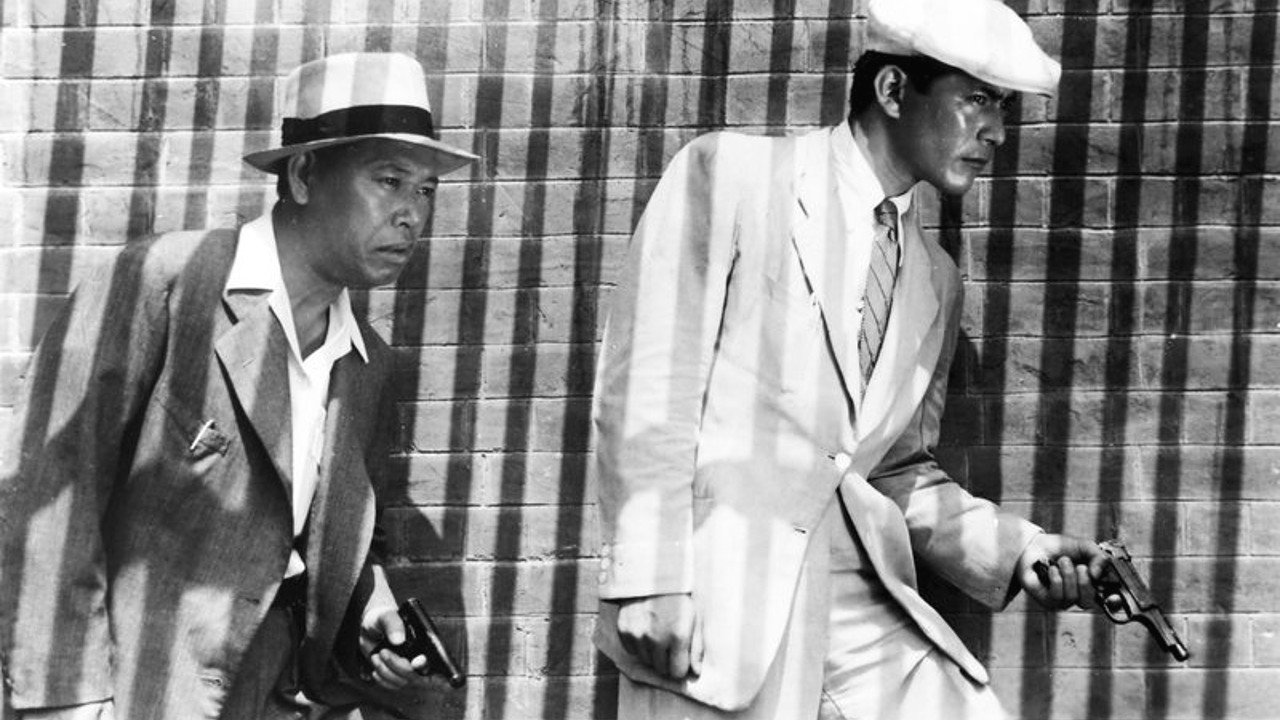
A bad day gets worse for young detective Murakami when a pickpocket steals his gun on a hot, crowded bus. Desperate to right the wrong, he goes undercover, scavenging Tokyo’s sweltering streets for the stray dog whose desperation has led him to a life of crime. With each step, cop and criminal’s lives become more intertwined and the investigation becomes an examination of Murakami’s own dark side.
Kurosawa made Stray Dog in 1949, four years into the American occupation, and the film is saturated with the specific texture of that moment: a city still half-rubble, a generation of young men who came back from the war with nothing, and institutions — the police, the courts, the economy — that were being rebuilt from scratch with uncertain legitimacy. The detective Murakami loses his service pistol to a pickpocket, and what follows is less a manhunt than a prolonged excavation of the question of how two men who started from the same place — same war, same poverty, same displacement — end up on opposite sides of the institutional line. The film is interested in that gap between structure and outcome: why does the system absorb one person and reject another?
The procedural mechanics are deliberate and slow in a way that rewards attention. Murakami does not solve the case by insight but by method — going undercover in black markets, following supply chains, interviewing witnesses, wearing down the distance between detective and criminal by physically inhabiting the criminal's world. His senior partner Sato, played by Takashi Shimura with the weary authority he brings to every Kurosawa institutional role, represents a different relationship to the work: experience has taught him that the question of why some people become criminals and others become cops is not useful. The tension between Murakami's guilt-driven need to understand his double and Sato's professional detachment frames the film's central argument about what institutions require of the people inside them — and what that requirement costs.
For someone thinking about digital products and organisations, the film's most instructive passage is the extended undercover sequence in the first hour, where Murakami traces his stolen weapon through layers of informal economy — black market dealers, fences, dancers, criminal intermediaries — and the camera makes no moral distinction between the institutions he belongs to and the ones he is infiltrating. Both run on hierarchy, information asymmetry, and the controlled release of resources. The police department and the criminal network share a structural logic; what differs is which side has the right to write the rules. Kurosawa is asking where accountability actually lives when two systems with similar architectures produce different legitimacy claims.
The film ends with a confrontation that refuses catharsis. The criminal Yusa is not a monster but a man who made a different set of decisions under the same pressures Murakami faced. Murakami's guilt — the thing that has driven the entire investigation — does not resolve into satisfaction. He has done his job, the system has been served, and the question of whether the system itself is just remains entirely open. This is the Kurosawa move that appears across High and Low, Ikiru, and Rashomon: the institutional outcome is achieved, the personal meaning is unresolved. It is, among other things, a precise description of what it feels like to ship a product on behalf of an organisation whose values you are not sure you fully share.