Prince of the City
Writers: Jay Presson Allen (screenplay), Sidney Lumet (screenplay), Robert Daley (book)
Based on: "Prince of the City" by Robert Daley (1978) ↗
Cast: Treat Williams, Jerry Orbach, Richard Foronjy, Don Billett, Kenny Marino, Carmine Caridi
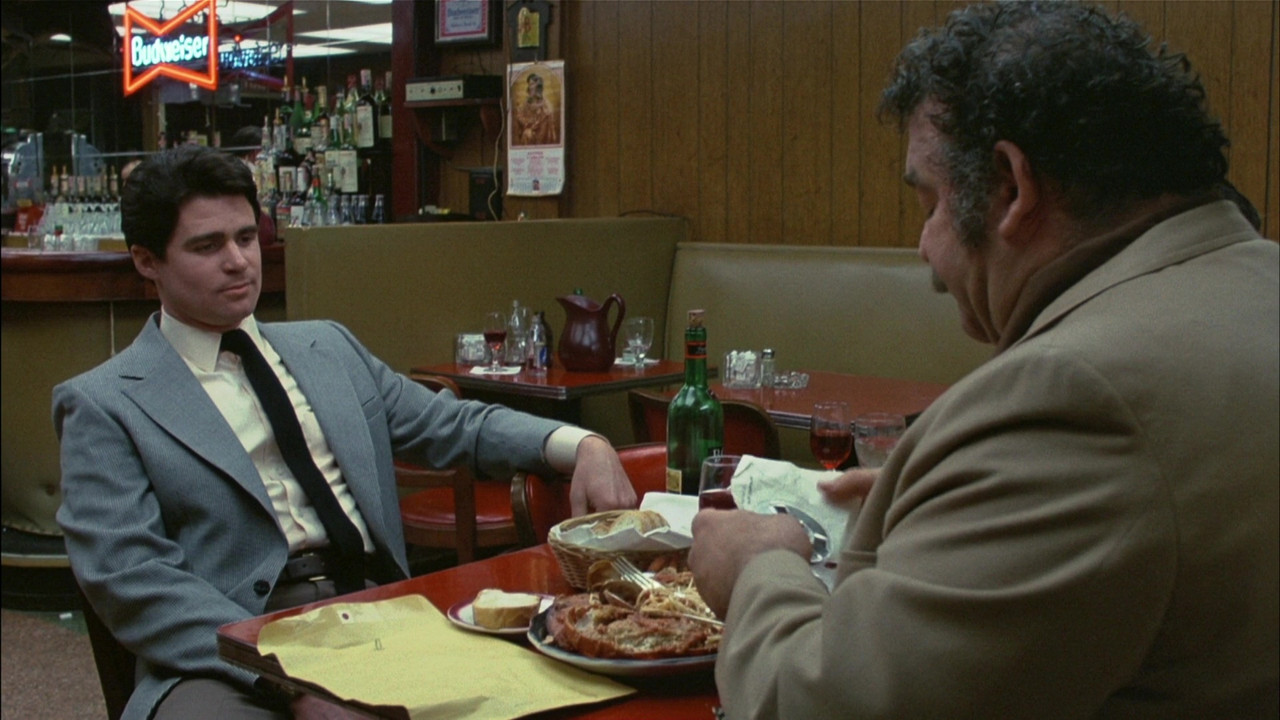
New York City detective Daniel Ciello agrees to help the United States Department of Justice eliminate corruption in the police department, as long as he will not have to turn in any close friends. In doing so, Ciello uncovers a conspiracy within the force to smuggle drugs to street informants.
Prince of the City opens with a question that most films about police corruption never ask: not whether a man will cooperate with investigators, but under what terms, and what those terms reveal about how he understands loyalty, institution, and self. Daniel Ciello agrees to inform on corrupt colleagues, but insists on a condition — he will not name his closest partners. This negotiation is not dramatised as weakness or evasion. Lumet presents it as the first of many decisions made under incomplete information, in which Ciello does not yet understand that the boundary he has drawn is not his to control. The Department of Justice accepts the condition. The condition does not survive contact with institutional logic. What Lumet traces across 167 minutes is not a story of betrayal but a study in how organisations consume their informants — how the mechanism of accountability, once set in motion, operates independently of the intentions of any individual who agreed to participate in it.
The film's most precise structural observation is that corruption in organisations rarely looks like conspiracy. It accumulates through small accommodations: a detective who skims from a drug seizure because everyone else does, partners who cover for each other because the alternative is the destruction of the unit's operational effectiveness, supervisors who know and do not ask because the information would require them to act. Ciello is not an innocent observer of this system — he has participated in it, which is precisely why the Justice Department wants him. His guilt is not incidental to the plot; it is the mechanism by which the institution reaches him. This is the pattern Lumet returns to across his New York films: organisations do not need to be consciously corrupt to produce corrupt outcomes; they need only to create conditions in which the cost of compliance with formal rules exceeds the cost of informal deviation.
Where Prince of the City earns its place in a collection about decision-making under uncertainty is in its treatment of information asymmetry across institutional levels. Ciello knows things his handlers do not. His handlers know things their superiors do not. Federal prosecutors know things that local departments do not. No one in the film has a complete picture, and the decisions made at each level are rational given local information and catastrophic given the full structure. This is not a failure of individual intelligence; it is a feature of how investigative bureaucracies process complex human material. The film is essentially an argument that accountability systems, when applied to networks of mutual obligation, do not restore order — they propagate damage through the network in ways that the system's designers cannot predict and the system's participants cannot prevent.
For someone directing digital products, the film's lesson is structural rather than moral. Ciello's mistake is not that he cooperated; it is that he believed the terms of his cooperation would remain stable once the institutional machinery began operating. Every product team that agrees to a reform initiative, an audit, or a transparency process and then discovers that the process has its own momentum will recognise the dynamic. The organisation does not lie to Ciello — it simply pursues its own objectives, which are not identical to his. Lumet's camera stays close throughout, preferring faces in the middle of sentences to clean declarative confrontations, because the point is never the moment of decision — it is the accumulation of smaller moments that made the larger decision, in retrospect, inevitable.