Advise & Consent
Writers: Loring Mandel (theatre play), Allen Drury (novel), Wendell Mayes (screenplay)
Based on: "Advise and Consent" by Allen Drury (1959) ↗
Cast: Henry Fonda, Charles Laughton, Don Murray, Walter Pidgeon, Peter Lawford, Gene Tierney
Proposed by the President of the United States to fill the post of Secretary of State, Robert Leffingwell appears before a Senate committee, chaired by the idealistic Senator Brig Anderson, which must decide whether he is the right person for the job.
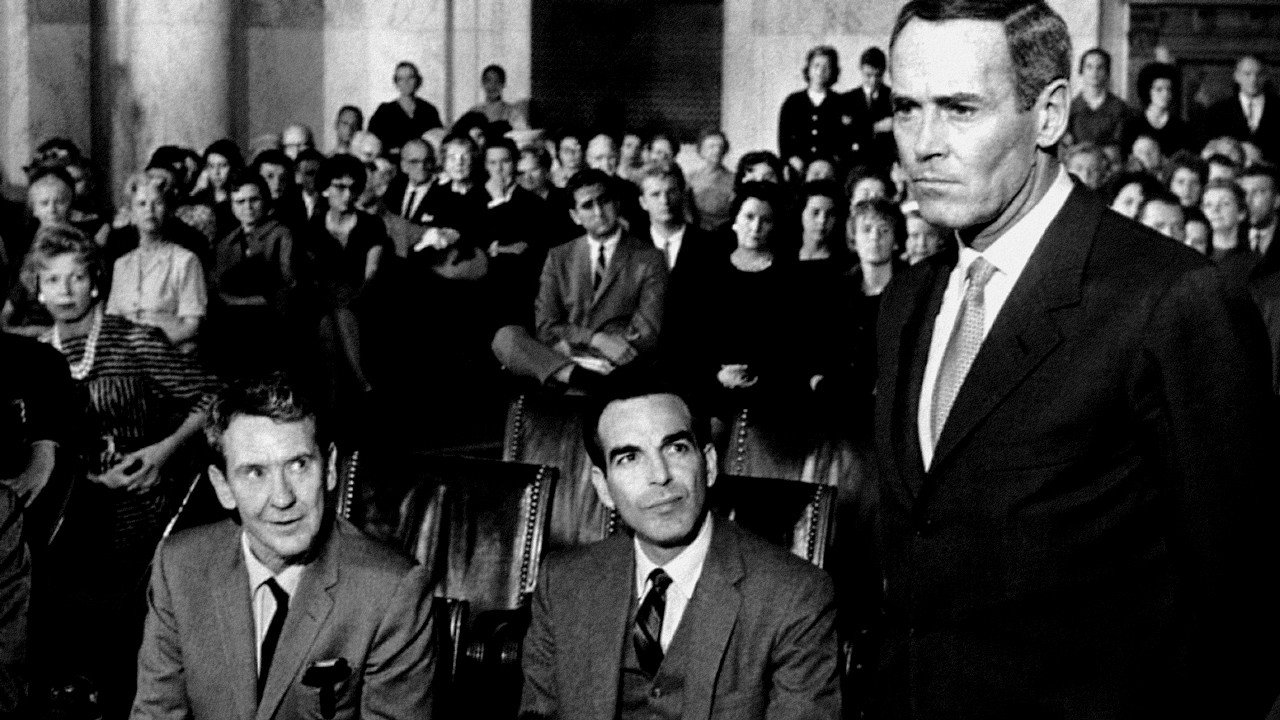
Advise & Consent is a film about a process, not a verdict. The confirmation hearing for Robert Leffingwell as Secretary of State functions less as a courtroom drama than as an extended study in how institutions produce decisions that are never quite what they appear to be. Preminger shoots the Senate chamber with the same flat, unsentimental precision he brought to Anatomy of a Murder: the wide-angle compositions refuse to identify a hero, distributing moral weight across committees, corridors, and cloakrooms with a rigour that makes the machinery of deliberation visible. The film's first structural move is to establish that the stated question — is Leffingwell qualified? — is almost entirely beside the point. What the Senate is actually deciding is a set of questions about precedent, factional loyalty, the balance of power between the executive and legislative branches, and which senators owe what to whom. The hearing is a protocol through which other negotiations are conducted.
The film is particularly sharp on information asymmetry and how it structures institutional power. Different actors know different things — about Leffingwell's past, about each other's vulnerabilities, about what the President actually needs — and the confirmation process becomes a field in which these asymmetries are deployed, concealed, and occasionally weaponised. Senator Seab Cooley (Charles Laughton, in his final screen role) is the collection's archetype of the institutional survivor: a man who understands that patience and memory are more durable instruments than argument. His opposition to Leffingwell is personal and partly irrational, but he prosecutes it through procedure, never breaking the rules he has spent a career learning to use. This is how institutions actually function — not through dramatic confrontations but through the slow accumulation of procedural advantage by people who know where the levers are.
The subplot involving Senator Brig Anderson introduces the collection's recurring theme of how organisations use private information as a control mechanism. Anderson's past is discovered and used against him not to expose truth but to extract compliance — a form of institutional coercion that operates entirely within the nominal rules of democratic process. What makes Preminger's treatment valuable for this collection is that the film does not frame this as corruption so much as as the logical extension of how any institution with high stakes and limited information manages the problem of getting people to behave. The Senate shown here is not a degraded version of some ideal deliberative body; it is what deliberative bodies are when real decisions are at stake.
For anyone directing digital products, Advise & Consent offers a precise model of what happens when the formal decision process and the actual decision process diverge — which is most of the time. Leffingwell's fitness for office is evaluated through testimony, questioning, and committee votes, but the outcome is shaped by conversations that precede and follow every formal session, by information that cannot be introduced into the record, and by a presidential intervention that illustrates what it means to have authority without accountability. The film was made in 1962 and the institutional mechanics it describes have not changed. The committee is still the room where decisions are pre-processed before being ratified elsewhere.