In the Loop
Writers: Armando Iannucci (screenplay), Jesse Armstrong (screenplay), Simon Blackwell (screenplay), Tony Roche (screenplay)
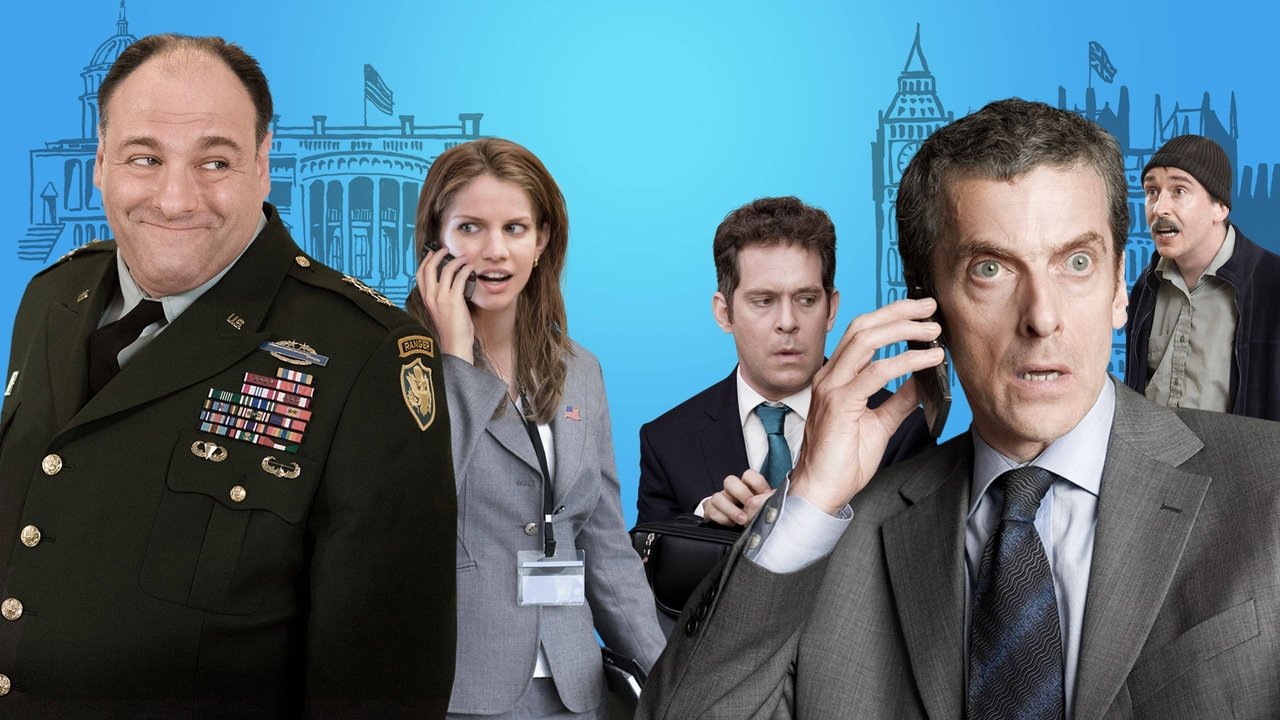
Cast: Peter Capaldi, Tom Hollander, Gina McKee, James Gandolfini, Chris Addison, Anna Chlumsky
The US President and the UK Prime Minister are planning on launching a war in the Middle East, but—behind the scenes—government officials and advisers are either promoting the war or are trying to prevent it.
In the Loop begins with a Cabinet minister saying, on a radio programme, that war is 'unforeseeable' — a word chosen for its deliberate vagueness — and then watches as that single adjective triggers a cascade of institutional responses that nobody planned and nobody can stop. Iannucci's central insight, carried over from The Thick of It but scaled up to the transatlantic machinery of pre-war intelligence and foreign policy, is that modern political decisions are not made: they accumulate. No one in the film actually decides to go to war. Instead, a committee is convened, a report is selectively quoted, a memo is accidentally forwarded, a general's private doubts are reframed as public endorsement, and the mechanism advances. The war is the residue of a hundred small acts of careerism, miscommunication, and bureaucratic self-preservation — which is, of course, exactly how most consequential institutional decisions are reached.
The film's most structurally important character is not Malcolm Tucker, the Director of Communications whose profane velocity dominates every room he enters, but Simon Foster, the hapless Minister who cannot formulate a position and cannot maintain silence. Foster is the collection's canonical figure of the decision-maker who lacks a model: he does not know what he thinks, he cannot articulate what he wants, and so he is continuously interpreted, co-opted, and redrafted by everyone around him. Tucker weaponises his ambiguity. The American hawk faction uses him as a placeholder vote. The doves use him as a symbolic figurehead. Foster himself oscillates, not from principle but from social pressure, which is exactly how institutional positions form in the absence of genuine analysis. The film understands that the most dangerous person in a bureaucracy is not the ideologue but the empty signifier.
What Iannucci adds that pure political satire rarely provides is a working account of information architecture. The classified document that drives the plot's second half — a genuine policy memo arguing against intervention — is not suppressed through malice but through the ordinary mechanics of document control, classification status, and the social cost of being the person who introduces inconvenient material into a process that has already built momentum. The scene in which Karen Clarke's aide attempts to get the memo into the right hands, and finds herself blocked not by conspiracy but by procedure, is a precise illustration of what organisational theorists call the escalation of commitment: systems do not continue because people want bad outcomes, but because the cost of changing course now exceeds the cost of continuing, at every level of the hierarchy simultaneously.
For anyone directing digital products, In the Loop offers something more useful than its obvious lesson about spin and communications management. It demonstrates how the framing of a decision — the language in which options are presented, the committee charged with evaluating them, the timeline imposed — determines the outcome before any deliberation begins. Tucker's genius is not persuasion but architecture: he controls the room, the agenda, the draft, and the clock. By the time anyone is asked to decide, the decision is already made. Product directors who believe that good arguments win in well-run organisations would benefit from watching what happens when the process itself is the argument.