Conspiracy
Writers: Loring Mandel (writer)
Cast: Kenneth Branagh, Stanley Tucci, Colin Firth, Jonathan Coy, Brendan Coyle, Ben Daniels
At the Wannsee Conference on January 20, 1942, senior Nazi officials meet to determine the manner in which the so-called "Final Solution to the Jewish Question" can be best implemented.
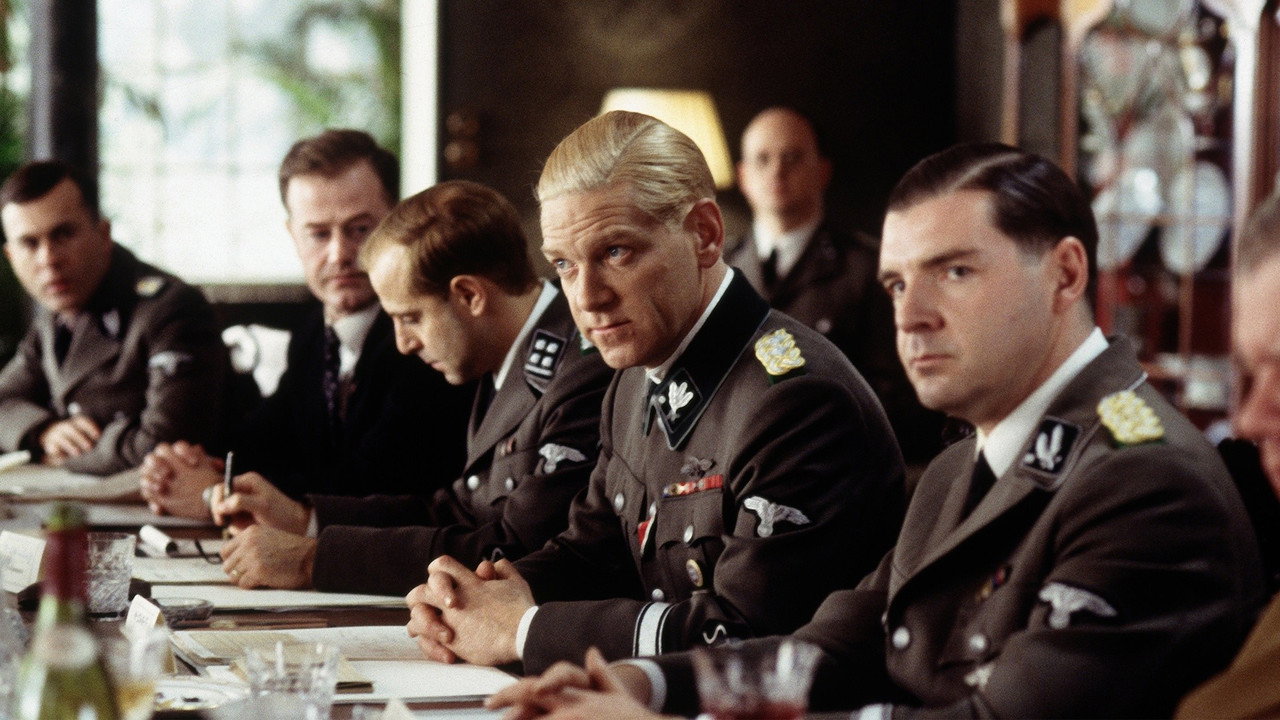
Conspiracy reconstructs the Wannsee Conference almost entirely through meeting mechanics — who sits where, who speaks when, who is permitted to object and under what conditions. Frank Pierson's film, working from Loring Mandel's meticulously researched screenplay, understands that what happened in that villa on 20 January 1942 was not a conspiracy in the popular sense of shadowy plotting, but something more banal and more instructive: a bureaucratic coordination meeting, with an agenda, minutes, and refreshments. Reinhard Heydrich (Kenneth Branagh) runs it the way a competent executive runs any difficult cross-functional alignment: he establishes the authority structure early, manages the room's energy, gives dissenters just enough space to feel heard before closing off every exit. The horror is that the form is recognisable. The protocol is the mechanism.
The film's most analytically rich contribution is its treatment of language as organisational technology. Euphemism is not deployed here as mere evasion — it is a coordination instrument. Terms like 'evacuation,' 'special treatment,' and 'Final Solution' allow participants with different levels of knowledge and different institutional interests to sign onto the same document without ever having to agree on what they are signing onto. Adolf Eichmann (Stanley Tucci), taking the minutes, is the film's sharpest figure for this: a proceduralist whose competence is entirely in logistics and documentation, who has no apparent ideological passion but whose administrative precision is what makes the thing executable. Hannah Arendt's phrase is not invoked, but it haunts every scene he appears in. Tucci plays him as a man who has found perfect alignment between his professional skills and his assigned task, which is perhaps the most disturbing form of institutional capture imaginable.
For anyone working in organisations — and particularly in digital product contexts where technical complexity creates its own euphemistic vocabularies and distributed accountability structures — Conspiracy is a limit case that clarifies something essential. The film demonstrates how decision-making can be managed so that no individual in the room is ever required to make the decision in full moral light. Objections from the legal and foreign ministry officials (Colin Firth's Friedrich Wilhelm Kritzinger being the most legible conscience in the room) are not suppressed by force; they are absorbed, reframed, deferred, and finally dissolved by procedural momentum. Heydrich does not overrule dissenters — he makes dissent structurally expensive and ultimately purposeless. The meeting ends with consensus not because everyone agrees, but because the architecture of the meeting makes disagreement incoherent.
This is not a film about evil as aberration. It is a film about how institutions process decisions that no individual participant would endorse alone. The collection already holds films about systems failure, about accountability gaps, about the way organisations diffuse responsibility until no one is responsible. Conspiracy sits at the extreme end of that continuum and in doing so clarifies the whole range. It fills no slot already occupied — there is no existing film in the collection that interrogates the meeting as a tool of control, or that so precisely demonstrates how procedural form can be weaponised to achieve outcomes that the form itself appears to legitimise. For a reader thinking about how language is used in technical organisations, how agendas are set, and who gets to frame what is even discussable, this film is indispensable.