Nineteen Eighty-Four
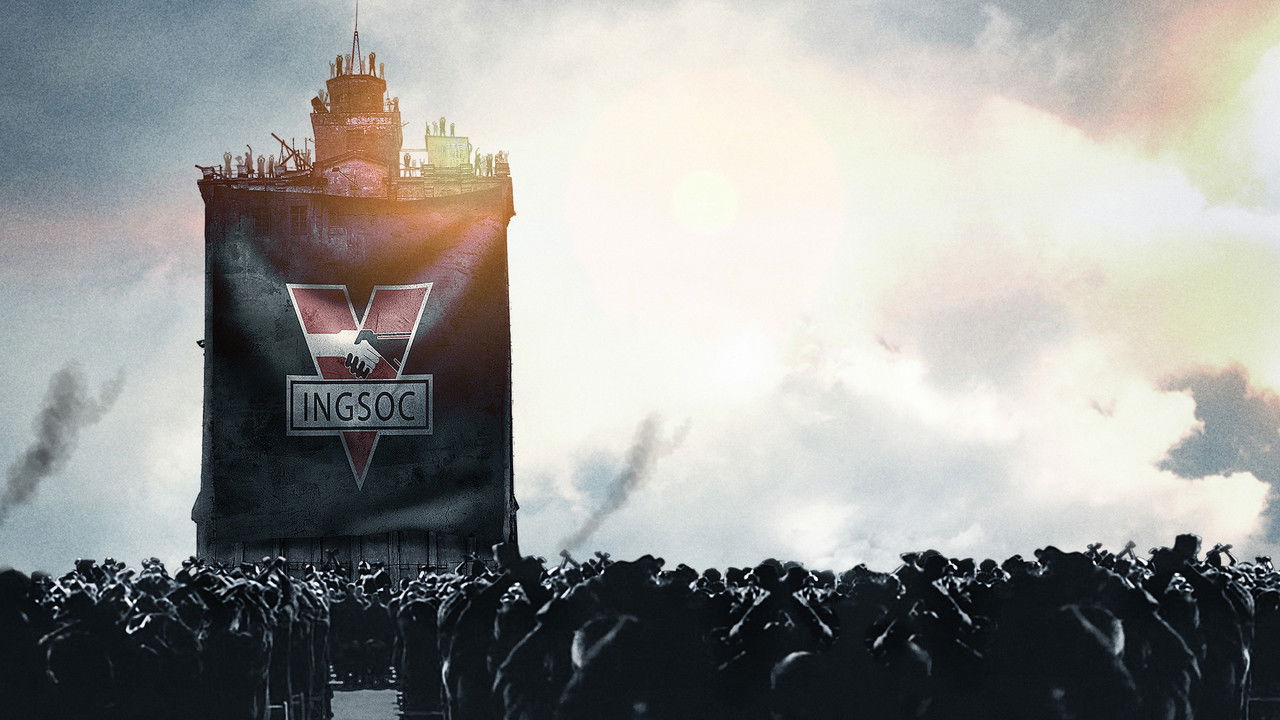
Writers: George Orwell (novel), Michael Radford (screenplay)
Based on: "Nineteen Eighty-Four" by George Orwell (1949) ↗
Cast: John Hurt, Richard Burton, Suzanna Hamilton, Cyril Cusack, Gregor Fisher, James Walker
Winston Smith is a government employee whose job involves the rewriting of history in a manner that casts his fictional country's leaders in a charitable light. His trysts with Julia provide his only measure of enjoyment, but lawmakers frown on the relationship -- and in this closely monitored society, there is no escape from Big Brother.
The Ministry of Truth is not a propaganda bureau. That framing would be too simple, and Orwell knew it. What Winston Smith does for a living is something more vertiginous: he rewrites the historical record so that whatever the Party claims was always true has always been true. The distinction matters. Propaganda says one thing while another thing is happening. The Ministry of Truth abolishes the gap between the two by retroactively adjusting the evidence. Winston's department receives memory holes — literal slots in the desks through which discarded documents fall into incinerators — and the bureaucratic routine of this work is what Radford's film captures that most discussions of Orwell miss. The horror is not spectacle; it is administration. Falsification arrives as a workflow, a quota, a procedure. The connection to how organisations actually operate is not metaphorical: every institution that controls its own audit trail, that defines what counts as a successful outcome, that can reclassify a failure as a planned transition, is doing a version of what the Ministry of Truth does. The mechanism differs in degree, not kind.
Doublethink is the operational concept that distinguishes this work from any simpler dystopia. It is not that Party members believe the lies told to them; it is that they have developed the capacity to hold two contradictory beliefs simultaneously, knowing the second to be true while believing the first. Radford's film, shot on location in austere 1984 London with a colour palette drained to grey-brown, stages this as a problem of epistemology rather than morality. The question the film asks is not whether the characters will choose truth over falsehood but whether, after sufficient conditioning, the category of 'truth' retains any operational meaning at all. For anyone who has watched an organisation reframe a catastrophic decision as a strategic pivot, or seen a product team earnestly defend a metric that measures the wrong thing because it was the metric that was set, Doublethink will feel less like science fiction than institutional anthropology.
O'Brien — played by Richard Burton in his final complete performance, a casting decision that works as its own argument — is not a fanatic. That is the film's most unsettling contribution to the collection's concerns about power and hierarchy. He is a theorist, a patient one, who has thought more carefully about the structure of control than anyone the Party has produced. His explanation of power, delivered in the torture chamber, identifies the decisive distinction between this system and any that preceded it: earlier tyrannies claimed to serve a purpose beyond themselves — God, the nation, the race, the future. The Party claims nothing. Power is its own justification and its own end. The film presents this not as a statement about totalitarianism alone but about any institution that has achieved sufficient internal closure — where the feedback loops that could correct it have been severed, where accountability flows only upward, and where the system's continued existence is treated as synonymous with the purpose for which it was supposedly created.
For anyone directing digital products, the film is required viewing for a reason that has nothing to do with authoritarian politics. Newspeak — the project to shrink the English language until unorthodox thought becomes grammatically impossible — is the most rigorous fictional treatment of how the vocabulary available to an organisation shapes the decisions it can consider. When a product team lacks words for 'harm,' 'dependency,' 'extraction,' or 'manipulation,' it is not because those things are not happening; it is because the inherited vocabulary of engagement, retention, and conversion has made them unnameable within the normal flow of work. The Party did not need to forbid heresy; it needed only to eliminate the words in which heresy could be expressed. Radford's film, grim and unrelenting, makes this mechanism visible with a precision that no management text has matched.