A Scanner Darkly
Writers: Richard Linklater (screenplay), Philip K. Dick (novel)
Based on: "A Scanner Darkly" by Philip K. Dick (1977) ↗
Cast: Keanu Reeves, Robert Downey Jr., Woody Harrelson, Winona Ryder, Rory Cochrane, Mitch Baker
An undercover cop in a not-too-distant future becomes involved with a dangerous new drug and begins to lose his own identity as a result.
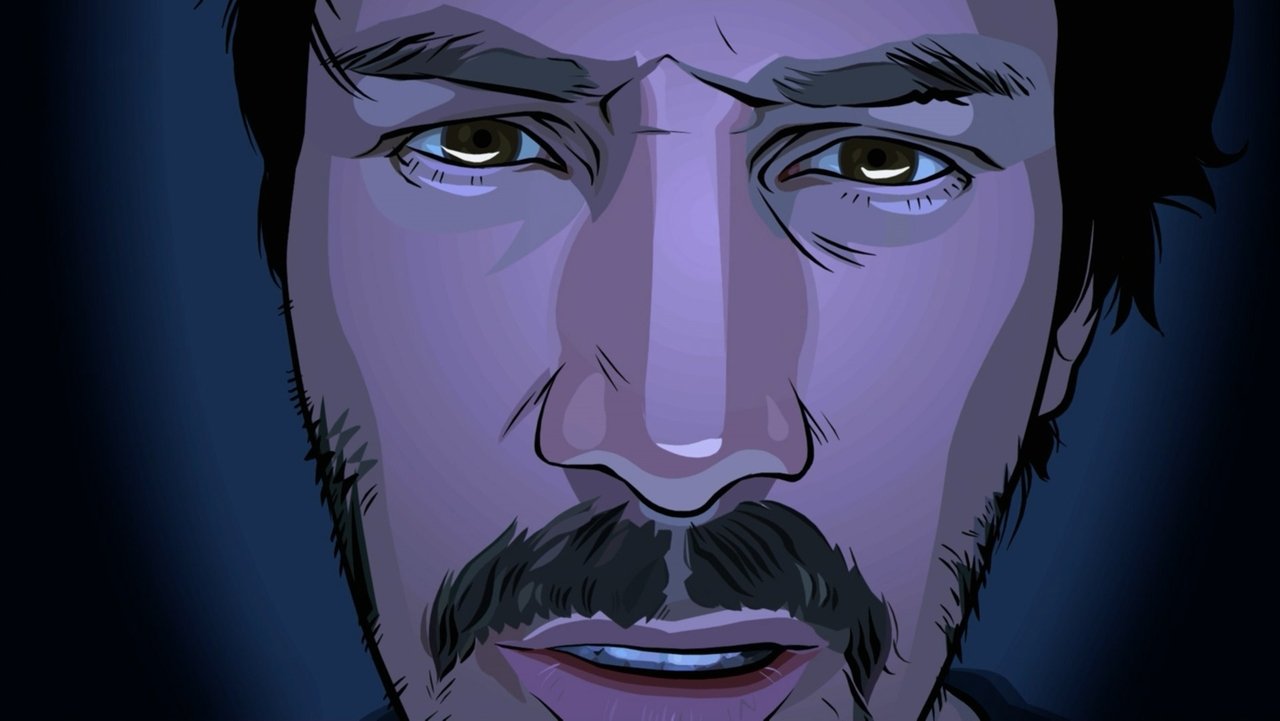
The scramble suit is the film's central organisational object. Agent Fred — undercover narcotics officer Bob Arctor — wears a device that projects a constantly shifting composite of thousands of different people onto his surface, making him unidentifiable to anyone, including his own department. When he reports to his superior, he is reporting on himself: his handlers assign him to surveil the household he lives in, the people he has become, the person he is losing. The suit is not presented as a technical marvel but as a bureaucratic solution to a bureaucratic problem — how do you run an informant network when the informants need to be protected from each other? The answer, Linklater shows, is a system so compartmentalised that it defeats its own purpose. The state cannot see what it is doing because it has designed itself not to see.
Linklater's decision to rotoscope the entire film — tracing live action with animation — is not stylistic ornamentation. It enacts the film's epistemological argument: you are watching something real that has been processed into something uncertain, and you cannot fully trust the surface. Every character in the film has the same problem. The drug Substance D erodes the connection between the brain's two hemispheres, producing a subject who watches themselves from the outside, who cannot be sure whether the thoughts they are having originate with them or with the compound or with the role they have been performing so long it has replaced the person underneath. This is surveillance internalised — the observer and the observed collapsing into a single confused agent who files reports on his own deterioration.
The institutional dimension is precise. When Arctor finally breaks down completely, the system does not malfunction — it delivers exactly what it was designed to deliver. He is processed through a rehabilitation facility that is, as it turns out, a front for the Substance D supply chain. The agency that deployed him as a tool to penetrate a drug network has routed him directly into the production source, without knowing it, without anyone having decided it. This is emergence in its most damaging form: a system of interlocking organisations, each following its local incentives, producing a catastrophic outcome that no participant intended or could have foreseen from their position inside it. Dick wrote the novel from experience — the dedication lists real people lost to the same logic — and Linklater preserves that specificity. This is not allegory. It is a case study in how systems consume the people they recruit.
For anyone directing digital products, the scramble suit is worth sitting with. It is an interface designed to maximise deniability and minimise accountability, and it works perfectly — which is precisely why it destroys everything it touches. The anonymisation that protects the agent also prevents any corrective feedback from reaching the institution. The organisation cannot learn because it has engineered itself against knowledge. Bob Arctor's disintegration is the end state of a system optimised for control at the expense of legibility: nobody can read the situation clearly, including the people responsible for it, and by the time the damage is visible it has already been institutionally processed into an outcome.