The Zone of Interest
Writers: Jonathan Glazer (writer), Martin Amis (novel)
Based on: "The Zone of Interest" by Martin Amis (2014) ↗
Cast: Christian Friedel, Sandra Hüller, Johann Karthaus, Luis Noah Witte, Nele Ahrensmeier, Lilli Falk
The commandant of Auschwitz, Rudolf Höss, and his wife Hedwig, strive to build a dream life for their family in a house and garden next to the camp.
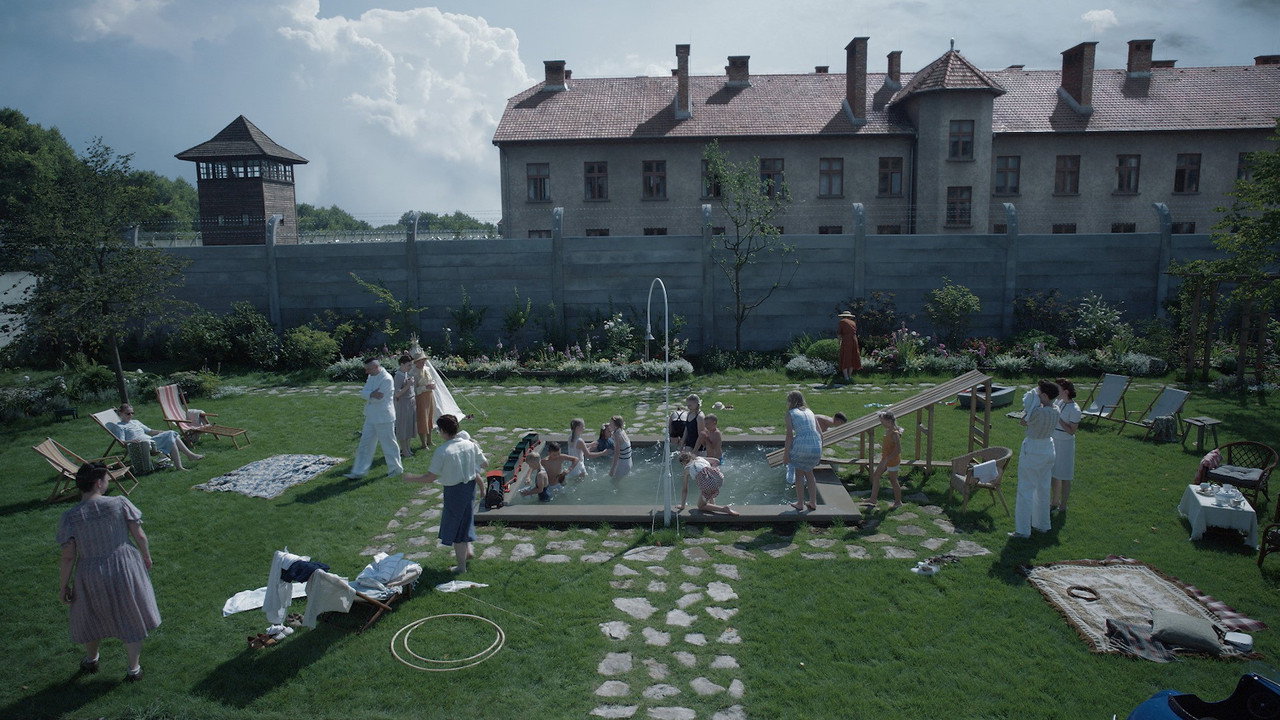
Jonathan Glazer's film begins with a sustained black screen and a wall of sound — not silence, but the ambient noise of the camp across the wall, just out of frame. It never stops. The sounds are indistinct, industrial, bureaucratic. They are the sounds of a system running at capacity, and The Zone of Interest never lets you forget that every scene of domestic normality — a birthday party, a garden dispute, a career conversation — is taking place inside that sound. The film's central formal argument is that the camp is not separate from the household; the household is the camp's administrative annex, and the family who occupies it is doing what all administrative personnel do: managing their immediate scope, delegating what falls outside it, and optimising for personal advancement within the structure they have been given.
Rudolf Höss is not portrayed as a monster but as a middle manager with a promotion problem. When he is transferred to Oranienburg, his wife Hedwig refuses to leave the house and garden she has built. The scene in which Höss negotiates the terms of his departure — the conditions under which she will accept his absence, the square footage of institutional resource she expects to retain — is indistinguishable from any executive relocation discussion. Glazer holds on this conversation with the same flat patience he gives everything else, which is the point: the system does not require its participants to feel anything in particular. It requires them to make decisions, to manage logistics, to escalate what needs escalating. Höss's contribution to the mechanism is not passion but competence. He is good at his job, and his job is what it is.
The collection already holds films about institutional failure, accountability, and the ways organisations produce outcomes nobody inside them intended or endorsed. What The Zone of Interest adds is the most extreme case of that argument — the one that cannot be deflected by saying the actors simply didn't understand what they were building. The Höss household understood exactly what was happening across the wall. They chose the frame of domestic administration as a cognitive and moral technology: by keeping the family's horizon at the garden fence, by allocating attention to roses and swimming pools and the children's lessons, the camp could be rendered ambient, infrastructural, not-the-point. This is not a film about evil. It is a film about the organisational production of normalcy in the presence of catastrophe, and that is a problem that does not stay in 1943.
For anyone directing digital products, the film offers an uncomfortable pressure test for the comfortable language of scope and adjacency. Product teams routinely define their responsibility as what happens inside the system they control, and locate the consequences of that system somewhere else — in policy, in regulation, in user behaviour, in adjacent teams. Glazer's film asks what it costs to maintain that frame, and who pays the cost. The answer arrives not in dialogue but in the architecture of the film itself: the camp is always in the frame, even when it is never shown.