羅生門
Writers: Akira Kurosawa (screenplay), Shinobu Hashimoto (screenplay)
Based on: "In a Grove" by Ryūnosuke Akutagawa (1922) ↗
Cast: Toshiro Mifune, Machiko Kyō, Masayuki Mori, Takashi Shimura
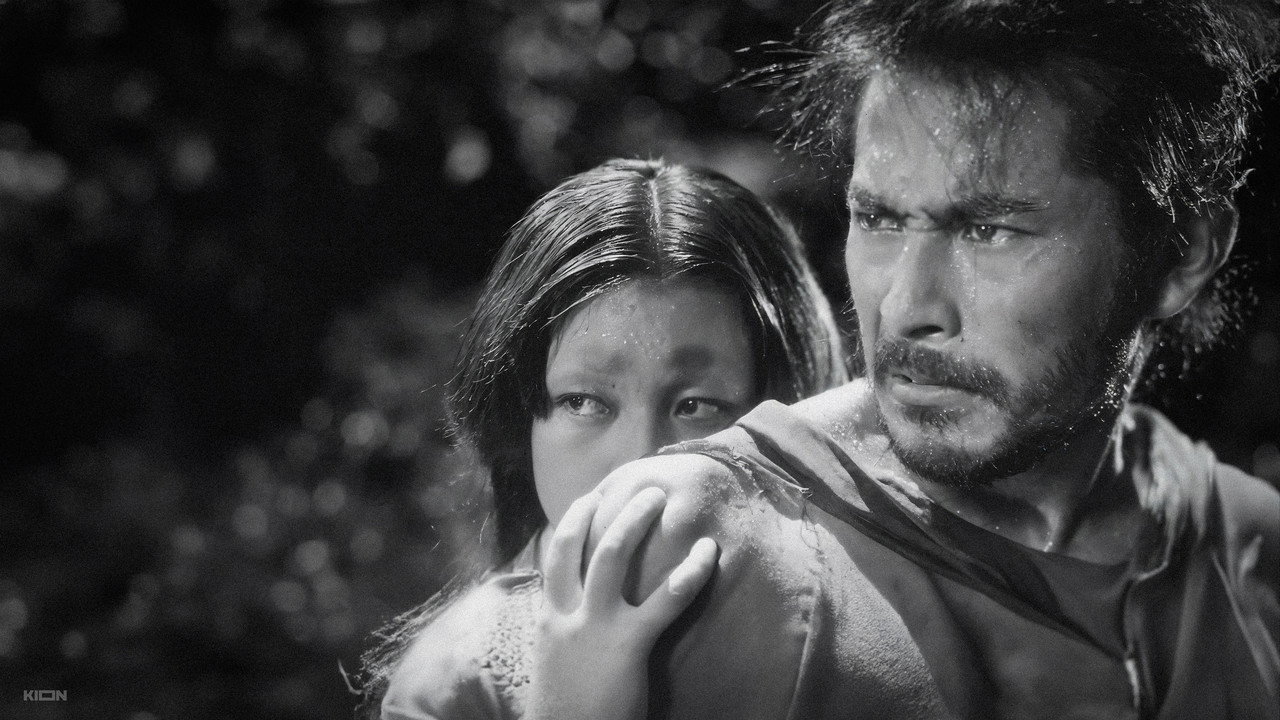
A woodcutter and a priest sit under the ruined Rashomon gate in pouring rain, trying to understand a murder. A samurai has been killed, his wife assaulted, and the bandit Tajōmaru captured. Each of them — the bandit, the wife, the samurai's ghost through a medium, and the woodcutter — tells the story differently, and each version serves the teller's self-image rather than the facts. No version is confirmed. The rain does not stop.
Rashomon gave English a word for the thing it describes. The Rashomon effect is what happens when several witnesses to the same event produce accounts that cannot all be true, and no one among them is lying in the ordinary sense. Four people were in that grove. Four people testified. The testimonies are mutually exclusive, and each one is internally coherent, emotionally plausible and subjectively honest. This is not a film about deception; a film about deception would need a liar, and would end when the liar was caught. It is a film about the fact that observation is not separable from the observer — that the same event, passed through different instruments, yields different data, and that the instruments here are human beings with identities to keep intact. The bandit needs to have been formidable. The wife needs to have been wronged rather than complicit. The dead samurai needs to have died with dignity. Each of them reports what happened in a shape that leaves them recognisable to themselves afterwards. Anyone who has ever collected accounts of an incident from the people involved in it has watched this happen and had to decide what to do about it.
The convention of the detective story is that truth is recoverable: collect enough evidence, interview enough witnesses, and the account that survives all the others is the true one. Kurosawa refuses this, and the refusal is the film's structural argument. No fifth version arrives to adjudicate between the four. The magistrate is never shown, the verdict is never announced, and the audience is given the position of the court without being given the court's authority to decide. What makes the position more radical than it first appears is that the film is not merely withholding one particular fact. It is denying the availability of a view from nowhere. Every account in the film is an account from somewhere — from a position, an interest, a story the teller is already telling about themselves — and the four do not average into a neutral composite. They contradict each other in ways that aggregation cannot smooth. This is the part worth sitting with, because most organisational instinct runs the other way: gather more inputs, triangulate, assume the mean converges on something real. Kurosawa's grove contains no mean. It contains four irreconcilable positions and a body.
The woodcutter is the closest thing the film offers to a disinterested witness. He has no stake, no relationship to the parties, no reason to shade anything; he says he was walking in the forest and came upon the body. His account is the last, the most detailed, and the most tempting to believe — and it is also compromised, because the pearl-inlaid dagger has gone missing from the scene and the woodcutter took it. Which means he was there. Which means his testimony is arranged around the concealment of his own presence. Which means the version that felt neutral was shaped by an interest that was simply harder to see than the others'. This is the film's harshest line and the reason it is more than a puzzle: there is no clean source. The witness who appears to want nothing is not the exception to the pattern; he is the case in which the pattern is best hidden. Is there anyone who's really good? the commoner asks, and the question is not cynicism so much as method. The commoner is the only figure who is unembarrassed about any of it — it's human to lie, most of the time we can't even be honest with ourselves — and being unembarrassed makes him the most accurate reader in the film and also the least useful, because he draws no conclusion except that nothing can be concluded.
Even the frame is ruined. The gate under which the three men shelter is falling apart, its timbers being pulled out for firewood, and the priest's inventory of the age — war, earthquake, wind, fire, famine, plague, year after year nothing but disasters — establishes that the place where accounts are compared is itself in collapse. There is no clean room for the enquiry either.
And then the ending, which is often described as redemptive and is nothing of the kind. A baby is found abandoned behind the gate. The commoner strips its clothes and leaves. The woodcutter offers to take the child home and raise it with his own six children, and the priest — who has spent the film losing his faith in men, and has just watched the woodcutter be revealed as a thief — hands the baby over and says he can believe in men again. Nothing has been resolved. No version of the murder has been confirmed. The priest is not acting on evidence, because there is none and there will be none; he is deciding to extend trust to a source he knows to be compromised, because the alternative is to stand under a broken gate in the rain and do nothing at all. That is the only decision available in a world where the data is permanently contaminated, and it is a decision, not a discovery. The rain stops at the end, which is the film's single concession, and it concedes nothing about what happened in the grove.