Your product is about stories
When digital product work is represented as a list of tasks, strategy ends up as a footnote. Telling the product as a story is the cure.
If something is broken in our industry, it is the way we represent to ourselves what we do. It has enormous consequences for everything. In the product management programme at Instituto Tramontana I argue for a representation in the form of stories.
Even though language and communication are the main materials you work with, they tend to be the most neglected part of the job. In many senses. We have looked at several of them over the course of the programme, from working with quantitative indicators to rationalising the discovery process, and some others become even more glaring when you have to give shape to the thing you are inventing.
We opened the session by asking why we abandon our principal instrument.
The effects of a faulty representation
How we represent what we do is best understood by looking at how we actually build digital products. We took a tour through the empirical material, which is abundant, and from which you extract, at best, an industry that treats the things in its hands as a technical material to be broken down into separate pieces.
That representation leads, for instance, to distorting complexity by reducing it to lists of tasks. Often in a strange robotic language that tries to imitate a sequence of steps towards something. But it is also why contexts and opportunities end up diluted into requests inside backlogs, where thoroughly heterogeneous things get mixed together, both in terms of their complexity and of their possible impact.
User stories are the most eloquent symptom. They were invented to provoke a conversation — they were a cardboard card, a reminder that something still needed to be discussed — and they have ended up as a mandatory field in a form. The «as a user I want X so that Y» formula gets filled in because it has to be filled in. What is left after filling it in is not a story: it is a dismembered corpse.
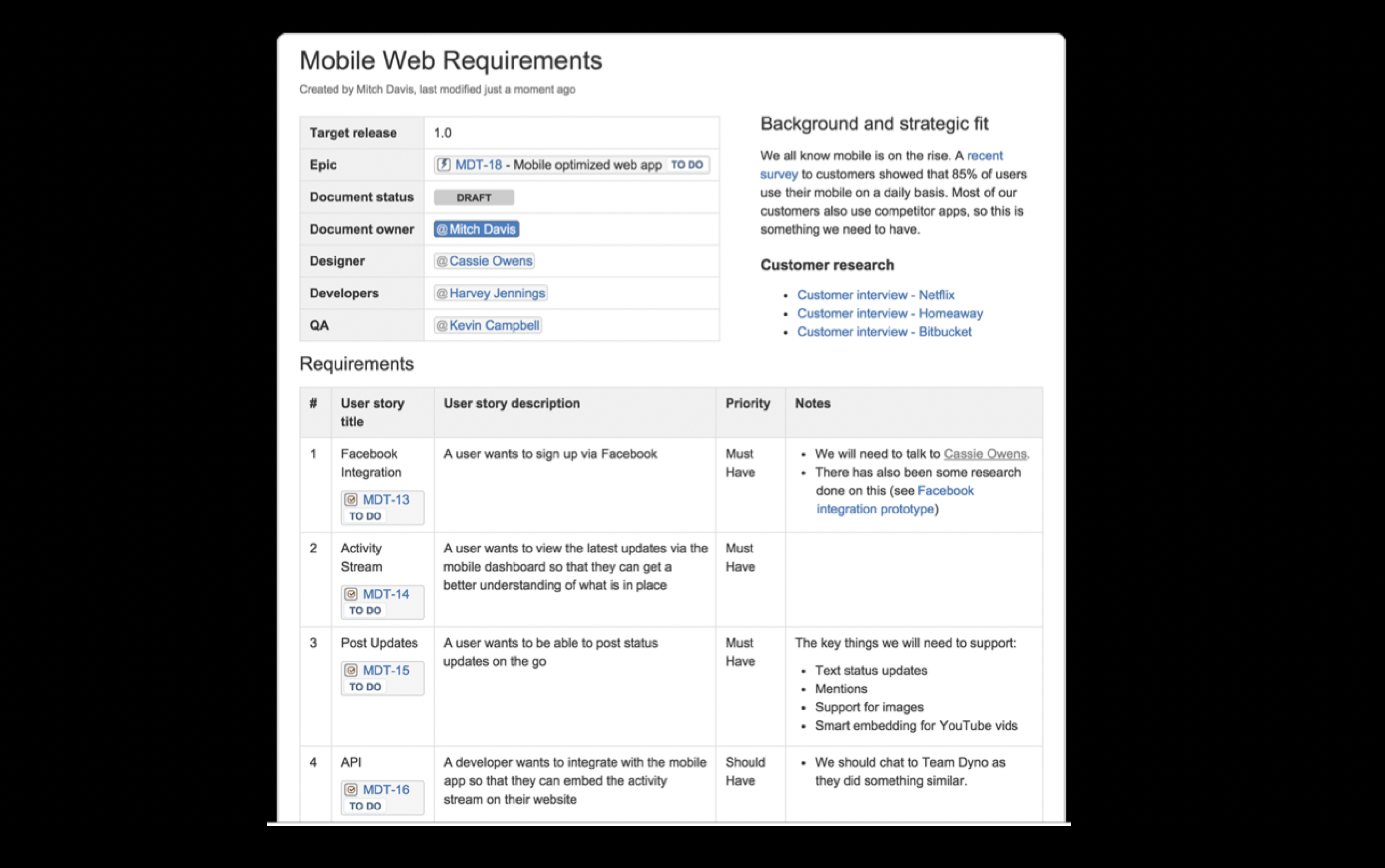
User stories often look like a dismembered corpse.
At the same time, the richness of flows and experiences tends to be mutilated into mute still images, unaccompanied by any explanation of the decisions they conceal. The failure of many startups begins the moment someone freezes an unarticulated idea in a Figma file. Once that projected solution — empty of any meaning — has lodged itself in people's heads, the next step, its breakdown into sets of tasks, happens so fast there is hardly anything you can do. Before you know it you will have a product that possibly discovers far too late that it answers nothing. At best, you will have executed something quickly that leads nowhere.
When all this happens, strategy is a footnote.
Our products are stories
We are wired to find patterns in information, and stories are a medium we move through especially well. Looking towards the arts where stories are invented, developed, told, orchestrated and materialised is the best cure for the errors above. It is the only route to understanding that what we really invent are opportunities and solutions attached to personal, cultural and social contexts, where alone they make sense.

A product can be understood as a conversation.
Robert McKee puts it with a precision worth stealing without apology: stories are the creative conversion of life itself into a more powerful, clearer, more meaningful experience. They are the currency of human contact. This is not a pleasant metaphor for livening up meetings. It is a fairly literal description of what a product does when it works.
"What is the product about?" is a question someone might ask, just as they would when talking about a film, a novel or a play. "What is the feature about?" The details can come afterwards.
Answering it is where you begin to commit to what matters in that plot: you have a reference from which you can sacrifice. Remember that the digital creates a false sense of unlimited abundance, through its own plasticity. There always seems to be room for one more thing, because technically there is. Having the skeleton of a story is the best way to know where, when, how and what to sacrifice.
There is an asymmetry worth noticing. A task list can be extended indefinitely without anything grating: adding a line to a list does not break the list. A plot, on the other hand, suffers. If you insert a scene that does not belong to the story, it shows. That resistance is exactly what you need, and exactly what a backlog never gives you.
We spent time practising different ways of telling features as stories, combining different materials, lengths and structures. We looked at the benefits this brings to a product-oriented organisation, by creating a shared language that is accessible and connected to motivations people can understand and communicate.
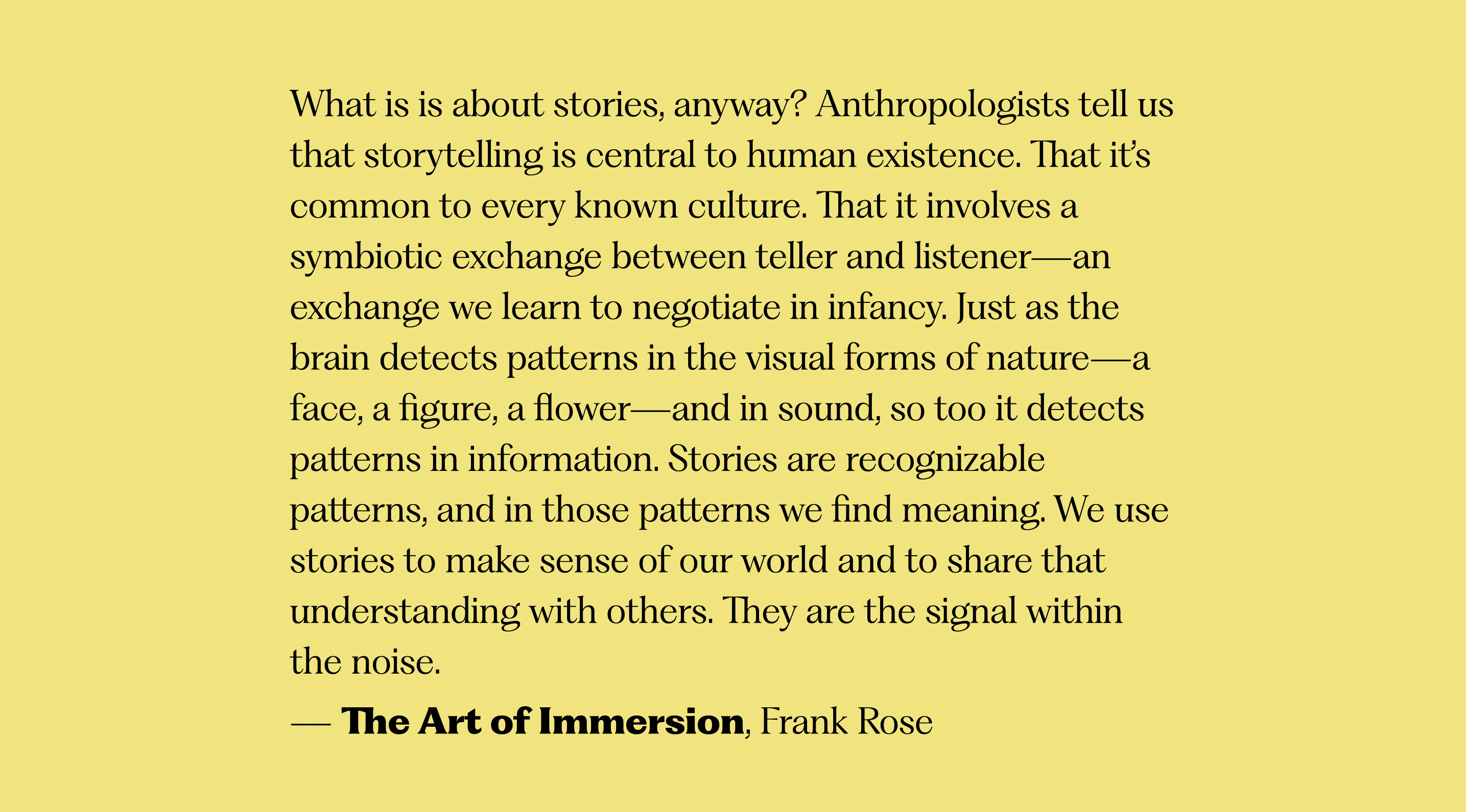
Stories are recognisable patterns: the signal within the noise.
That shared language is probably the most underrated effect. An organisation that can say what its product is about can argue about the product. One that only has tickets argues about tickets.