All the President's Men
Writers: William Goldman (screenplay)
Based on: "All the President's Men" by Carl Bernstein and Bob Woodward (1974) ↗
Cast: Robert Redford, Dustin Hoffman, Jason Robards, Jack Warden, Martin Balsam, Hal Holbrook, Jane Alexander, Ned Beatty, Stephen Collins
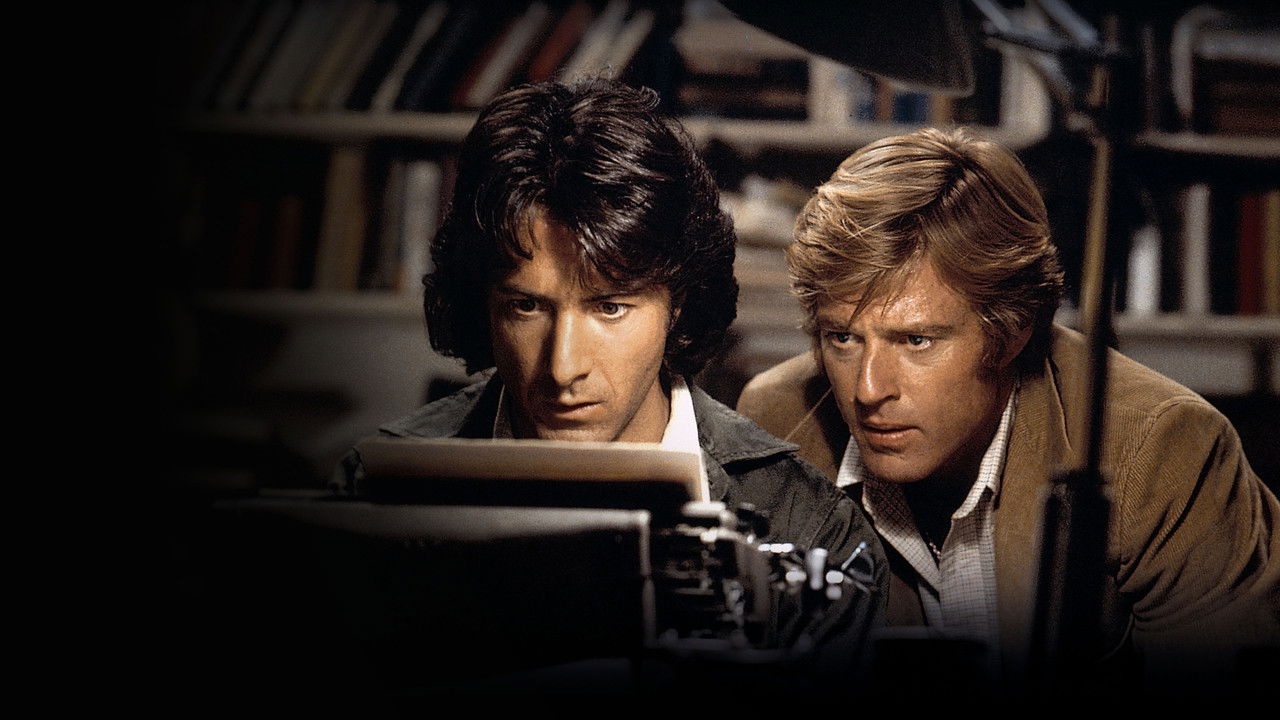
Two junior reporters at the Washington Post are assigned a minor break-in at the Democratic National Committee headquarters. Following the paperwork — cheque stubs, phone records, address books, a list of campaign employees — they trace the burglary upward through the committee to re-elect the president and into the White House itself. The film covers only the first months of the story, and almost all of it consists of two men making telephone calls, knocking on doors, and being told no.
The film's real subject is a method, and the method is stated once, almost in passing. In a conspiracy like this, you build from the outer edges in. Nobody in the Washington Post newsroom has access to the centre, so the centre is approached the only way it can be: through the bookkeeping of the people around it. A cheque stub. A long-distance call charged to a hotel room. The name of a lawyer written in a burglar's address book. Woodward and Bernstein never obtain a document that proves the case; what they obtain is a great many small facts that are individually meaningless and collectively impossible to explain any other way. The famous instruction — follow the money — is not a piece of moral advice about greed. It is a claim about where reliable evidence lives. Testimony is what people are willing to say; money leaves a record whether anyone intends it to or not. Anyone who has tried to establish what actually happened inside a system, rather than what its participants believe happened, ends up at the same place: not the narrative, but the ledger, the log, the transaction trail nobody thought to curate.
What the film shows in unglamorous detail is that a fact is not a thing you find but a thing you construct to a standard. Bradlee's get some harder information next time is the entire editorial function compressed into seven words, and it is said not to a liar but to two reporters who are substantially right. Being right is not the bar. The bar is a defined evidentiary threshold — two independent sources, on the record where possible, corroborated against a document — applied identically to information that flatters your thesis and information that does not. This is a quality discipline in the strict sense, and like every quality discipline it is experienced from the inside as an obstacle. The scene that matters most is not a revelation but a rejection: an editor sending a story back because its confirmation is one source thin. Every organisation that handles information at scale eventually discovers that the expensive part is not acquisition. It is the standard, and the willingness to enforce it against your own enthusiasm.
Then the film does the thing almost no film about journalism does: it lets them get it wrong. The Haldeman story is misreported — not in substance but in sourcing, because Bernstein constructs a confirmation out of a misunderstood silence — and the consequence is immediate and asymmetric. You've done worse than let Haldeman slip away, you've got people feeling sorry for him. I didn't think that was possible. One procedural error does not merely fail to advance the investigation; it transfers credibility from the accuser to the accused and makes the next true story harder to land. Trust behaves like a balance sheet with a very slow credit cycle and instantaneous debits. This is why Bradlee's line about accusing the second most important man in the country and how it would be nice if we were right is funny and also exact: the cost of a false positive here is not embarrassment, it is the loss of the institution's standing to make any claim at all.
And the institution is the point. Pakula shoots the newsroom in flat, even, merciless fluorescent light and the outside world in near-total darkness, which reads as suspense and is really a statement about infrastructure. Nothing in the dark can be verified. Everything that becomes true becomes true inside that lit room, through a structure of desks, editors, second sources, lawyers and a proprietor prepared to absorb risk — Bradlee's nothing's riding on this except the First Amendment to the Constitution, freedom of the press, and maybe the future of the country is a joke told by a man doing the arithmetic of institutional exposure in real time. Two reporters could not have produced the finding; the apparatus around them could. It is also worth noticing what the apparatus discovered at the end of all that rigour: not a criminal genius but, in Deep Throat's summary, men who were not very bright and lost control of a situation. The infrastructure of truth is elaborate, slow and costly precisely because the causes it uncovers are usually banal, and banal causes are the hardest kind to make anyone believe.