The Big Short
Writers: Charles Randolph (screenplay), Adam McKay (screenplay), Michael Lewis (based on the book by)
Cast: Christian Bale, Steve Carell, Ryan Gosling, Brad Pitt, John Magaro, Finn Wittrock
Between 2005 and 2007 a handful of investors — a hedge fund manager with a glass eye and a talent for reading prospectuses, a volatile former physician turned fund operator, two young traders working out of a garage, and an eccentric Wall Street outsider — independently discover that the American housing market is built on loans that cannot be repaid. Each bets against the market using credit default swaps, and then waits, first for the collapse, and then for the financial system to acknowledge that the collapse has already happened.
The film's opening gambit is also its thesis. It puts a quotation on the screen — it ain't what you don't know that gets you into trouble, it's what you know for sure that just ain't so — and then spends two hours demonstrating that the people who ran the American mortgage market between 2003 and 2007 did not, in any important sense, know what they were selling. This is not a claim about dishonesty. It is a claim about abstraction. A mortgage-backed security is a pool of home loans sliced into tranches by risk profile; a collateralised debt obligation is a pool of tranches from multiple securities repackaged into a new instrument with its own tranches; a synthetic CDO is a derivative of a derivative, referencing assets its holders may never have touched. At each level of composition the instrument becomes harder to price, the chain connecting it to the underlying loan — a person, a house, a payment — grows longer, and the people trading it rely more heavily on the rating rather than on the thing being rated. The film's structural argument is that the complexity of these instruments was not an incidental feature but a functional one: it was the mechanism by which risk was made invisible to the people absorbing it.
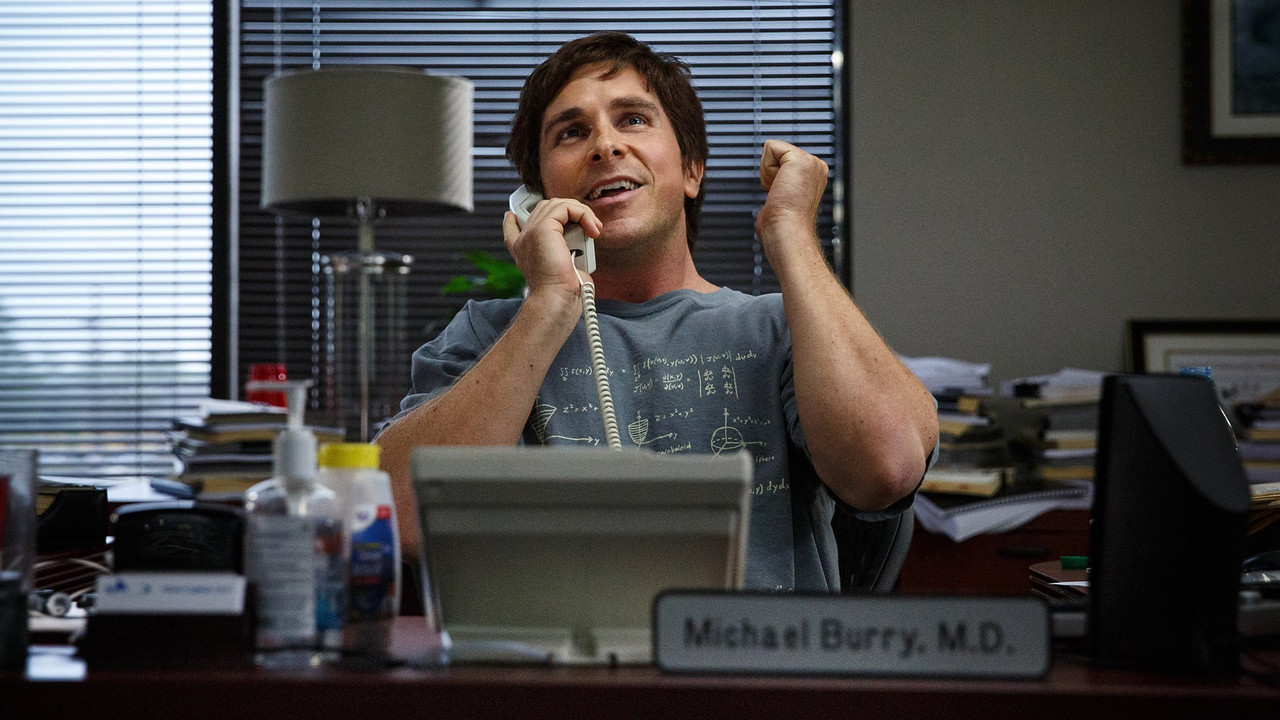
Michael Burry reads prospectuses. This is presented in the film as eccentric, almost as a character flaw, because the convention in the market was to read the rating instead. What he finds by reading the actual loan-level data is that a large number of the mortgages inside the securities he is examining will reset to higher rates within two years, and that the borrowers cannot pay those rates, and therefore that the securities rated triple-A by Moody's and Standard & Poor's will default. The logic is not complex. The data is public. The conclusion is available to anyone willing to do the work, and effectively nobody is willing to do the work, because the rating exists precisely so that nobody has to. This is the proxy-metric problem in its purest form: a measurement created to represent a property of the thing eventually replaces the thing, and when the property changes the measurement does not, because the measurement is upstream of the decision and the thing is downstream and nobody is looking downstream any more. Mark Baum's team visits Florida and discovers that a single stripper owns five houses and a condo on adjustable-rate mortgages, and the scene is played for absurdity, but the structural point is that a lending system designed to generate volume rather than quality will produce this borrower profile as a mathematical certainty. The stripper is not the failure. The incentive gradient that produced her loan portfolio is.
McKay breaks the fourth wall repeatedly, and the breaks are not a stylistic indulgence — they are an argument about opacity. Margot Robbie explains subprime lending from a bathtub, Selena Gomez explains synthetic CDOs at a blackjack table, Anthony Bourdain explains the repackaging of bad loans using three-day-old halibut in a stew. The film is telling you, in the act of telling you, that the instruments at the centre of the crisis cannot be explained using the language in which they were sold, and that this is not an accident. The vocabulary of structured finance evolved to make the products legible to traders and opaque to everyone else, including, as it turned out, the traders. Jared Vennett's pitch — I'm standing in front of a burning house, and I'm offering you fire insurance on it — is memorable because it substitutes a physical metaphor for the abstraction, and the reaction in the room makes visible how much easier it is to act on the metaphor than on the instrument it describes. The difference between stupid and illegal, he says elsewhere, and the line works because in a sufficiently complex system the distinction genuinely dissolves: if nobody involved can explain what the product does, the question of whether they intended to deceive becomes almost metaphysical.
The darkest thing about the film is what happens after the protagonists are proved right. The housing market collapses, the securities default, the credit default swaps pay out, and the people who made the bet collect. Baum stares at the cheque and cannot enjoy it, because the money comes from the collapse, and the collapse means that millions of people have lost their homes, and nobody responsible for the architecture of the crisis will be held accountable. His earlier prediction — that when the economy tanks, people will blame immigrants and poor people — lands as prophecy rather than cynicism, because the alternative would be blaming a system too complex to narrate in a courtroom. Ben Rickert, the quietest figure in the film, reminds the two young traders that every point of unemployment means forty thousand deaths. He is converting an abstraction back into a body count, and the conversion is itself the problem the film exists to pose. The epigraph at a Washington bar — truth is like poetry, and most people hate poetry — is placed as overheard, anonymous, unattributed to any character, and it is the film's last and most uncomfortable observation: the truth about the crisis was available before, during and after, and the system's defence was never that the truth was hidden. It was that the truth was stated in a form nobody wanted to process.