The Fog of War: Eleven Lessons from the Life of Robert S. McNamara
Writers: Errol Morris (director)
Cast: Robert S. McNamara
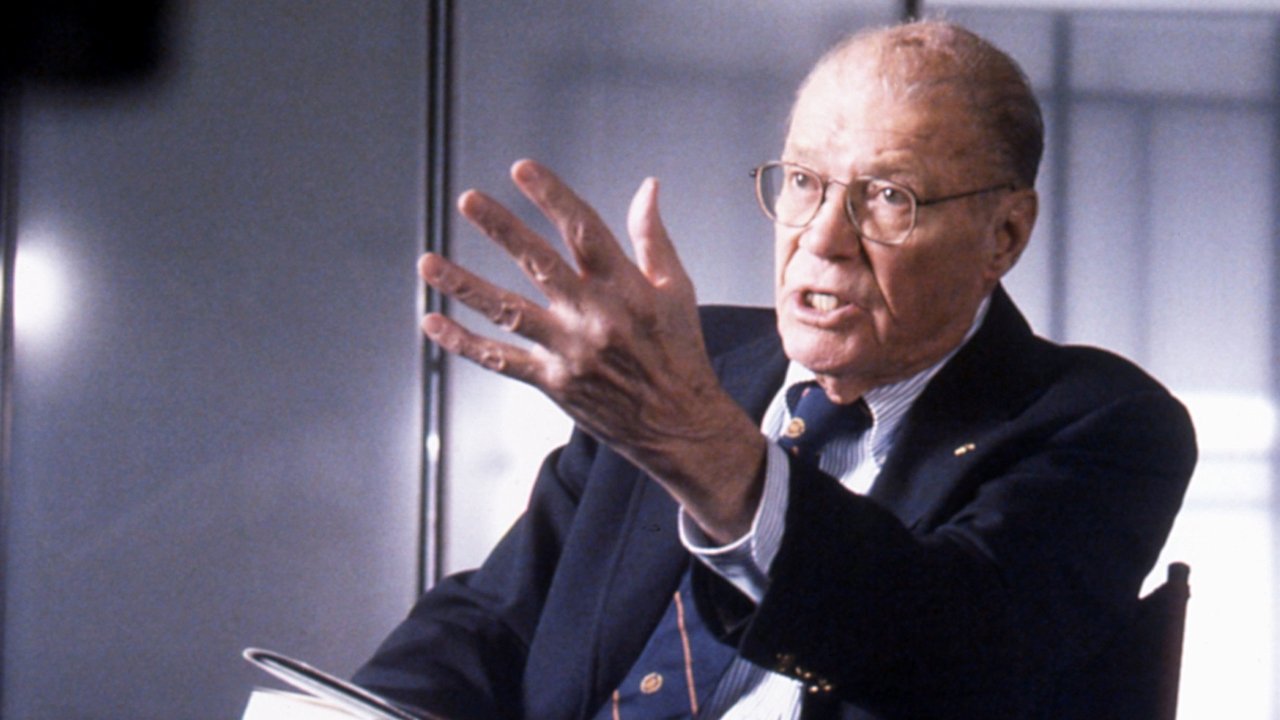
At eighty-five, Robert S. McNamara — Ford Motor Company president, Kennedy and Johnson's Secretary of Defense, architect of the Vietnam War, World Bank president — sits before Errol Morris's Interrotron camera and attempts to account for himself. Structured around eleven lessons McNamara extracts from his own career, the film is an extended study of a man who applied quantitative analysis to everything from automobile safety to firebombing campaigns, and who arrived at old age with the tools intact and the conclusions in ruins.
Robert McNamara was the first modern data-driven executive, and The Fog of War is the closest thing we have to a full accounting of what that identity costs. At Ford he was one of the whiz kids, the group of Air Force statistical-control officers who arrived after the war and found a company being run on instinct; he introduced seat belts and collapsible steering columns by counting deaths and reading actuarial tables, work that saved an enormous number of lives and that nobody at the time thought to ask for. At the Pentagon he brought operations research to the conduct of a war, and the war was subsequently run on body counts, sortie rates, kill ratios and tonnage delivered. The through-line is not ideology. It is a method, applied without hesitation to whatever domain the method was pointed at. What the film documents is what happens when a genuinely brilliant quantitative mind meets a domain that does not yield to quantification — and does not notice, for years, that it has stopped yielding. McNamara is the dashboard that can see everything except whether the war should be fought at all.
The firebombing sequence is where the film stops being a portrait and becomes an argument. Before either atomic bomb, Curtis LeMay's incendiary campaign destroyed between 50 and 90 per cent of sixty-seven Japanese cities; a single night over Tokyo killed roughly a hundred thousand civilians. McNamara's job was efficiency analysis — bomber altitude, formation, loss rates, tonnage per crew lost — and he was extremely good at it. He tells Morris that LeMay said afterwards that had they lost, they would both have been prosecuted as war criminals, and then he says, without softening it, that he thinks LeMay was right. What is unbearable about the sequence is not that the arithmetic was faulty. The arithmetic was correct. The campaign was optimised, the trade-offs were real, each calculation was defensible on its own terms. The lesson is that correct mathematics applied to the wrong question produces monstrous answers, and that nothing inside the mathematics will tell you the question is wrong. McNamara's own framing — that killing that many people was not proportional to the objective in the minds of some people — is the tell. Proportionality was never one of his variables. It could not be computed, so it was not in the model, so it did not exist until decades later, in a chair in front of a camera.
Rationality will not save us. This is the second of the eleven lessons, and it comes from the man who did more than almost anyone in the twentieth century to install rationality as an instrument of government. He arrives at it through the Cuban missile crisis: Kennedy was rational, Khrushchev was rational, Castro was rational, and rational individuals came that close to destroying their societies. The admission is not a renunciation of analysis, and it is important to be precise about this, because McNamara never stops analysing — not in the confession, not while conceding that he behaved as a war criminal, not for a single minute of the film. He answers questions the way a man reads out a report. What he has recognised instead is that the frame around the analysis determines what the analysis can see, and that no amount of rigour inside the frame compensates for a frame that excludes what matters. Empathising with the enemy, the first lesson, is not a moral improvement on measurement. It is an attempt to widen the frame — to model the adversary as someone with their own reasons rather than as a set of capabilities. In Cuba they did it, imperfectly, and survived. In Vietnam they did not do it at all, and never understood that they were fighting a war of independence rather than a front in a global system.
The form of the film carries as much of this as the content. Morris shoots through the Interrotron, a rig that puts his own projected face in front of the lens so that McNamara's eyes look directly into the camera, and therefore directly at us. We are not overhearing a confession, which is the comfortable position; we are being addressed. The effect is to convert a historical account into a question put to the viewer, and the question is not whether McNamara was culpable — he answers that himself, more than once, more plainly than his critics tend to allow. The question is whether we would have done differently with the same instruments, the same information and the same institutional pressures, holding the same sincere belief that we were being responsible. Anyone who has run an organisation on numbers, and watched those numbers become the only surface through which the organisation could perceive itself, is in the frame of the shot. Morris does not answer. He lets the eyes hold, and moves on to the next lesson.