살인의 추억
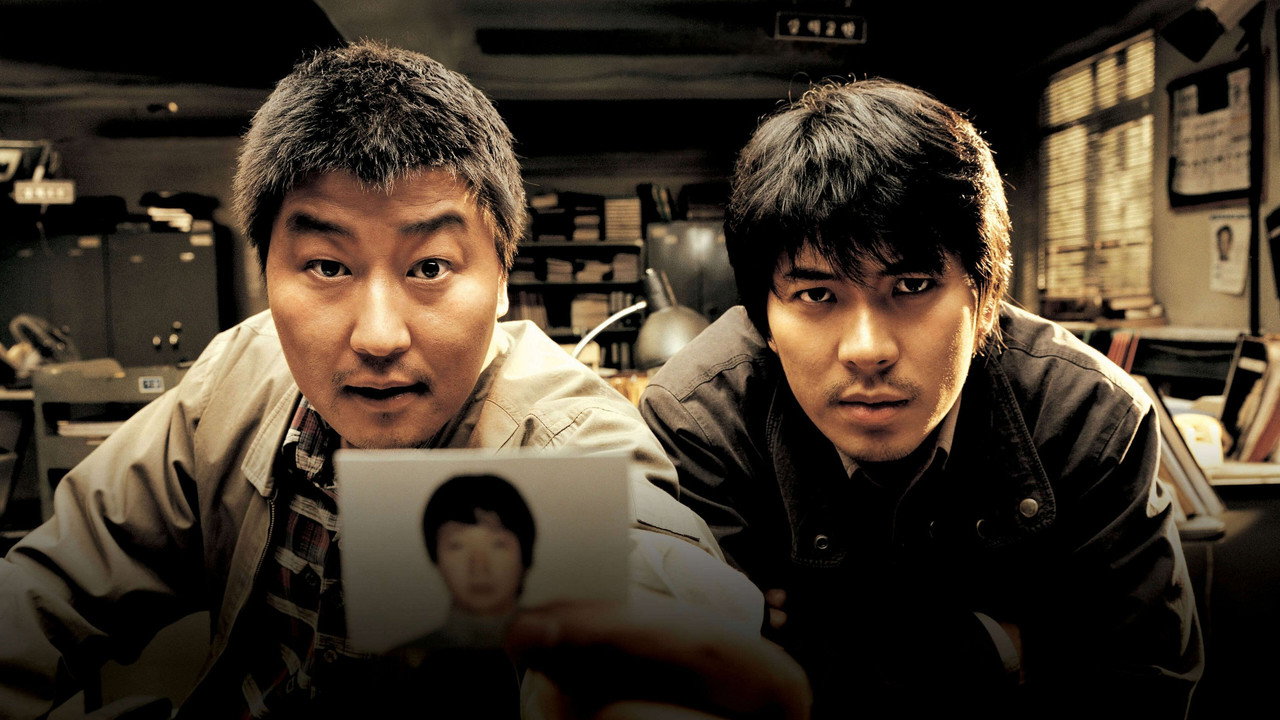
Writers: Bong Joon Ho (writer), Shim Sung-bo (writer)
Cast: Song Kang-ho, Kim Sang-kyung, Kim Roi-ha, Song Jae-ho, Byun Hee-bong, Go Seo-hee
A sadistic serial rapist and murderer of young women terrorizes a small province in 1980s South Korea. To prevent further crimes, three increasingly desperate detectives with conflicting methods race against time to unravel the violent mind of the killer in a futile effort to solve the case.
The central drama of Memories of Murder is not the murderer. It is the epistemology of the detectives. Detective Park Doo-man, the local investigator, works by intuition and coercion: he reads faces, trusts gut feeling, beats confessions out of suspects, and believes that looking into someone's eyes long enough will yield the truth. Detective Seo Tae-yoon arrives from Seoul with files, diagrams, and a methodology — he is the emissary of rational procedure, cross-referencing victimology, weather patterns, the radio programme playing on the nights of the murders. These are not just two personalities in conflict. They are two models of how knowledge is produced, and Bong Joon-ho is not kind to either of them. Park's intuition generates false positives that consume innocent men. Seo's methodology generates a profile that keeps missing. What the film understands about investigation — and about any serious analytical effort — is that the confidence of the method is independent of the accuracy of the result.
The institutional context is as important as the detective work. This is South Korea in the late 1980s, under a military government conducting anti-communist exercises that periodically requisition the investigation's resources — the forensics team is unavailable because it is being used for a civil defence drill; the national guard occupies the land around crime scenes on the same nights murders happen. The bureaucratic apparatus of the state is not hostile to the investigation, exactly; it is simply indifferent, running its own processes on its own schedule. Nobody is obstructing justice. The system is just doing what systems do: optimising for its own continuity. The murders are a local problem. The exercises are a national priority. This collision between institutional scale and individual urgency is one of the cleanest illustrations available on film of what organisations actually do to urgent decisions.
Bong also examines what happens to evidence when the infrastructure for handling it doesn't exist. The provincial police have no forensic laboratory. DNA testing requires sending samples to the United States. A result takes months. Evidence degrades, chains of custody break down, a crucial sample is returned with an inconclusive finding too late for the investigation to use it. This is not corruption — it is infrastructure failure, and it matters because the film is set at the exact historical moment when forensic science was becoming a credible investigative tool in South Korea. The detectives are caught between an old model that doesn't work (intuition and confession) and a new model that also doesn't work yet (forensic evidence without the supporting infrastructure). Anyone who has tried to introduce data-driven decision-making into an organisation that isn't yet equipped to process data will recognise the trap.
The film ends without resolution. The case was real; the murderer was not identified until DNA evidence confirmed a suspect in 2019, sixteen years after the film's release. The final shot, in which Park Doo-man stares directly into the camera, holds that irresolution as a permanent condition rather than a temporary frustration. The film refuses the consolation of retrospective clarity: the investigation failed, and nothing explains it away. It just shows you the face of someone who looked for a pattern and found nothing.