Rope
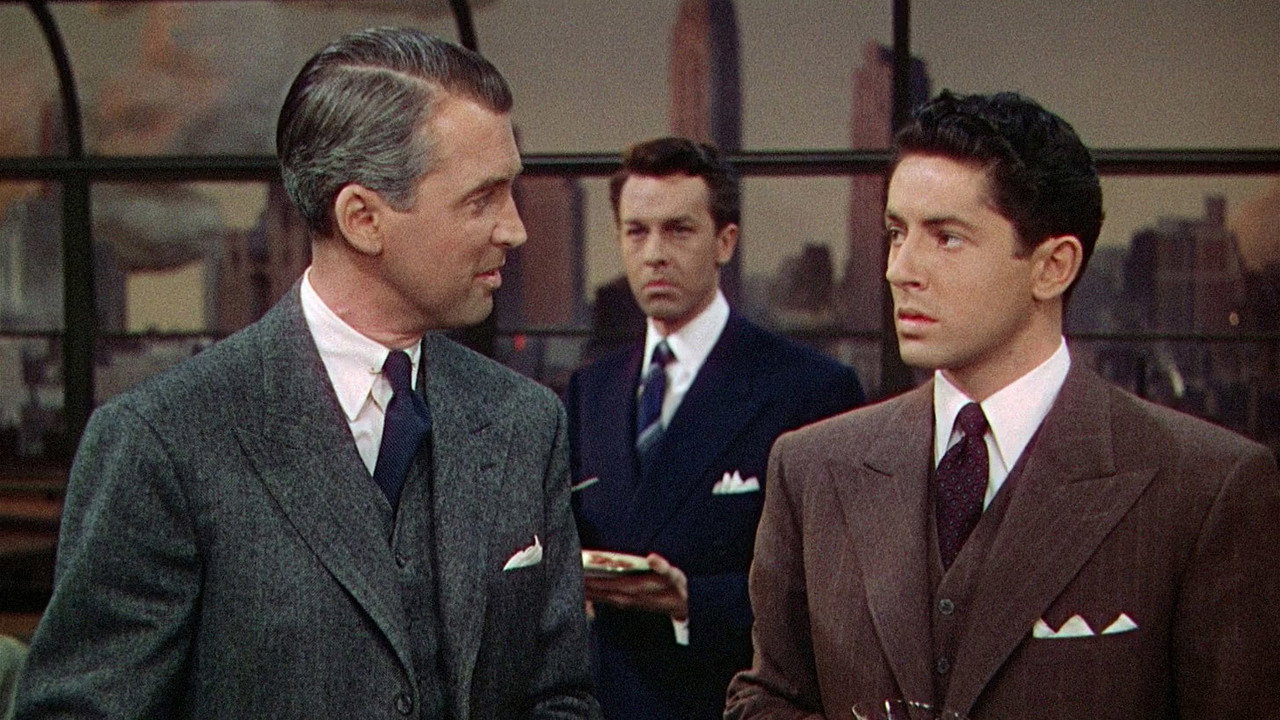
Writers: Arthur Laurents (screenplay), Hume Cronyn (adaptation)
Based on: "Rope" by Patrick Hamilton (1929) ↗
Cast: James Stewart, John Dall, Farley Granger, Cedric Hardwicke, Joan Chandler, Constance Collier, Douglas Dick, Edith Evanson, Dick Hogan
Brandon Shaw and Phillip Morgan, two young intellectuals, strangle their former classmate David Kentley in their Manhattan apartment. They place the body in a wooden chest, then host a dinner party on top of it — serving food from the chest — inviting David's father, his fiancee, and their former prep school housemaster Rupert Cadell, whose classroom lectures on Nietzsche and intellectual superiority gave them the philosophical framework they now claim justifies the act. Over the course of the evening, Rupert's suspicion grows, until he opens the chest and finds the logical conclusion of his own teaching.
Brandon kills David Kentley not because he hates him or profits from his death but because he has a theory. The theory holds that certain superior individuals exist beyond conventional morality, and that the act of murder — executed cleanly, motivated by nothing so vulgar as passion or gain — constitutes proof of that superiority. Brandon has not invented this theory himself. He has received it, in classroom form, from Rupert Cadell, the prep school housemaster who liked to lecture on Nietzsche, the superman, and the privilege of the exceptional mind. Brandon's contribution is to take the theory at its word. He murders a classmate to demonstrate a proposition, hides the body in a chest, and serves dinner on top of it, because the theory is not complete until it has been executed, and the execution is not satisfying unless it runs right up against the thing it violates. The guests eat canapés three feet from a corpse, and Brandon watches them with the pleasure of a man who has proved a theorem. What Hitchcock is describing — precisely, without editorial commentary — is the distance between a model and its implementation, and the specific kind of catastrophe that occurs when someone mistakes the model for permission.
Hitchcock's formal decision to shoot the film in what appears to be a single continuous take is not a stunt, though it was discussed as one. The technique serves the argument. A conventional film would cut away from the murder, then cut to the party, creating a structural gap between the act and its aftermath — the same gap Brandon depends on, the edit that lets the audience (and the murderer) hold the idea and the consequence in separate compartments. By refusing to cut, Hitchcock collapses that compartment. The body is in the room for every frame of the film. Every conversation happens on top of it. Every glass is poured, every joke is made, every polite enquiry about David's whereabouts — where is David, he's awfully late — takes place in unbroken visual continuity with the chest that contains him. The form of the film is the form of Brandon's situation: there is no edit available, no cut that separates what you did from what you are doing now. The camera insists on the connection that Brandon's theory was designed to sever. Brandon believes that the idea of superiority can be held separately from the dead body that proves it, and the camera demonstrates, for eighty minutes, that it cannot.
Rupert Cadell is the most uncomfortable figure in the film, and Stewart plays him with an intelligence that makes the discomfort worse. Cadell is not a villain. He is a teacher who said interesting things in a classroom and is now confronted with a student who listened. His lectures on the superman and the moral privilege of the exceptional few were ideas — provocations, dinner party material, the kind of intellectual position one can hold without ever having to test it against a corpse. Brandon tested it. You've given my words a meaning that I never dreamed of! Cadell says when he opens the chest and finds David's body, and the line contains both genuine horror and a specific kind of dishonesty. He did not dream of it, but the words dreamed of nothing else. Murder is, or should be, an art, Brandon repeats back to him, and it is a quotation, not an invention. The film's sharpest insight is that Cadell's real failure is not that he taught dangerous ideas — ideas are not dangerous in the way that guns are, and suppressing them solves nothing — but that he taught them as abstractions and then excused himself from the consequences of their concreteness. He never imagined that anyone would act on them, which is another way of saying he never took his own ideas seriously enough to consider what they would look like if they worked.
The dinner party is the structure that holds the whole thing together, and it is worth noting how precisely Hitchcock uses its conventions. The social rituals of the evening — greetings, drinks, conversation, the timing of arrivals and departures — function as a protocol that the characters follow even as the situation underneath becomes unbearable. Phillip, the weaker of the two murderers, begins to crack almost immediately; his hands shake, he drinks too much, he says things that any attentive listener would find strange. But the social protocol absorbs the signals. People do not investigate because the rules of a dinner party do not include investigating your host. David's father wonders where his son is and accepts deflection. Janet, David's fiancee, senses something wrong but lacks a framework for what it could be. The form of the gathering — polite, structured, governed by etiquette — provides cover for the content it contains, just as Brandon intended. He chose a dinner party because a dinner party is a system with its own logic, and within that logic the chest is a piece of furniture and the host's nervousness is social awkwardness and the missing guest is simply late. The system cannot see what it was not built to see.
Rupert sees through it not because he is smarter, though he is, but because he is the one person in the room who recognises the theory underneath the practice, having built it himself. He does not discover the murder through evidence. He discovers it through authorship. He opens the chest because he knows what his own ideas look like when someone takes them literally, and the recognition is the most damning verdict in the film — not on Brandon, who merely applied what he was taught, but on the teacher who built the model and assumed it would never run.