Zodiac
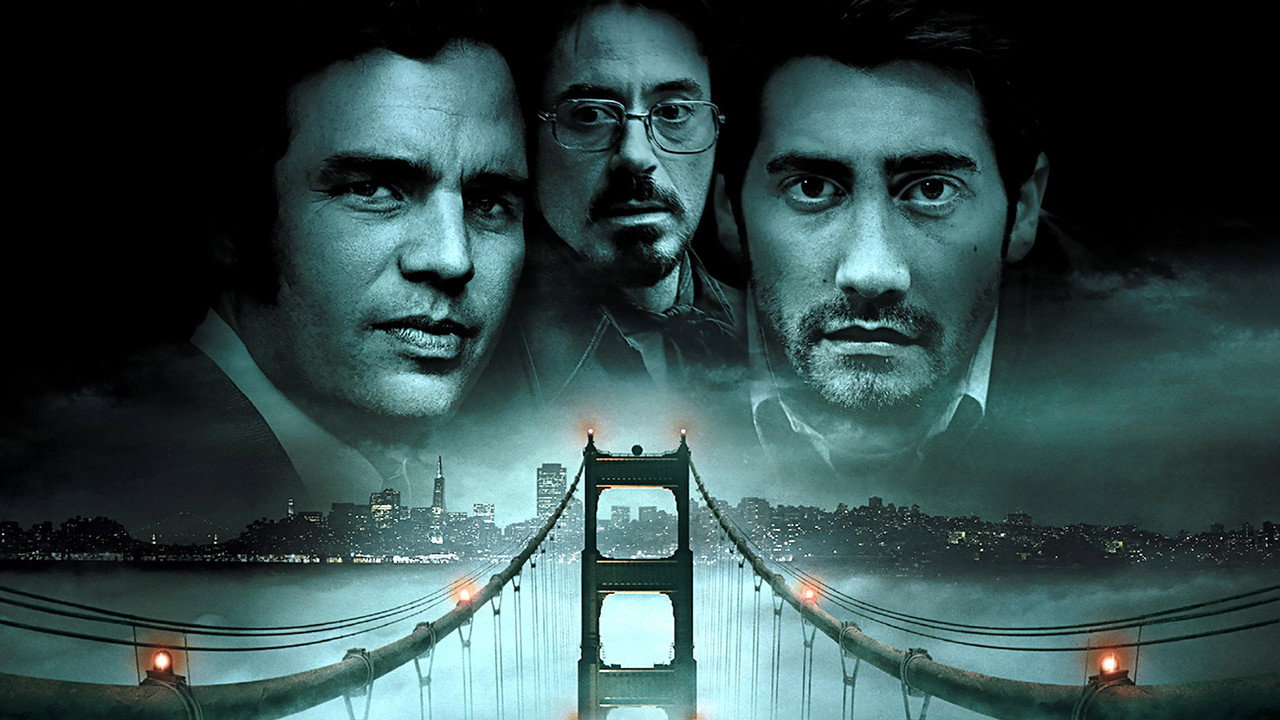
Writers: James Vanderbilt (screenplay), Robert Graysmith (books)
Cast: Jake Gyllenhaal, Robert Downey Jr., Mark Ruffalo, Anthony Edwards, Brian Cox
Between 1969 and the early 1980s, the Zodiac killer terrorises the San Francisco Bay Area with murders, cryptograms, and taunting letters to the press. Three men pursue him through different decades and from different positions — a police inspector, a newspaper reporter, and a newspaper cartoonist — and each is progressively consumed by the case. The evidence accumulates without converging. Suspects appear and recede. The investigation outlasts careers, marriages, and the institutions that housed it, and the case is never officially solved.
The film is structured as an investigation that refuses to converge, and the structure is the argument. Fincher begins with the murders — sudden, arbitrary, filmed with a flatness that drains them of the dramatic tension they would carry in a thriller — and then spends the remaining two and a half hours showing what happens when competent people try to make a pattern out of events that may not have one. The evidence arrives steadily: letters, ciphers, witness descriptions, handwriting samples, fingerprints, timelines, circumstantial links. At no point does the accumulation clarify. Each new piece of information opens more questions than it closes, introduces more candidates than it eliminates, and creates a richer and more detailed picture that is also, somehow, less decisive. The film does not withhold the answer for dramatic effect. It demonstrates, with the patience of a procedural that runs past the audience's comfort, that there may not be an answer of the kind the characters are looking for — that the space between evidence and certainty is not a gap to be closed by more work but a structural feature of the problem. Anyone who has watched a product team accumulate research that was supposed to clarify a decision and watched the decision become harder, not easier, will recognise the shape immediately. More data did not help. More data produced more ambiguity, because ambiguity was not a symptom of insufficient information but a property of the domain.
The three investigators map precisely onto three responses to this kind of problem. Inspector Toschi is the professional — methodical, bounded by procedure, aware that the case must compete for resources with every other case, and ultimately forced to stop not because he gave up but because the institution withdrew its support. His trajectory is the trajectory of any sustained effort inside an organisation: funded when the problem is visible, defunded when something more urgent appears, and never formally cancelled, just slowly starved of the attention it requires. Paul Avery is the journalist — brilliant, erratic, drawn to the case by the quality of the story rather than the obligation of the role, and the first to see that the investigation is destroying the people conducting it. His decline — from the sharpest person in the newsroom to a houseboat recluse checking his mail for letter bombs — is the decline of anyone who stayed too close to a problem that rewards engagement without ever rewarding resolution.
And Robert Graysmith is the amateur, the cartoonist who has no professional reason to be involved and whose obsession is therefore unconstrained by any institutional boundary. He cannot be reassigned because no one assigned him. He cannot be defunded because he is not funded. The cost falls entirely on his own time, his own marriage, his own mental health, and the film watches him pay it in the specific, granular currency of evenings missed, conversations not had, and a family that eventually reorganises itself around his absence. Fincher is not unsympathetic. He simply refuses to suggest that the obsession is redeemed by the outcome, because the outcome does not arrive.
What Graysmith wants — and this is the line that carries the weight of the film — is not justice and not even certainty. He wants to stand in front of the man and look him in the eye and know. Not prove, not convict, not publish: know. It is a desire for the kind of resolution that evidence cannot provide, because evidence is probabilistic and what he wants is a feeling.
The film gives him a version of this in its last act — a scene in a hardware store where he stands across the counter from Arthur Leigh Allen and the two of them look at each other and nothing happens — and the moment is devastating precisely because it delivers what he asked for and it is not enough. He cannot know. He can believe, and belief is what he has at the end, presented by Fincher without endorsement or refutation. The case file is open. The circumstantial evidence points in a direction. The direct evidence does not. And the gap between pointing in a direction and arriving at a conclusion is the gap the film is about, the gap that every model, every analysis, every carefully constructed business case leaves between what the data suggests and what the decision requires. Just because you can't prove it doesn't mean it isn't true, Graysmith says at one point, and Toschi's response — easy, Dirty Harry — is the response of someone who understands that this principle, while correct, is the end of rational investigation, not its continuation.
The genius of the film is temporal. Fincher makes you feel the years. Title cards announce dates and the jumps between them grow longer — months become years become decades — and the world changes around the investigation while the investigation does not change at all. The newsroom empties. The police department reorganises. Technology advances. Avery disappears. Toschi is transferred. And Graysmith is still in the library, still cross-referencing, still drawing lines between points on a map that do not form the shape he is looking for. The passage of time is the film's deepest argument: the case absorbs effort without transforming it into progress, and the only rational response is to stop — which is precisely what the person most invested in it cannot do. The film is a study in sunk cost experienced from the inside, without the distance that would make it a cautionary tale. It is too sympathetic for that. Graysmith is not foolish. He is thorough, he is careful, and he is wrong about what thoroughness and care can achieve in a domain where the evidence does not converge. That is not a character flaw, and Fincher's refusal to resolve it is the most honest thing about the film.