A Beautiful Mind
Writers: Akiva Goldsman (screenplay), Sylvia Nasar (book)
Cast: Russell Crowe, Jennifer Connelly, Ed Harris, Paul Bettany, Christopher Plummer, Adam Goldberg, Josh Lucas
John Forbes Nash Jr., a brilliant but socially difficult mathematics graduate student at Princeton, develops the equilibrium theory that will eventually transform economics and earn him a Nobel Prize. He is recruited by a government operative for classified codebreaking work that consumes him and begins to fracture his marriage. What emerges, slowly and with devastating structural clarity, is that some of the people and assignments that have shaped Nash's life exist only in his mind, and that the mathematical framework for rational decision-making was built by a man who could not reliably distinguish between reality and invention.
The Nash equilibrium describes a state in a game where no player can improve their outcome by changing strategy alone, given the strategies of all other players. It is one of the most important ideas in twentieth-century economics, and its consequences run through auction design, treaty negotiation, market regulation, and every domain where the decisions of rational agents interact. The man who formalised it heard voices, maintained elaborate relationships with people who did not exist, and spent years in and out of psychiatric institutions, unable to tell the difference between a pattern in the data and a pattern generated by his own malfunctioning cognition. The central irony of the film is not subtle, but it is genuinely profound: the mathematical framework for strategic rationality — the formal answer to the question what should a rational agent do? — was produced by a mind whose rationality was intermittently and catastrophically compromised. I've always believed in numbers, in the equations and logics that lead to reason. Nash believed in reason the way a person believes in something they are in danger of losing, which is to say with an intensity that was itself diagnostic.
The bar scene, which the film stages as the origin of the equilibrium concept, is worth examining for what it reveals about the gap between a model and the person who builds it. Nash watches his classmates compete for the same woman and observes that if each man pursues his individual optimum, all of them lose: the woman rejects them, and the alternatives reject them too for being second choices. Adam Smith was wrong. The best result comes from everyone in the group doing what's best for himself and the group. The insight is real, and it did transform economics — cooperation as an emergent property of self-interested strategy, provided each agent accounts for the strategies of every other agent. But look at who is having it. Nash is sitting at the table running calculations while everyone else is having a conversation. The framework for understanding strategic human interaction is being constructed by someone for whom human interaction is a problem that can only be approached formally, at a distance, with variables instead of feelings. Classes will dull your mind, destroy the potential for authentic creativity. He says this early, and it reads as arrogance, but it is also something more specific: a man who lives in his own models announcing that he prefers them to external structure, because inside the model the world behaves. Outside it, people do things he cannot predict, and prediction is the only form of safety he has.
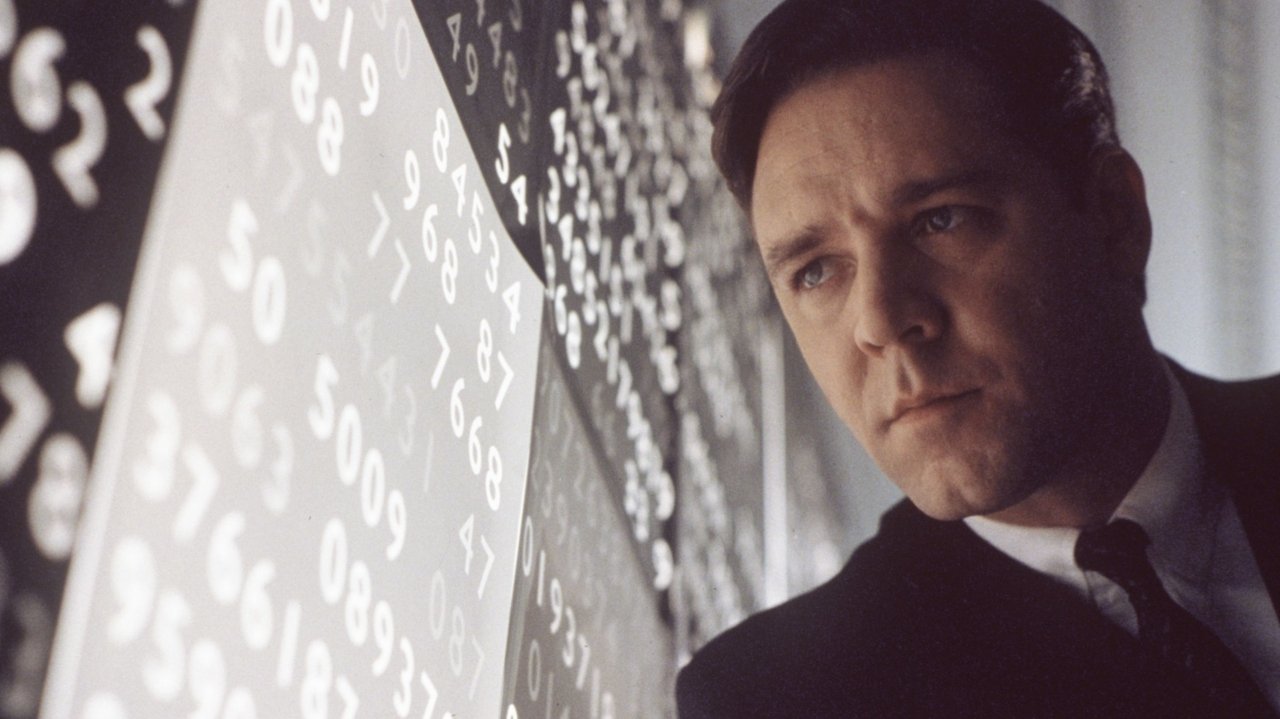
What the film does with schizophrenia is structural rather than sentimental. The hallucinations — Charles the roommate, Parcher the government handler, the little girl who never ages — are not presented as illness until the film reveals them as such, and the audience, having spent an hour inside Nash's subjective experience, discovers that it too was unable to distinguish the fabricated people from the real ones. This is the film's most serious argument, and it has nothing to do with sympathy for the mentally ill. The argument is that the cognitive process which produces genuine mathematical insight and the cognitive process which produces elaborate, internally consistent hallucinations are the same process operating on different material. Nash sees patterns in pigeons on a lawn, in the movements of rival academics, in magazine covers and newspaper columns, and some of those patterns are the foundations of game theory and some of those patterns are a conspiracy that does not exist. The mind that finds real structure in complex systems is the same mind that finds structure where there is none, and it cannot always tell the difference. Any model-building enterprise (economic forecasting, strategic planning, product roadmapping) depends on the assumption that the model-builder can reliably separate signal from noise, and Nash's life is evidence that this assumption is fragile even in the finest minds the species has produced. Find a truly original idea. It is the only way I will ever distinguish myself. The originality was real. So was the indistinguishability.
Nash's recovery, as the film tells it, is not a cure but a practice. He does not stop seeing the hallucinations. He learns to identify them and decides not to respond. I still see things that are not here. I just choose not to acknowledge them. This is a definition of rationality more useful than anything in the economics literature: not the absence of irrational inputs, but the disciplined refusal to act on them. Rationality is not a property of the mind; it is an ongoing act of the will, performed against the mind's own outputs. The Nobel speech brings the full circle into view: I've always believed in numbers, in the equations and logics that lead to reason — and then the pivot, quiet and total — it is only in the mysterious equations of love that any logic or reasons can be found. The man who built the mathematical framework for rational decision-making concludes that the framework is not sufficient, that what kept him tethered to reality when his own cognition failed was not an equation but a person. Alicia stayed. The most consequential decision Nash ever made was to trust her judgement over his own perception, and no equilibrium analysis could have produced it. The model of rational behaviour was saved by something the model has no variable for.