Contact
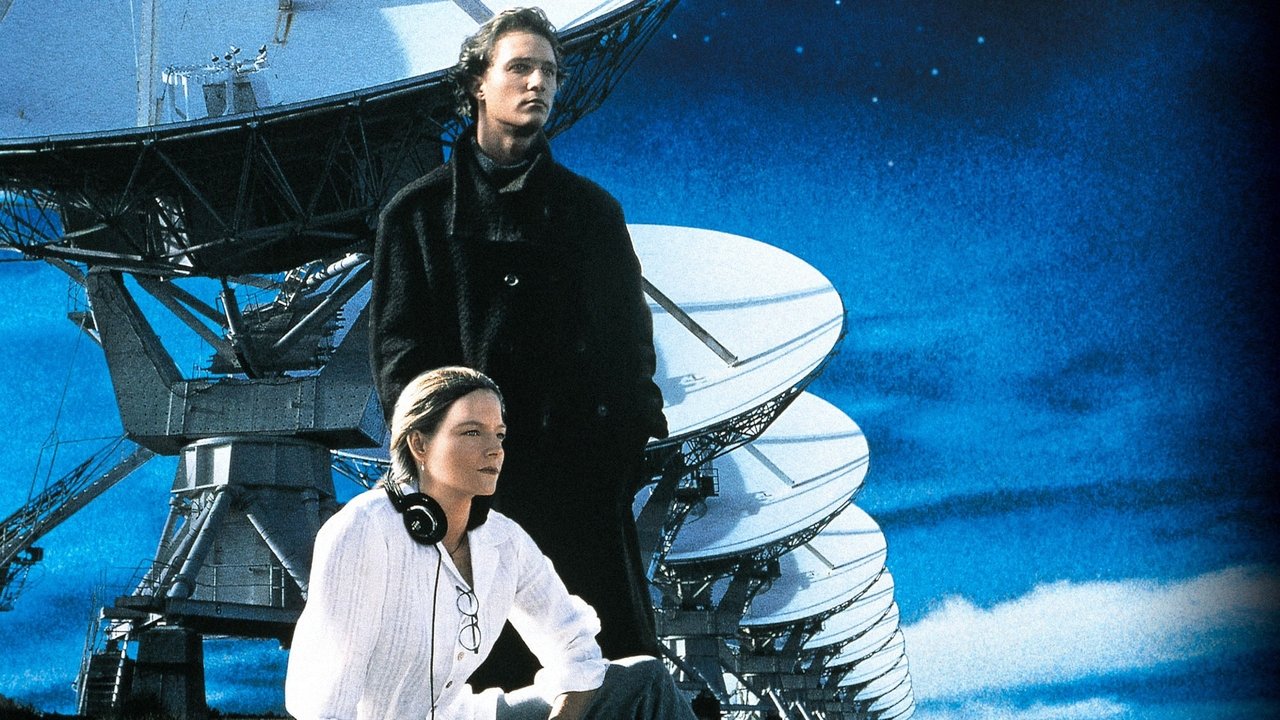
Writers: James V. Hart (screenplay), Michael Goldenberg (screenplay)
Based on: "Contact" by Carl Sagan (1985) ↗
Cast: Jodie Foster, Matthew McConaughey, James Woods, John Hurt, Tom Skerritt, Angela Bassett, David Morse
Dr. Eleanor Arroway, an astronomer who has spent her career searching for extraterrestrial signals, detects a transmission from the star Vega containing blueprints for a machine of unknown purpose. Governments, corporations, and religious institutions compete to control the project. The machine is built and Ellie travels through it, experiencing eighteen hours of contact with an intelligence that presents itself in the form of her dead father. She returns to find that from Earth's perspective, the journey lasted a fraction of a second and produced no recordable data. She is left with an experience she believes to be true and no evidence that it happened.
The signal from Vega arrives as prime numbers, and the film is precise about why this matters. Primes are the one pattern that natural processes do not produce — no star, no pulsar, no geological formation generates a sequence of numbers divisible only by themselves and one. The signal is therefore, by definition, intentional. Somebody sent it. And this is the last moment in the film when evidence and interpretation point in the same direction without ambiguity. Everything that follows — the political manoeuvring over who controls the project, the theological debate about what the signal means, the committee hearings about who should go — is the story of an unambiguous datum entering a system of institutions and being transformed, not falsified but transformed, by the interests, anxieties, and frameworks that each institution brings to it.
The signal does not change. The interpretations multiply. The military sees a weapon. The religious see a revelation. The politicians see an opportunity. The scientists see data, which is to say they see the one thing nobody else is looking at, and this turns out to be its own kind of blindness, because the data is a set of blueprints for a machine whose purpose cannot be determined by analysis. You have to build it and sit inside it and turn it on. Sagan's novel and Zemeckis's film both understand that some knowledge cannot be obtained by observation alone — it requires participation, and participation changes the observer, which means the knowledge cannot be transmitted back in the form it was received.
Ellie Arroway's journey is, structurally, the inverse of Robert McNamara's in The Fog of War. McNamara had the data — tonnage dropped, casualties counted, villages destroyed, spreadsheets extending to the horizon — and lacked the experience that would have given the data meaning. He could quantify the war completely and understand it not at all. Ellie has the experience — eighteen hours in a space that is not space, a conversation with an intelligence that presents itself wearing her dead father's face, a vision of the universe that she will spend the rest of her life failing to articulate — and returns with no data whatsoever. Her recording device captured eighteen hours of static. From the outside, the machine's pod dropped through the apparatus in a fraction of a second. There is nothing to measure, nothing to reproduce, nothing to peer-review. She cannot prove that anything happened. The congressional hearing that follows is the film's most uncomfortable sequence, because it forces Ellie to do something she has never done before: ask people to believe her. Not to examine her evidence — there is none. Not to replicate her experiment — it cannot be replicated. To take her word. The scientist who spent two decades insisting that claims require evidence is now standing on the other side of that standard, and the standard is exactly as merciless as she always said it should be.
The film does not resolve this tension, and the refusal to resolve it is the point. Palmer Joss, the theologian, has been making the same argument from the first act: that the thing people are most hungry for — meaning — is the one thing science has not been able to give them. Ellie dismissed this as a category error, and in one sense she was right — science describes mechanisms, not purposes, and asking it for meaning is like asking a thermometer for advice. But what happens to her inside the machine is precisely the category error she rejected: an experience that is meaningful, transformative, and evidentially void. She comes back different and cannot show her work. When she tells the hearing that she had an experience she cannot prove, cannot even explain, but that everything she knows as a human being tells her it was real, she is making a statement that is formally identical to a statement of faith. She knows this. The film knows she knows this. And the point is not that science and religion are the same — they are not — but that any epistemology eventually encounters a boundary where its methods stop working and the only remaining option is to either stay silent or speak from a position it cannot justify by its own rules. Ellie chooses to speak. The film suggests that this is what honesty looks like at the edge of a framework.
There is a line she delivers on the beach of that other place, whoever's beach it is, that functions as the film's quiet thesis. They should have sent a poet. It is usually read as wonder, and it is wonder, but it is also a precise admission of professional inadequacy. Ellie is a scientist, which means she is someone trained to decompose experience into components that can be measured, recorded, and communicated to others in a form they can independently verify. And she has just encountered something that cannot be decomposed. The components are there — light, geometry, a presence — but the meaning is in the composition, not the parts, and composition is what poets do, not physicists. The film's deepest claim is lodged in that sentence: that there exist phenomena whose nature is destroyed by the act of analysis, and that a civilisation built on the premise that everything worth knowing can be analysed will periodically run into something important and find itself without the language to say what it saw. Ellie does not lose her commitment to science. She gains an awareness of where it stops, and the awareness costs her nearly everything — her credibility, her career, her certainty — because the institution she belongs to has no procedure for a member who returns from the field and says: I found something real, and I cannot show it to you.