Pressure
Writers: David Haig (theatre play), David Haig (writer), Anthony Maras (writer)
Based on: "Pressure" by David Haig (2014) ↗
Cast: Andrew Scott, Brendan Fraser, Kerry Condon, Chris Messina, Damian Lewis, Tamsin Topolski
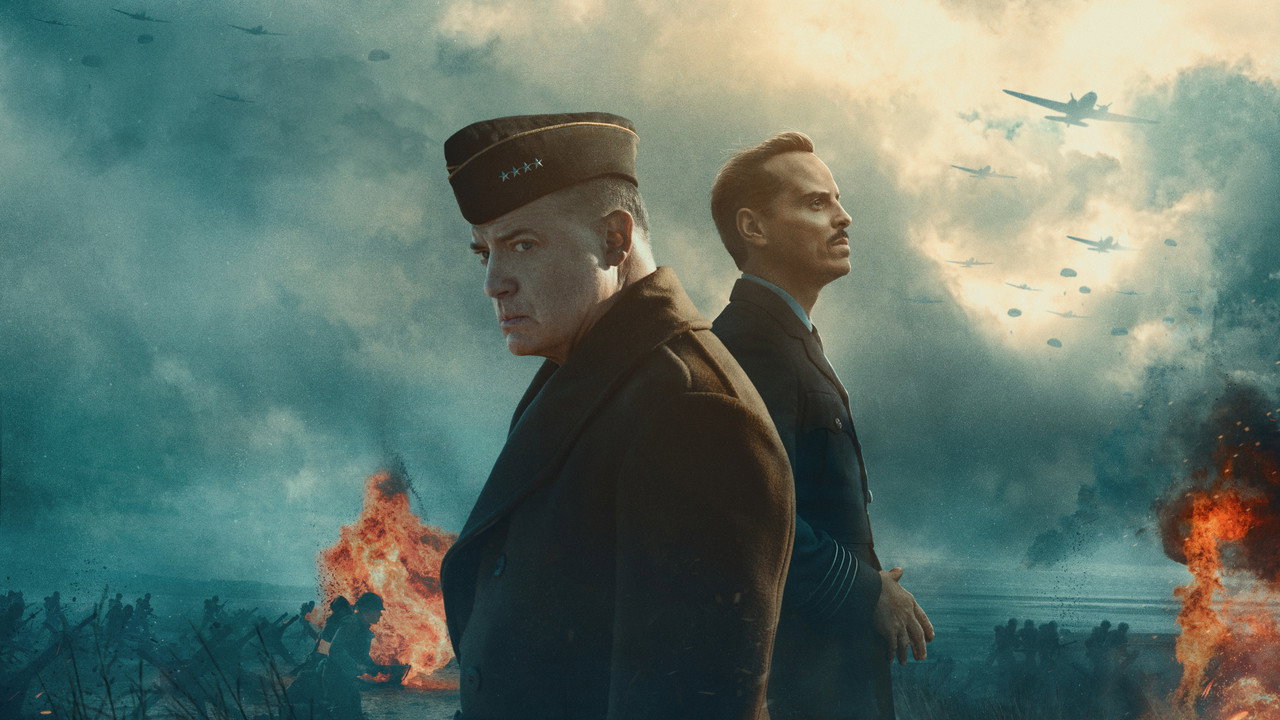
In the tense 72 hours before D-Day, and the fate of the free world hanging in the balance, General Dwight D. Eisenhower and Captain James Stagg face an impossible choice—launch the largest and most dangerous seaborne invasion in history or risk losing the war altogether.
The decision Eisenhower makes on the night of 4 June 1944 is not a military decision in any straightforward sense. It is an epistemological one. Captain James Stagg, the Scottish meteorologist who stands between the Supreme Commander and a forecast nobody fully trusts, is not telling Eisenhower what will happen. He is telling him the probability distribution of what might happen, hedged against the limits of 1944 atmospheric modelling, disagreeing forecasting teams, and instruments that cannot see far enough west. The drama that David Haig's play constructs — and that Anthony Maras's film preserves — is the drama of communicating uncertainty upward through a command structure that has been designed to receive certainty. Generals need answers. Stagg has confidence intervals. The gap between those two things is where the film lives.
What Pressure understands about organisations is that the hierarchy does not merely receive decisions — it shapes what counts as a decision in the first place. Eisenhower's staff, his allied commanders, his political superiors are all exerting pressure not only on the timing of the invasion but on the form in which information must be presented. Stagg's meteorological colleagues cannot agree among themselves, which is professionally honest but institutionally unacceptable. The film watches him translate genuine scientific disagreement into something an organisation can act on, and the translation involves loss. Every time a probabilistic judgment becomes a briefing-room sentence, something real is discarded. This is not a failure of Stagg's character; it is the structural tax that institutions levy on expertise when they need it to cross the threshold between analysis and command.
For anyone directing digital products, the film functions as a precise diagnostic of a problem that recurs in every roadmap season: the model is never as confident as the slide deck implies. Stagg's weather window — a narrow band of tolerable conditions visible only because one forecasting approach caught something the others missed — is structurally identical to every product decision made on incomplete data under institutional time pressure. The temptation is to round up, to present the range as a point estimate, to give the commander what he needs rather than what the data supports. Pressure shows what happens when someone refuses to do that, and also what it costs them to refuse. Stagg does not become a hero by giving Eisenhower the right answer. He becomes one by insisting that the uncertainty itself is the answer, and letting Eisenhower bear the weight of deciding what to do with it.
The film's tonal control is what earns it a place in the collection alongside Fail Safe and Eye in the Sky — films where the tension is not whether something explodes but whether the decision-making apparatus will hold under the strain of its own design. Andrew Scott plays Stagg as a man who understands that his authority is entirely epistemic: he has no rank that matters, no political capital, no leverage except the quality of his reasoning. That is an unusual kind of power to render dramatically compelling, and the film manages it because it treats the forecast — the model, the method, the argument about what the data means — as the actual subject, not the backdrop.