Tenet
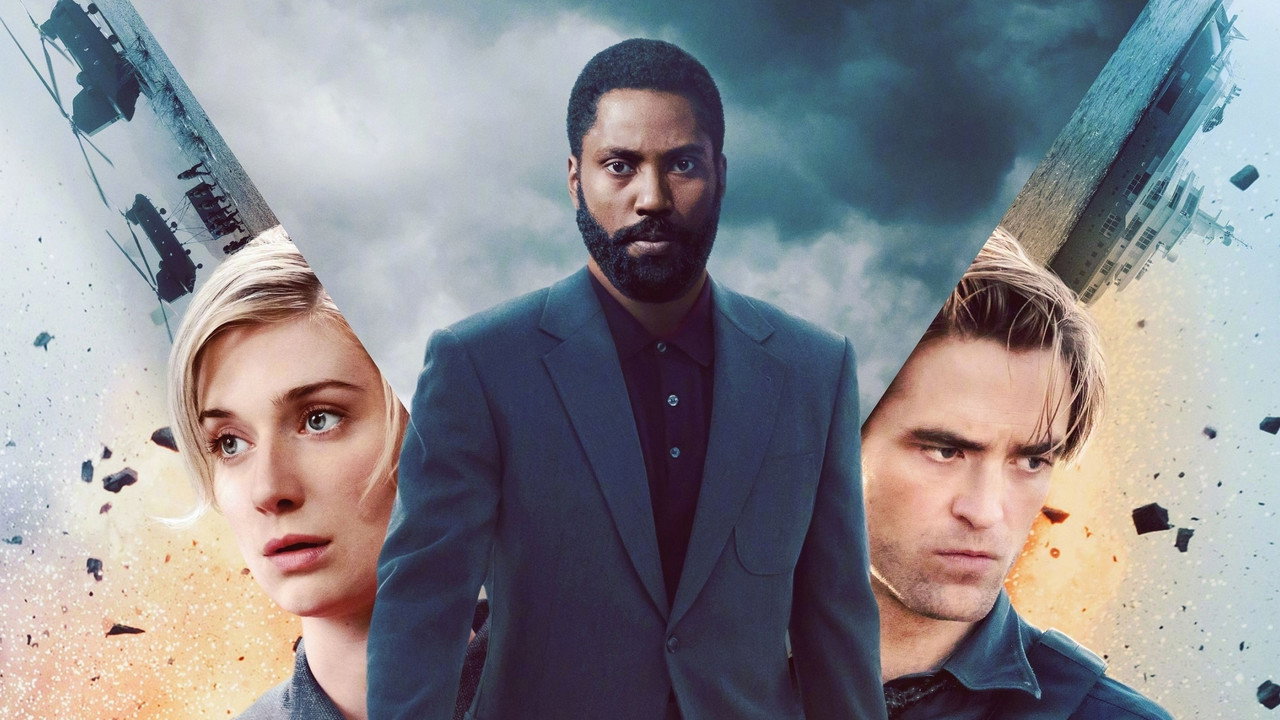
Writers: Christopher Nolan (written by)
Cast: John David Washington, Robert Pattinson, Elizabeth Debicki, Kenneth Branagh, Dimple Kapadia, Michael Caine, Martin Donovan
A CIA operative known only as the Protagonist survives a test of loyalty and is recruited into a secret organisation called Tenet, whose mission concerns a threat more fundamental than nuclear war: the future is sending objects and weapons backward through time, and someone in the present is assembling them. As the Protagonist traces the trail through Mumbai, the Amalfi Coast, Tallinn, and Oslo, he discovers that the mechanics of the operation run in both temporal directions simultaneously, and that success requires him to execute plans he cannot fully understand because the information that would explain them has not happened yet.
Most espionage films ask their protagonist to acquire information. Tenet asks its protagonist to operate without it. The Protagonist — unnamed, because naming would imply a stable identity that the film's structure works against — is recruited into a mission he cannot fully understand, given instructions that are deliberately incomplete, and told to execute an operation whose logic will only become visible after it has already been carried out. Ignorance is our ammunition. This is not a line about humility. It is a design constraint. The mission works precisely because its operators do not know what they are doing; if they understood it, their behaviour would change, and the future that depends on their behaviour would change with it. Nolan has built an action film around a problem that belongs to distributed systems design: how do you coordinate agents who cannot share information without corrupting the operation the information describes? The answer the film arrives at is that you do not coordinate them at all. You give each agent a fragment, ensure that no fragment is sufficient to reconstruct the whole, and trust that the pattern will assemble itself when the fragments are executed in sequence — a sequence that, in this case, runs in two temporal directions at once.
The mechanism the film introduces — temporal inversion, in which objects and eventually people move backward through time while the rest of the world moves forward — is science fiction, but the decision-making problem it creates is not. The Protagonist must act on information that is, from his temporal perspective, from the future: consequences he has already observed but whose causes he has not yet initiated. What's happened, happened. Neil says this more than once, and it is the film's most unsettling philosophical claim, because it does not merely describe determinism; it describes a world in which cause and effect are directional properties of the observer rather than of reality. From the forward-moving perspective, the car chase in Tallinn is a sequence of choices. From the inverted perspective, the same events are the inevitable unfolding of a pattern that was already completed before it began. Both perspectives are true simultaneously, and neither is sufficient on its own. Nolan stages this literally: the same scene is shown twice, once from each direction, and the second viewing does not clarify the first so much as reveal that clarity was never available, because the information needed to understand the scene from one direction exists only in the other direction. Don't try to understand it. Feel it. The scientist who says this is not being evasive. She is stating the operational limit of cognition in a system where linear causality does not hold.
The film has been criticised for being difficult to follow, and the criticism is correct, and it misidentifies what it is criticising. Tenet is not a puzzle with a solution the audience is expected to assemble. It is a formal demonstration that some operations cannot be understood by any single participant, including the audience. The temporal pincer movement — the film's climactic tactical manoeuvre, in which one team advances forward through the battle while a second team, inverted, advances backward through the same battle, and the two teams exchange information at a midpoint that each experiences at a different moment — is not confusing because Nolan failed to explain it. It is confusing because the manoeuvre itself exceeds the representational capacity of a linear narrative, just as it exceeds the cognitive capacity of any single operator within it. No one in the film understands the full operation. The forward team sees consequences without causes; the inverted team sees causes without consequences. The coordination works not because someone at the top has the complete picture but because the protocol was designed so that the complete picture is unnecessary. This is the structure of every large-scale operation that actually works, from distributed databases to military logistics to open-source software development: no single node holds the whole state, and the system's coherence is a property of the protocol, not of any participant's understanding.
And then there is Neil, who knows more than anyone and says the least. At the end, he reveals to the Protagonist that they have known each other for years — years the Protagonist has not yet lived, years that are in Neil's past and the Protagonist's future. We live in a twilight world. And there are no friends at dusk. The passphrase recurs throughout the film, and its meaning shifts each time: first a test of allegiance, then a statement of loneliness, finally an epitaph. Neil walks back into the battle knowing that he will die, because he has already seen the lock picked from the other side of the door and recognised his own charm hanging from the dead man's pack. His decision is not a sacrifice in the ordinary sense. It is the completion of a causal loop he has no power to break, and his freedom — the only freedom the film's physics permits — is the freedom to accept it with open eyes. What's happened, happened. The line that sounded like resignation is, in the end, the statement of an agent who has achieved the only form of understanding available in a system where information flows in both directions: not the understanding of why, but the understanding that why is a question that belongs to one temporal direction and cannot be answered from the other.
Nolan has made an action film about the limits of knowledge, and the limits hold. The audience leaves the cinema having experienced, rather than understood, a system too complex for any single observer. That is, for once, not a failure of storytelling. It is the story.