Interstellar
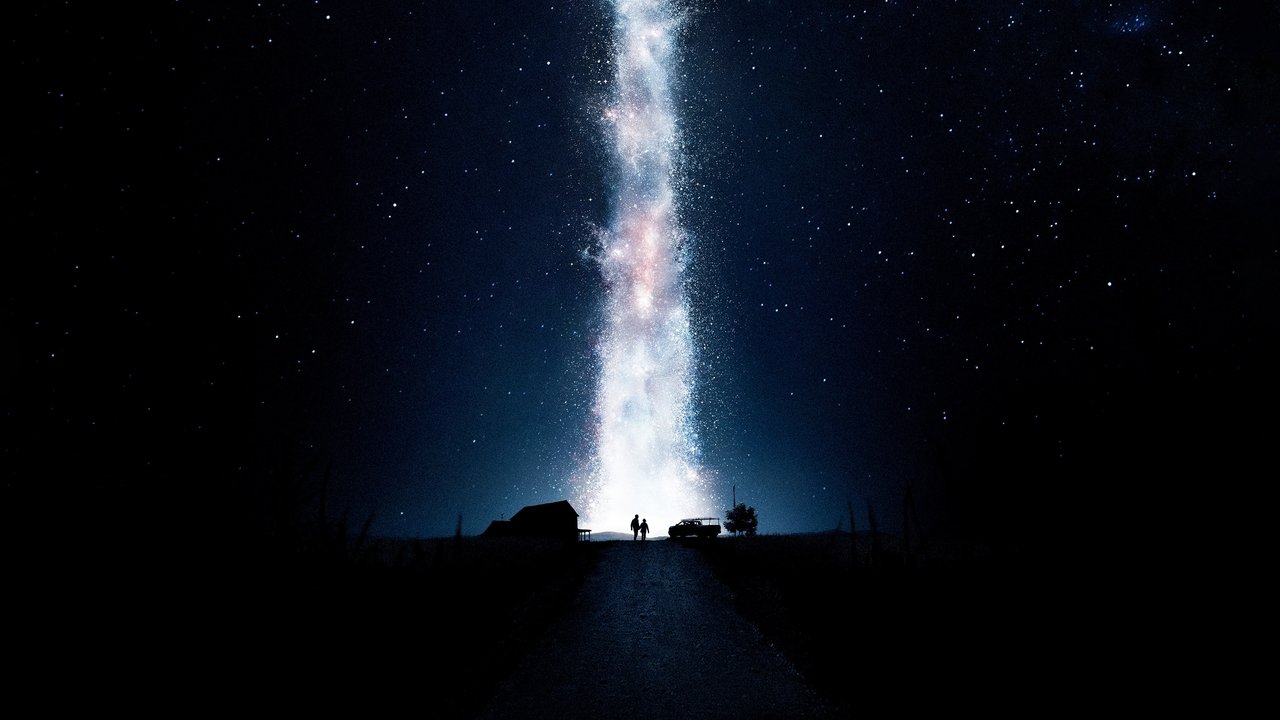
Writers: Jonathan Nolan (screenplay), Christopher Nolan (screenplay)
Cast: Matthew McConaughey, Anne Hathaway, Jessica Chastain, Michael Caine, Matt Damon, Mackenzie Foy
Earth's crops are failing and dust storms are burying civilisation. Cooper, a former NASA pilot turned farmer, is recruited for a last-chance mission through a wormhole near Saturn to evaluate three potentially habitable planets identified by earlier scouts. The mission is designed by Professor Brand, who has spent decades working on a gravity equation that would allow humanity to leave Earth — an equation he has already proved unsolvable. Brand sends the crew anyway, because the mission has a second, secret plan: if the equation fails, the ship carries a population bomb of frozen embryos to seed a new colony, and the crew will never go home.
Professor Brand's lie is the centre of the film, and it is worth taking apart because it is not a simple deception. Brand has spent decades working on an equation that would allow humanity to manipulate gravity well enough to lift a viable population off a dying Earth. At some point — it is never specified exactly when — he proved to himself that the equation cannot be solved without data from inside a black hole, data that cannot be obtained and transmitted by any known means. He continues working. He continues recruiting. He continues sending people through the wormhole to evaluate planets. He does all of this knowing that the mission's stated purpose — saving the people on Earth — is impossible under the physics as he understands them. The mission's actual purpose, the one he does not disclose, is Plan B: a cargo of frozen embryos that the crew will raise on whatever habitable planet they find, seeding a new human colony while the old one dies. Brand tells no one because if the crew knew, they would not go. This is the management problem at the centre of every project that depends on people doing something they would not do if they understood the full picture.
The film distributes this problem across every relationship. Cooper leaves his daughter to save humanity, and the leaving works only because he believes he is coming back. Murph, the daughter, spends decades angry at her father for leaving, and the anger compounds when she discovers Brand's lie: he knew the equation could not be solved, yet he still sent them. Her fury is not about the physics. It is about the information asymmetry. She was a child when her father left, and the decision that shaped her entire life was made on the basis of a model that the person who built the model knew to be wrong. Every child of a leader who made a hard call has some version of this feeling, but the film makes it precise by tying it to an actual equation — a falsifiable claim that was falsified and then suppressed because the falsification would have collapsed the mission.
Meanwhile, on the other side of the wormhole, the crew encounters Mann, an earlier scout who faked his planet's data to trigger a rescue, because he could not face dying alone. Mann's lie is smaller and more selfish than Brand's, but it has the same structure: a person with unique information about conditions on the ground chose to transmit false data because the true data would have produced an outcome they could not accept. The film sets these two deceptions in parallel — the idealist who lies to save the species and the coward who lies to save himself — and asks whether the structural difference matters.
Time is the resource the film is actually about, and Nolan uses the physics of general relativity to make the cost legible. When Cooper lands on the first planet, which orbits close to a black hole, every hour on the surface corresponds to seven years on Earth. He spends three hours investigating a planet that turns out to be uninhabitable, and when he returns to the ship, twenty-three years of messages from his children are waiting. He watches his daughter grow up in a compressed playback, and the scene works because it makes the cost of a wrong decision visible in the one currency that cannot be recovered. Time dilation is the film's mechanism for expressing what every wrong strategic bet costs an organisation: not money, which can be raised again, but time, which moves in one direction and whose loss is absolute. The planet was a bad bet. The data suggested otherwise. The data was sparse and the conditions were unprecedented and the decision had to be made under pressure, and three hours of exploration consumed twenty-three years of life on the other side of the ledger. This is the shape of high-stakes decisions under uncertainty — not that you lack information, but that the cost of gathering enough information to decide well may exceed the cost of deciding badly, and you cannot know which until after you have spent the time.
Cooper's final transmission of the data from inside the black hole — through the mechanism the film constructs involving gravity and a bookshelf and Morse code across time — is narratively improbable and thematically precise. The equation that Brand declared unsolvable required data from inside a singularity. Cooper falls into one, survives by means the film does not try to explain in conventional physics, and manages to encode the data in a form his daughter can receive decades earlier. The point is not the plausibility. The point is that the information bottleneck — the specific piece of knowledge that the entire project depended on and that the project leader had declared unobtainable — turned out to be obtainable by a method no one in the planning phase could have modelled. Brand's lie was built on a correct assessment of the known physics and a failure to account for the possibility that someone inside the system might encounter conditions that the model did not anticipate. The equation was unsolvable given the information available at the time of the decision. It was not unsolvable in absolute terms. This is the difference between a conclusion and a forecast, and every project that was cancelled because someone proved it could not work has a version of this gap: the proof was valid within the model, and the model was not the world.