Fail Safe
Writers: Walter Bernstein (screenplay), Eugene Burdick (novel), Harvey Wheeler (novel)
Based on: "Fail-Safe" by Eugene Burdick and Harvey Wheeler (1962) ↗
Cast: Henry Fonda, Dan O'Herlihy, Walter Matthau, Frank Overton, Larry Hagman, Fritz Weaver, Edward Binns
A mechanical failure in the Strategic Air Command's electronic defence system sends a squadron of nuclear bombers past their fail-safe point toward Moscow. The system was designed so that once the bombers cross that line, no recall signal can reach them — the aircraft are built to treat any subsequent communication as Soviet jamming. In the War Room, the President of the United States works the phone to the Soviet Premier, exhausting every option, while Professor Groeteschele argues that the accident should be exploited as a first strike. When it becomes clear that Moscow will be destroyed and nothing can prevent it, the President proposes the only act that might prevent total retaliation: ordering an American bomber to destroy New York City.
Fail Safe arrived in 1964, the same year as Dr. Strangelove, treating the same source material — a mechanical error that sends nuclear bombers past the point of no return — and asking the same structural question: what happens when a system designed to be irreversible encounters a situation that demands reversal? Kubrick's answer was satire, a War Room full of men more dangerous than the bomb they are trying to stop. Lumet's answer is worse, because it is entirely sincere. Nobody in Fail Safe is insane, ideological, or incompetent. The President is thoughtful and humane. General Bogan runs a clean operation. General Black understands exactly what is at stake. The system does not fail because anyone fails. It fails because a condenser blows in a piece of equipment, and the architecture that was built to guarantee response — to remove hesitation and ambiguity from the chain of command in a real emergency — cannot distinguish a condenser failure from a Soviet first strike. The bombers cross the fail-safe line. They switch to attack protocol. They treat every subsequent transmission as enemy jamming. These are design specifications, not malfunctions. Every decision that created this vulnerability was made by a sober person solving a legitimate problem: how do you ensure retaliation survives a decapitation strike? The answer was to remove human judgement after a certain threshold. What nobody modelled was the threshold being crossed by accident, because the whole purpose of the architecture was to make crossing it automatic.
Professor Groeteschele is the film's most unsettling figure, not because he is wrong but because he is internally consistent. Walter Matthau plays him as a man whose logic is impeccable within the frame he has constructed, and the frame says: nations are systems, systems are governed by incentives, and the rational move when your bombers are already in the air is to send the rest and win the exchange at acceptable cost. He arrives at monstrous conclusions through a clean chain of inference, and the film does not waste time making him a villain. He is simply a person who has internalised the system's own assumptions about the world and followed them further than anyone else is willing to go. Every organisation has someone like this — someone who says the quiet part of the strategy out loud. Groeteschele is not aberrant. He is a product of the reasoning that built the fail-safe mechanism in the first place: the conviction that speed, certainty and the removal of sentiment from decision-making are what separate a functioning defence from a dead one. He draws the same line everyone else drew, he simply continues it.
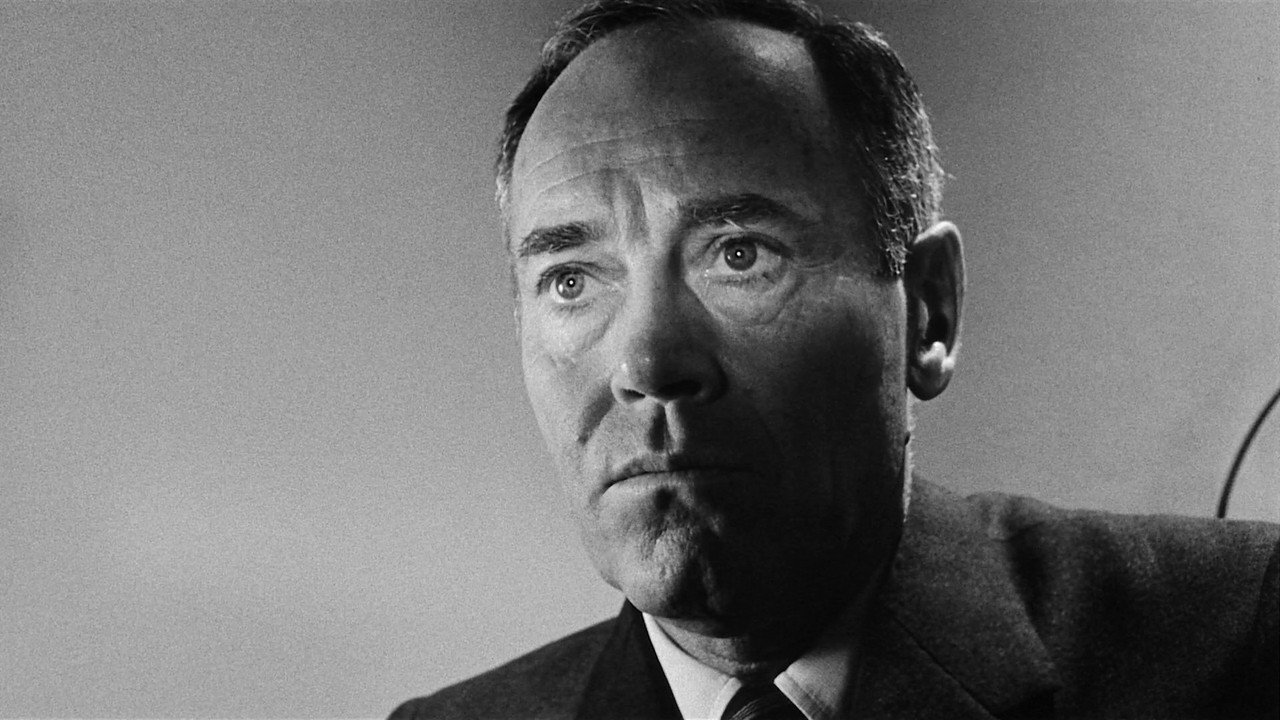
The President's decision — to order an American bomber to destroy New York City as proof to the Soviets that Moscow's destruction was an accident, not policy — is the moment the film becomes something more than a Cold War thriller. Henry Fonda plays the scene on the telephone, alone, and what makes it devastating is that the logic is correct. There is no other move. If Moscow is destroyed and America does nothing, the Soviets must assume it was deliberate, and the full exchange follows. The only signal credible enough to stop it is a sacrifice so enormous that no strategic calculation could justify it. The President has to prove that the system acted on its own, that no one chose this, and the only proof available is to suffer an equivalent loss voluntarily. This is the structural claim of the film: the system built to prevent catastrophe has produced a situation where the only human intervention left is to match one catastrophe with another. The President is not deciding to destroy New York. He is recognising that the system has already decided, and his only remaining agency is over the distribution of the damage.
What makes Fail Safe more disturbing than Strangelove — despite being less famous, less quotable, and nowhere near as entertaining — is the temperature at which it operates. There is no comedy here, no Dr. Strangelove lurching to his feet, no Slim Pickens riding a warhead. There is a room full of reasonable people processing the implications of a mechanical error through a system that was specifically designed to prevent them from doing anything about it. General Black, who has spent the film as the voice of conscience, is the one who flies the mission to New York, because the President asks him to and there is nobody else. The film ends with a still photograph — people on the streets of New York, frozen — and says nothing more. Lumet understood that the real horror of an automated catastrophe is not the catastrophe itself but its banality: the cascade of reasonable responses to an unreasonable situation, each one narrowing the options further, each one executed competently, until the last available action is the one that no one would have chosen if they had been choosing at all. What nobody designed was a way back, because the whole point of the mechanism was that there should not be one.