Safety Last!
Writers: Hal Roach (story), Sam Taylor (story), Tim Whelan (story)
Cast: Harold Lloyd, Mildred Davis, Bill Strother, Noah Young, Westcott Clarke
A young man leaves his small town for the city, promising to send for his sweetheart once he has made good. He does not make good: he is a fabric clerk in a department store, sharing a room he cannot afford, writing letters home that imply an executive career and buying her a pendant with money he does not have. When she arrives unannounced, the performance has to be sustained in person — and when he overhears the general manager offer a thousand dollars for any idea that would draw a crowd to the store, he proposes that his friend, a professional building climber, scale the twelve-storey facade. On the morning of the stunt his friend is unavailable, the crowd has already gathered, and there is nobody else to climb.
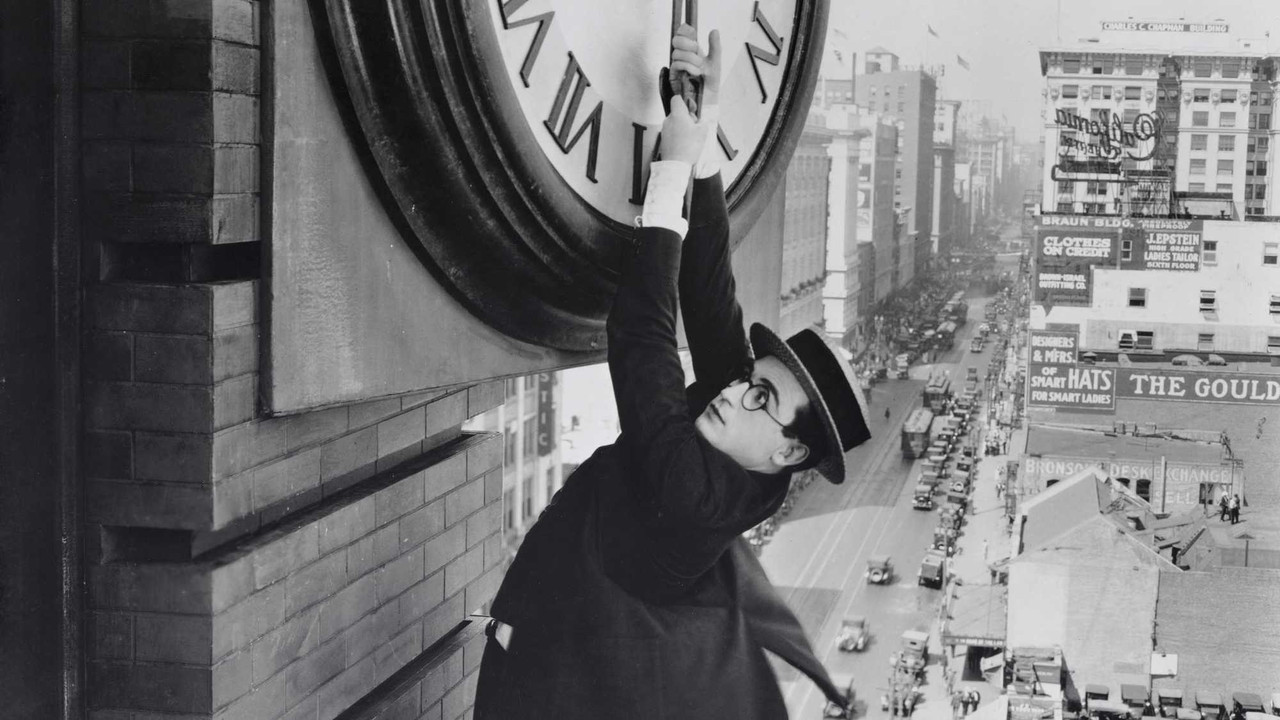
The most famous image in silent cinema is a man hanging from a clock face twelve floors above Los Angeles, and it is usually remembered as a stunt. It is better understood as the last step in a chain of small, reasonable decisions. The film opens with a young man who has told his girlfriend he is doing well, which is not true, and who must now keep telling her — she's just got to believe that I'm successful, until I am, he explains to his roommate, and the qualifier is the whole argument. The lie is provisional. It is a bridge to a future state in which it will retroactively become accurate. So the letters go out on every day of the week, the pendant is bought on credit, the fabric clerk describes himself as a general manager, and each individual act of maintenance is cheap while the accumulated position becomes more expensive to abandon. Anyone who has watched a status report drift from the state of the work knows the mechanism precisely. The first optimistic report costs nothing, because it will be true next week. The problem is that the gap does not close on its own, and the reporting has to keep pace with the story rather than with the system, until the only remaining option is to make the story come true by extraordinary means.
The extraordinary means arrive as an incentive. The general manager, in one line, offers a thousand dollars to anyone with an idea that will draw an enormous crowd to the store. It is a perfectly ordinary piece of management: a bounty, scoped to an outcome, open to all comers, with no specification of method. And it produces exactly what such bounties produce. The winning proposal is not the best idea but the one most willing to convert risk into spectacle, and the risk in question does not sit with the person collecting the money. The boy's plan is to pay his friend Bill, a genuine building climber, to do the climbing; Bill's line about climbing to heaven for five hundred dollars and hanging by his heels from the pearly gates is the entire economics of contracted danger stated as a joke. Nobody in this arrangement is behaving badly. The manager wants footfall, the clerk wants a thousand dollars, the climber wants to be paid for the one thing he can do. What the structure guarantees is that the physical exposure ends up furthest from the decision, distributed to whoever has least leverage to refuse it — and the film's plot is simply the discovery of who that turns out to be.
Then the substitution fails. Bill is being pursued by a policeman he has previously humiliated, the crowd is already assembled, the store is committed, and the boy starts climbing on the understanding that he will do one floor and hand over at the second. He does not hand over at the second, or the fifth, or the ninth, because at every floor the same calculation returns the same answer: continuing is cheaper than the collapse that stopping would produce. This is the shape the film has bequeathed to everyone who has ever shipped a temporary measure. The workaround that goes in on a Friday to hold a launch together, the manual step someone performs each month because automating it was never scheduled, the schema hack that exists to avoid one migration and is now depended on by four services — none of them was ever meant to be permanent, and none of them is ever the most urgent thing to remove. Harold on the clock is that arrangement made visible: a man far above the ground, holding a minute hand, with a crowd below whose expectation is now part of the load-bearing structure, and no floor at which the sensible decision is to climb back down. His panic is not irrational. The plan really was temporary. It simply never had a defined end.
What keeps this from being a fable is that the risk was partly real. Lloyd's crews built sets on the roofs of actual downtown buildings so the drop behind him was genuine, with a platform placed below the frame that would have caught a fall from a few feet and nothing more; the height in the shot is the height that was there. He was also climbing with a prosthetic glove, having lost his right thumb and forefinger to a prop bomb four years earlier — a detail invisible on screen and inseparable from what the image is worth. The scene endures because the exposure was not entirely simulated, which is the honest and uncomfortable economics of spectacle: the audience's pleasure and the performer's danger are the same event, and the first cannot be manufactured without some quantity of the second. The modern version is the demo that works because two people are holding it together outside the frame, and the launch date that holds because a team absorbed the difference privately. The film ends by rewarding him. He gets the money, he gets the girl, the store gets its crowd, and the improvisation is retrospectively ratified as strategy. That is why the shape keeps recurring. It worked.