Peter Drucker: the knowledge worker cannot be supervised
Drucker wanted for knowledge work what Taylor achieved for manual work, by the opposite method. AI agents reopen the question he left unanswered.
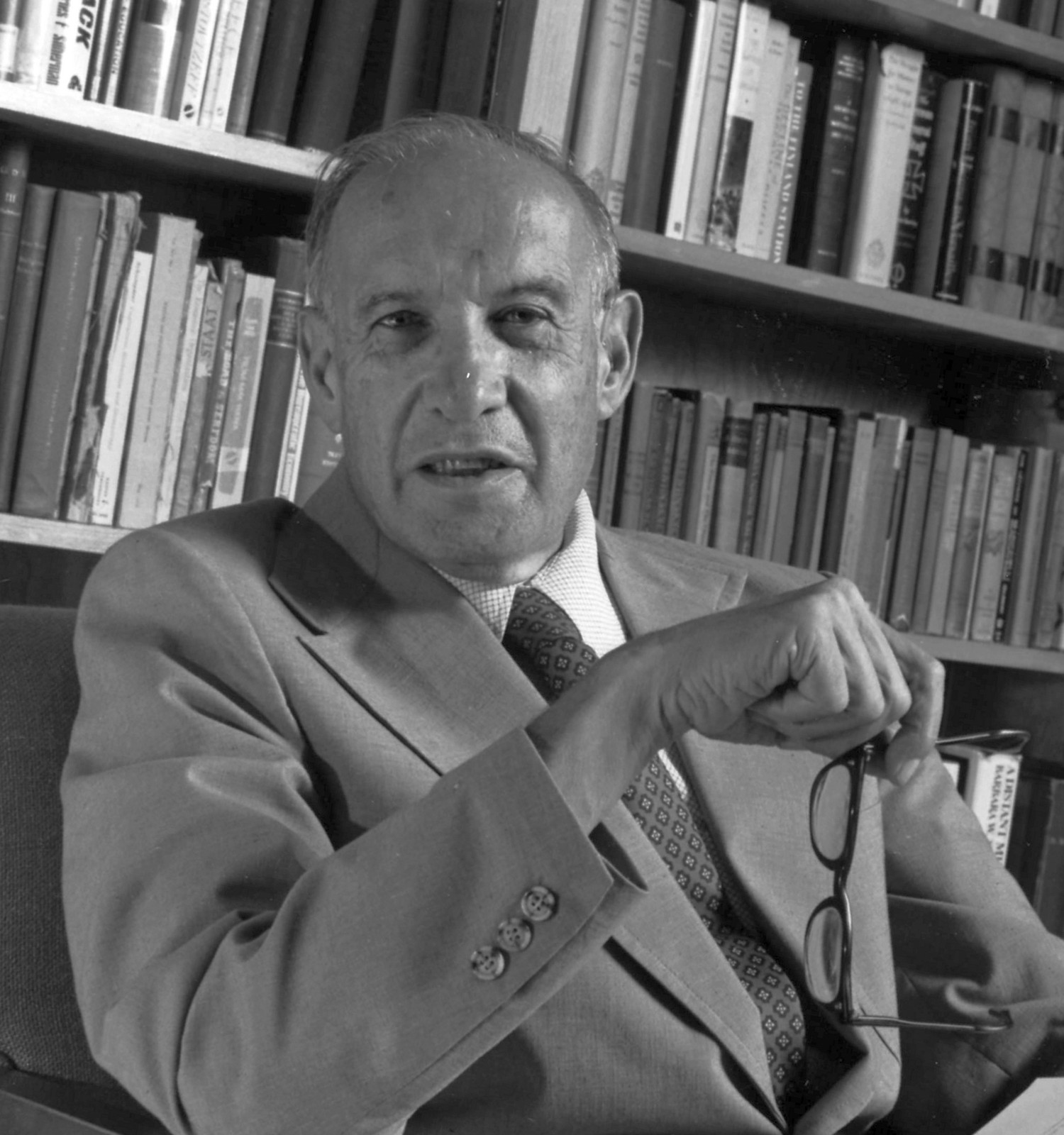
Peter Drucker (1909–2005). He named the knowledge worker in 1959 and spent the rest of his life explaining why that work could not be run like a factory. Photo: Jeff McNeill, CC BY-SA 2.0.
A quarterly review. On the screen, an AI adoption dashboard: suggestions accepted per engineer, pull requests opened by agents, hours saved. In the corner of the slide, in small type, a line in quotation marks: "What gets measured gets managed." And underneath, Peter Drucker.
Drucker never wrote it. The line appears nowhere in his books. The paper most often named as its source, published in 1956 by V. F. Ridgway in the first volume of Administrative Science Quarterly, argued nearly the opposite: performance measures are useful tools, and relying on them without understanding their side effects produces results nobody wants.
And yet the misattribution is not entirely unfair.
Drucker did want knowledge work to be productive, and he used that very word. He admired Frederick Taylor more than almost anyone in the history of management. What he did not believe is that Taylor's method would get us there. The slide keeps the goal and discards the reservation. It is the most common way to read him, and also the surest way to get him wrong.
Taylor's admirer
Drucker was born in Vienna in 1909. In April 1933 he published a short monograph on Friedrich Julius Stahl, a conservative philosopher of Jewish origin. By his own account, the Nazis read it exactly as he meant it: they banned it and burned it. He left for England within weeks, and for the United States in 1937. His first book, The End of Economic Man (1939), was about fascism: how a Europe whose institutions had stopped making sense to people fell into the arms of anyone who promised meaning.
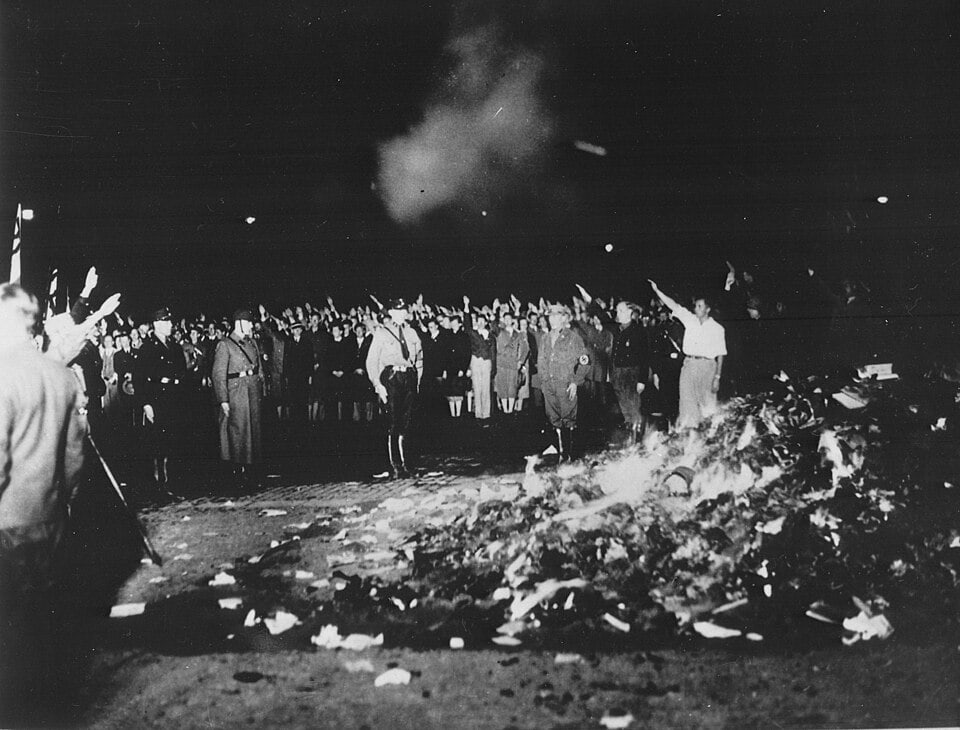 Berlin, Opernplatz, the night of 10–11 May 1933. Student associations organized the burning, and it was repeated in more than twenty university towns. Tyranny was not inefficient; it was very well organized. Photo: Georg Pahl, Bundesarchiv (Bild 102-14597), CC BY-SA 3.0 DE.
His enemy was tyranny, long before inefficiency. For Drucker, management was a political question before it was a business one. If the large organization was going to be the defining institution of the century, it had to work, and it had to be legitimate. Otherwise someone would come along offering something worse.
He did not invent management out of nothing. Fayol, Barnard and Mary Parker Follett had been there first, and Drucker later helped rescue Follett from oblivion. What he did was turn the subject into something executives actually read.
His view of Taylor surprises anyone who knows him from slides. In Post-Capitalist Society (1993) he took the trinity usually credited with making the modern world, Darwin, Marx and Freud, and wrote that "if there were any justice in the world" Marx would be taken out and Taylor put in. For Drucker, Taylor was the first person to look at work itself as something worth studying. The productivity revolution he started had turned Marx's proletarian into a member of the middle class.
The same project, the opposite method
Around 1959 Drucker gave a name to a new kind of worker: the knowledge worker, who produces with what they know rather than with their hands. The analyst, the engineer, the doctor, the software developer. Their means of production are not in the factory or in the owner's hands. They live inside the worker's head. They go home every evening and can leave for another company on Monday.
Forty years later he put the challenge in Taylor's own terms:
"The most important, and indeed the truly unique, contribution of management in the 20th century was the fifty-fold increase in the productivity of the manual worker in manufacturing. The most important contribution management needs to make in the 21st century is similarly to increase the productivity of knowledge work and the knowledge worker."
— Peter Drucker, "Knowledge-Worker Productivity: The Biggest Challenge" (1999)
The key word is similarly. Drucker is not abandoning Taylor's project. He is proposing to repeat it, and to extend it. But in the same paper he warns that the methods have to be completely different, and the first difference changes everything.
Taylor started from a given task: the pig iron is there, and someone has to load it. The only question was how. Drucker's first factor of knowledge-worker productivity is a different question: "What is the task?" For a manual worker the task is obvious. For a knowledge worker, working out what the task is is the first part of the job. Only the person standing in front of the material can answer it.
Further down the same list comes a factor that undoes the dashboard before anyone builds it. In knowledge work, Drucker argued, quality matters at least as much as quantity, and often more. Counting units of output tells you how much was done, not whether it was any good.
That is why he had written, thirty years earlier:
"The knowledge worker cannot be supervised closely or in detail. He can only be helped. But he must direct himself, and he must direct himself towards performance and contribution, that is, toward effectiveness."
— Peter Drucker, The Effective Executive (1967)
The second sentence is the one that gets quoted. The third is the one that gets dropped. Drucker does not leave the knowledge worker alone. He asks them for something harder than obedience: to direct themselves toward a contribution they help define.
His best-known distinction lives here. Efficiency is doing things right; effectiveness is doing the right things. Taylor perfected the first. A product team can close more tickets every sprint for a year and never ask whether those were the tickets. Nothing in the method will warn them, because the method starts after the task has been chosen.
Self-control, in the small print
Drucker's answer to the question of who directs a knowledge worker was management by objectives. People forget its full name, which he used in The Practice of Management (1954): management by objectives and self-control. Its greatest advantage, he wrote, is that it lets a manager "control his own performance."
He was careful with the word control. It can mean the ability to direct oneself and one's work. It can also mean the domination of one person by another. Objectives were meant for the first and never for the second.
What organizations kept was the objectives. They cascaded them from the top, tied them to bonuses and reviewed them every quarter. The self-control fell out of the name first and out of the practice soon after.
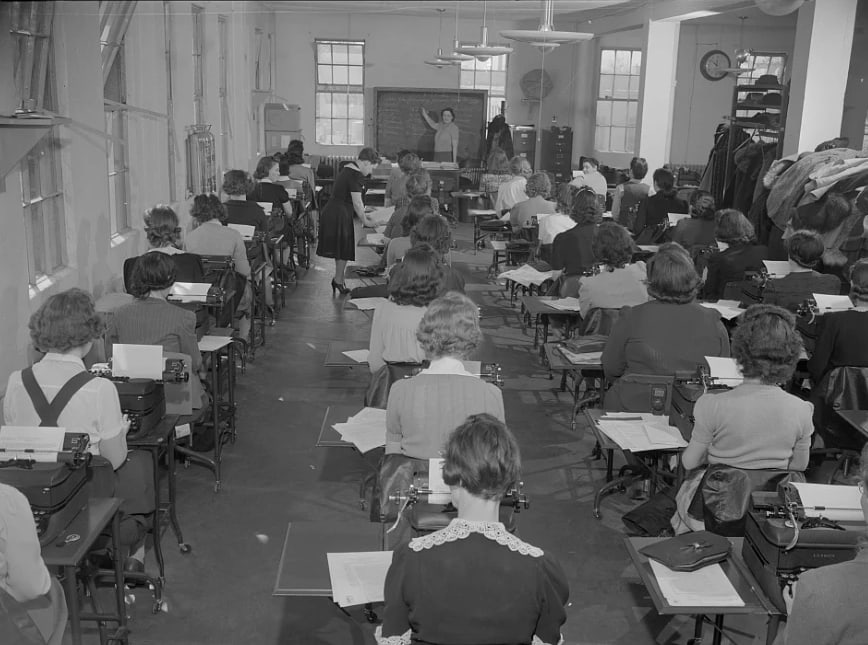 The typists' and stenographers' classroom at the War Production Board, Washington, 1942. They were taught the agency's organization, procedures, routing and priorities. Before Drucker named the knowledge worker, the office had already been arranged like a factory: rows of desks, a blackboard, the task handed down. Management by objectives arrived in organizations built like this room, and adapted to the room rather than the other way round. Photo: Howard Liberman, Office of War Information, Library of Congress, public domain.
Drucker kept pulling the same thread to the end. In "Managing Oneself" (1999), written at eighty-nine, he argued that the great achievers, "a Napoleon, a da Vinci, a Mozart", had always managed themselves, and that now most of us, "even those of us with modest endowments," would have to learn to do the same. The man who turned managing others into a discipline ended up saying that the smallest unit of management is the person.
Where Deming was right
W. Edwards Deming took the opposite view. The eleventh of his famous fourteen points, in Out of the Crisis (1986), is blunt: "Eliminate management by objective. Eliminate management by numbers, numerical goals. Substitute leadership."
The best version of Drucker's defence is that Deming was attacking MBO as it was practised, which Drucker rejected too. That is true. It is also the problem. An idea that turns into its opposite so easily has a weakness of its own.
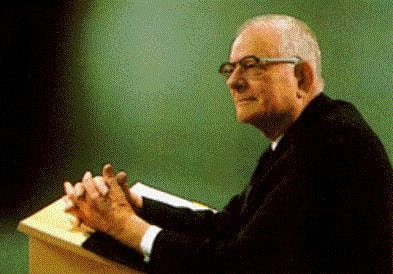 W. Edwards Deming. Japan listened to him in 1950; Detroit took thirty years, until Ford called him in 1981 with its sales collapsing. General Motors never listened to Drucker at all. Photo: FDA, public domain.
The weakness is power. An objective agreed between a boss and a subordinate is agreed between unequal parties, and once written down it belongs to whoever holds the pen. Self-control needs a distribution of power that MBO assumed and never provided. Drucker described what works. He thought less about who decides whether it gets used.
He had seen it early. General Motors received Concept of the Corporation in 1946 as an attack and ignored it. Alfred Sloan's memoir, My Years with General Motors (1963), does not mention it. Drucker was right inside the company, and the people who ran it simply declined to listen.
The descendants of MBO have had the same fate. Andy Grove reworked it at Intel and John Doerr carried it to Google as OKRs. Rolled out in a hurry on an organization with no position of its own, they add speed and an air of rigour to the dispersion that was already there.
Drucker's optimism was that organizations would choose what works. They tend to choose what can be seen.
The first knowledge worker that can be supervised
Drucker's whole argument rests on a fact he took for granted: knowledge work is invisible while it happens. Nobody outside can see whether someone is thinking well, or whether a silence is idleness or the minute before the best decision of the quarter.
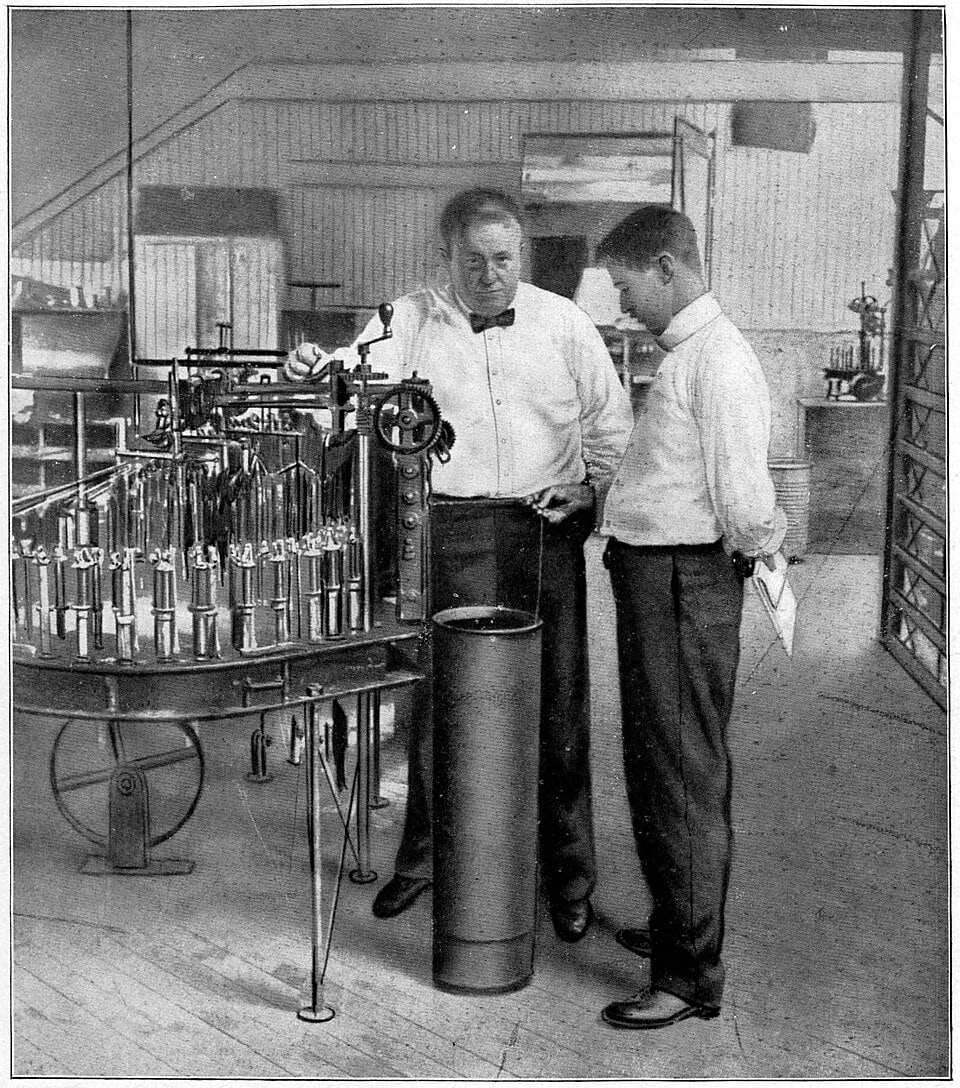 Frank Gilbreth studies an operator's movements at a textile machine, 1916. Close, detailed supervision had a body back then: someone standing next to you, watching every motion so it could be measured and shortened. With knowledge work that gaze was useless. With an agent it returns, turned into a log. Photo: The World's Work (1916), public domain.
That fact now has an exception.
A coding agent is a knowledge worker in the literal sense of 1959: it produces with what it "knows", not with its hands. And it can be supervised closely and in detail. Every step is logged: each file it read and each command it ran. Its task is set from outside. Its means of production do not go home in the evening; they live in someone else's data centre, on someone else's terms.
In Drucker's vocabulary, it is a knowledge worker under Taylor's conditions.
It is tempting to read this as Taylor's revenge. Perhaps the fifty-fold increase Drucker asked of the 21st century will arrive after all. It would come not from making knowledge workers productive, but from building one that can be timed.
The temptation skips a step. The agent does not answer Drucker's first question. It turns that question into the whole of the human's job. Someone has to write the task. A well-specified task gets executed quickly; the agent cannot say whether it was the right one. The log records what it did, not whether it was worth doing. What is left for the human is the part Drucker said could not be supervised: deciding the task and judging the result.
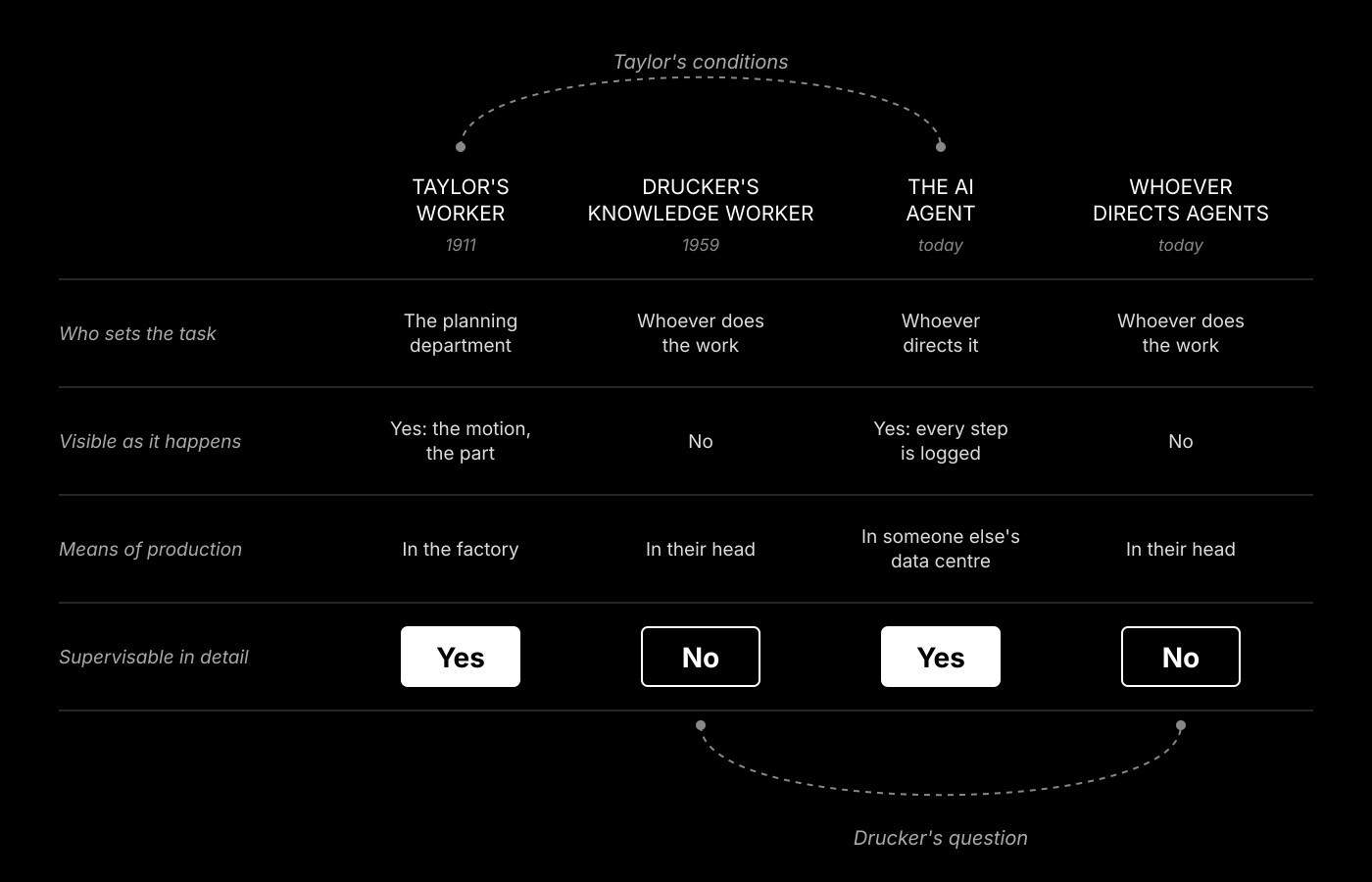 Four workers. The agent looks more like Taylor's worker than like Drucker's knowledge worker. Whoever directs it inherits, whole, the question that cannot be supervised.
This is where the dashboard comes back. It measures the agent, which is legible, and quietly extends that legibility to the people directing it: suggestions accepted per engineer, pull requests per week. It counts the part of the work that has become "Taylorizable" and credits it to people whose job is the part that has not. Ridgway would recognize the effect.
I do not know whether that division will hold. The share of knowledge work that can be timed may keep growing until little remains of the rest. Drucker would have bet the other way: the more gets executed, the more weight falls on the question of what to execute. He never had to direct an agent, and nobody has done it long enough to know.
The line on the slide is not his, but it can be corrected in his terms. What gets measured gets managed. What gets decided before anything is measured, the task, does not appear on any dashboard.
Who wrote the tasks your team completed this quarter, and who would have been in a position to say they were the wrong ones?