Modern Times
Writers: Charlie Chaplin (written by)
Cast: Charlie Chaplin, Paulette Goddard, Henry Bergman, Chester Conklin
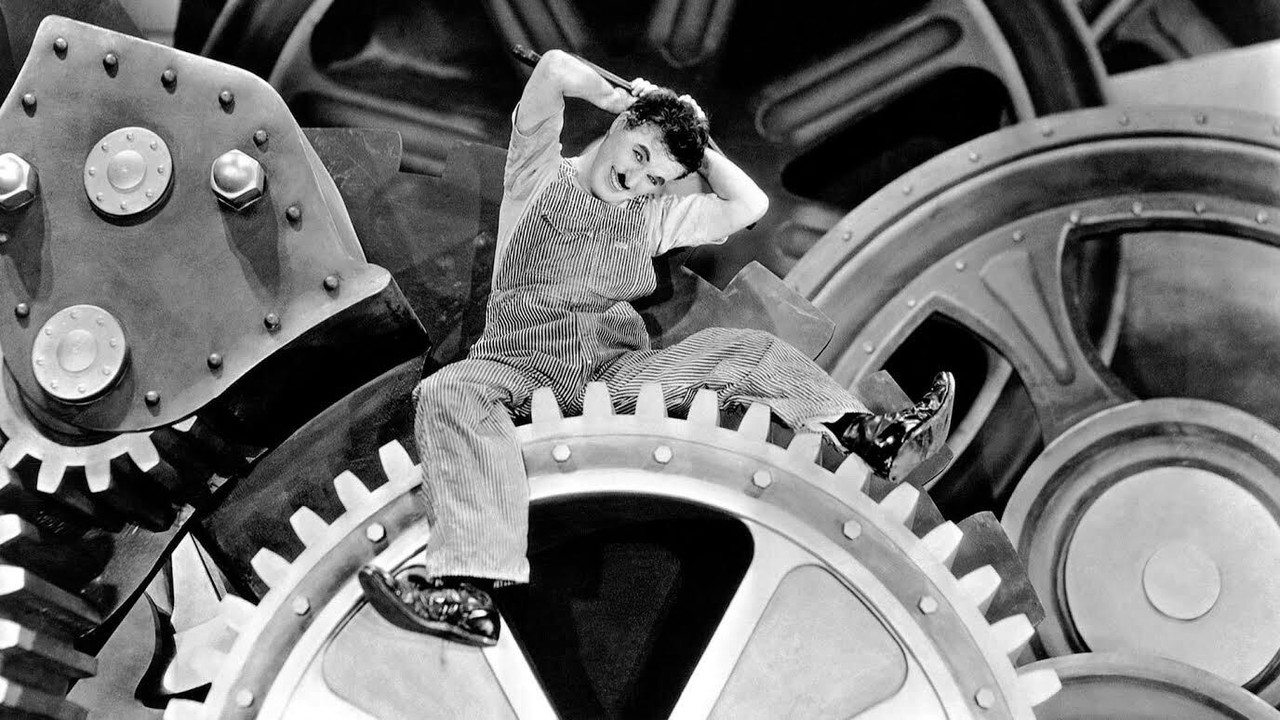
A factory worker tightens bolts on an assembly line whose speed is set by a president watching him on a screen from a private office. After being used as the test subject for an automatic feeding machine and then swallowed by the machinery he tends, he suffers a nervous breakdown, loses the job, and drifts through a Depression-era city of strikes, arrests and vanishing work alongside an orphaned young woman. Chaplin's last outing as the Tramp is a comedy about industrial rhythm, and the closest thing cinema has to a primary document of what scientific management felt like from below.
The opening title of Modern Times announces a story of industry, of individual enterprise, humanity crusading in the pursuit of happiness, and then cuts to sheep being herded through a gate and workers emerging from a subway. Chaplin sets the terms of the argument in nine seconds: the language of enterprise and the observable facts of enterprise have come apart, and the film will spend eighty-seven minutes in the gap. What follows is not a polemic about factories. It is a study of rhythm — who sets it, who has to match it, and what happens to a body that matches it for long enough. The Tramp's job on the line is to tighten two bolts as they pass. He does not build anything, cannot see what he is building, and has no way of knowing whether the thing being built is any good. His entire relationship with the product is a two-second window and a wrench. Adam Smith described the division of labour as a productivity miracle and worried, in a passage that gets quoted far less often, about what it would do to the person performing the divided task. Chaplin films the worry rather than the miracle, and finds it funny, which is a more devastating choice than filming it as tragedy.
The president of the factory appears on a screen. He sits in a quiet office with a jigsaw puzzle and a newspaper, and when he wants more output he speaks into a monitor: section five, speed her up, 4-1. This is the most modern thing in the film and it was 1936. The person who sets the pace never sees the line, never touches the material, and experiences the consequences of the instruction only as a number moving in the direction he asked for. The foreman relays it, the line accelerates, the bodies compensate. There is no malice anywhere in the chain and no feedback either — nothing travels back up from the wrench to the office except throughput. Any organisation that manages by dashboard has inherited this arrangement wholesale, and the sequence is worth watching by anyone who has ever raised a target from a room where the work is not done. Chaplin's joke is that the instruction is always to speed her up. There is no observable mechanism in the system by which the answer could ever be anything else.
Then comes the feeding machine, which is the finest depiction of a failed user test ever committed to film. A salesman arrives — a recorded voice from a phonograph, the human vendor silent beside it, itself a small essay on automation — pitching the Billows Feeding Machine as a device that will eliminate the lunch hour, increase production and decrease overhead. Note the order of beneficiaries in that sentence, and note that the worker is not among them. The Tramp is strapped in because he is available, not because anyone wanted his view, and the machine proceeds to work exactly as designed while destroying the person it is working on: soup on the shirt, corn on the cob at the wrong cadence, a mechanical mouth-wiper on a schedule that has nothing to do with a mouth. The president watches, considers, and delivers the verdict: it's no good, it isn't practical. He has learned nothing about the men and everything about the vendor.
What the film understands best is that the rhythm outlasts the shift. The Tramp is pulled into the machinery, comes out the other side, and cannot stop twitching; he moves through the world tightening every hexagonal thing he sees, including buttons on a passing coat and a fire hydrant. This is the sharpest observation in the picture and the one least often taken seriously. Repetition does not stay in the factory. It becomes the shape of the person, and the person carries it out through the gate, home, into whatever remains of the rest of their life. That is a claim about attention and about habit as much as about labour, and it holds for work that involves no machinery whatsoever — anyone who has spent three years inside a ticket queue knows what it does to the way they think about a problem. Chaplin gives the Tramp and the Gamin no resolution at the end, only a road and an instruction to keep going: buck up, never say die, we'll get along. It is a refusal to pretend the conditions have changed. The last shot is two people walking away from an economy that has no use for them, and it is offered as the happy ending, because in 1936 it was.