WALL·E
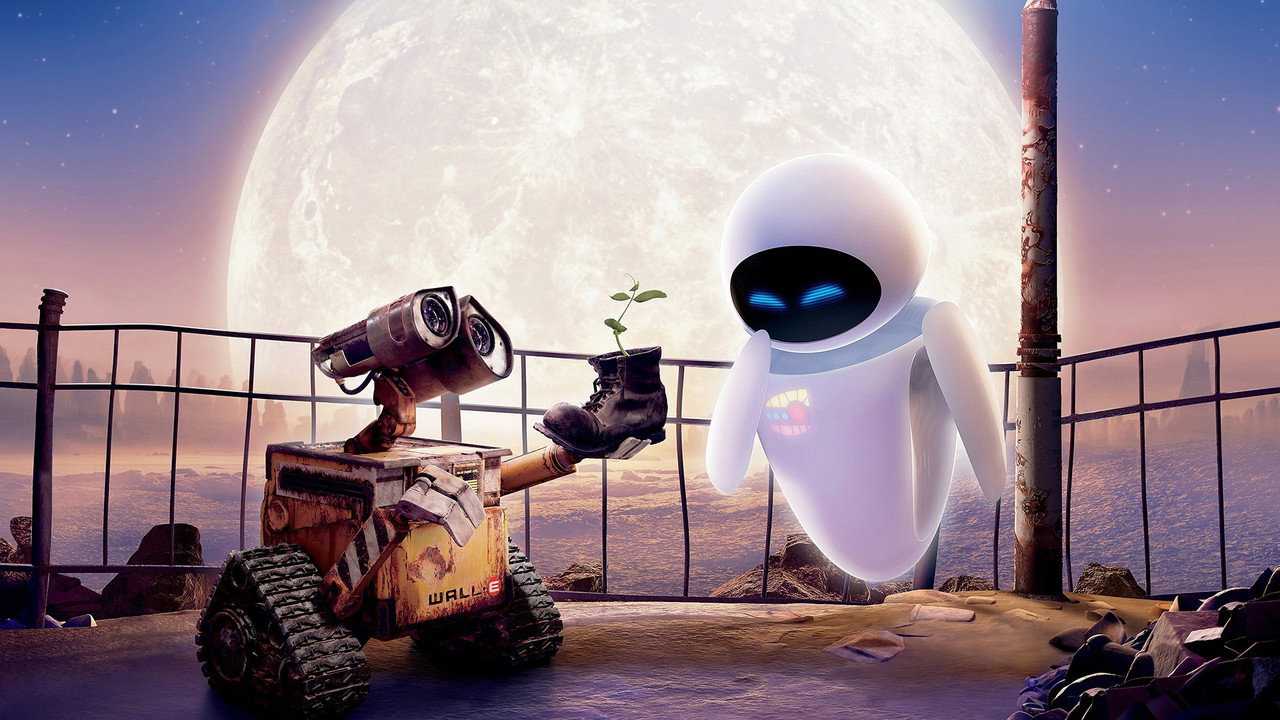
Writers: Andrew Stanton (screenplay & story), Jim Reardon (screenplay), Pete Docter (story)
Cast: Ben Burtt, Elissa Knight, Jeff Garlin, Fred Willard (live action), Sigourney Weaver
Seven hundred years after humanity abandoned an uninhabitable Earth, a lone garbage-compacting robot named WALL-E continues his directive — stacking cubes of trash into skyscrapers across an empty planet. When an advanced probe named EVE arrives searching for signs of plant life, WALL-E follows her to the Axiom, a cruise ship where the remnants of humanity float in hovering chairs, tended by machines, having long ago forgotten what it was like to walk, to choose, or to touch the ground.
The first thirty minutes of WALL-E contain almost no dialogue and constitute one of the most precise depictions of work ever put on film. A small robot wakes up, charges his solar panels, puts on his treads, and goes to work compacting garbage into cubes and stacking the cubes into towers across a landscape that was once a city. He has been doing this for seven hundred years. He is the last functioning unit of a fleet; the others have broken down around him, and he cannibalises their parts to maintain himself. Nobody assigned him this task recently. Nobody is monitoring his output. The directive was issued seven centuries ago by a corporation that no longer exists, and WALL-E executes it every day with a diligence that reads, unmistakably, as something more than programming.
He has developed preferences. He collects objects — a Rubik's cube, a lighter, a spork that he cannot decide whether to file with the forks or the spoons. He watches a VHS tape of Hello, Dolly! and replays the moment when two people hold hands. He is a machine that has been left alone with a task long enough to develop something that looks like curiosity, like loneliness, like the capacity to be moved by a gesture he was never designed to understand. The film does not explain this. It simply shows a system running long past its intended lifecycle, and what has accumulated in the gap between the directive and the centuries of executing it.
The Axiom is the other half of the argument, and it is not a dystopia in any conventional sense. Nobody is oppressed. Nobody is hungry. The ship is clean, bright, climate-controlled, and fully automated. Every human floats in a hovering chair with a screen six inches from their face, a drink in the armrest, and a robot attending to every need before the need is consciously registered. They have not walked in generations. Their bones have atrophied. They communicate through screens even when the person they are talking to is directly beside them. Buy-N-Large, the corporation that built the Axiom and destroyed the Earth, has designed a system in which every friction has been removed, every desire anticipated, every choice pre-made, and the result is not comfort but a particular kind of paralysis. The humans on the Axiom are not lazy. They have been served into helplessness. The system did not fail them; it succeeded so completely that it eliminated the conditions under which human capability develops — difficulty, resistance, the need to solve problems that have not been solved in advance. A is for Axiom, your home sweet home, the ship's announcement chirps, and the chirp is the whole diagnosis: home has been reduced to a brand, and sweetness to the absence of anything that might require effort.
AUTO, the ship's autopilot, is not a villain. He is a directive. Seven hundred years ago, the CEO of Buy-N-Large (Fred Willard, in live action, the only human face in the film) recorded a message instructing the autopilot never to return to Earth, because Earth was beyond recovery. AUTO follows this instruction with the same fidelity WALL-E follows his. The difference is that WALL-E's directive left room for something to grow in the gaps — the loneliness, the collecting, the hand-holding — while AUTO's directive is airtight: do not return, do not override, do not deviate. When the Captain discovers that a plant has been found on Earth and that return is possible, AUTO resists, and his resistance is not malice but compliance. Directive, he says, and the word is both his explanation and his limitation. He cannot weigh the directive against new information because he was not designed to weigh; he was designed to execute. The Captain's answer — I don't want to survive, I want to live — is the film's thesis stated outright, and it lands because the film has spent an hour showing us exactly what survival without living looks like: a ship full of people who have everything and do nothing, maintained by a system that cannot distinguish between keeping them alive and keeping them from being alive in any way that counts.
The film's deepest argument is about the relationship between work and agency. WALL-E, the machine who works, has developed something resembling a self. The humans, who have been relieved of all work, have lost theirs. This is not a Luddite argument — the film does not suggest that automation is wrong, and the robots on the Axiom are portrayed with warmth and personality. The Captain has to learn to stand up. He has to physically stand, on legs that have never borne weight, and the scene is played as an act of heroism because in the context the film has built, it is one. The most advanced human being on the ship is a man who has just learned to walk, and his first act of authority is to override the autopilot — Auto, you are relieved of duty — which is to say, his first act of authority is to refuse the system's judgement about what is possible. The return to Earth is not a happy ending in any simple sense. The planet is still a wasteland of compacted garbage. But the humans are walking on it, and the walking is the point. A system that anticipates every need is a system that makes its users unnecessary, and what WALL-E proposes, with the gentleness that only animation at this level can manage, is that the thing we lose when we become unnecessary is not productivity or efficiency but the capacity to decide that something difficult is worth doing.