Playtime
Writers: Jacques Tati (screenplay), Jacques Lagrange (screenplay), Art Buchwald (English dialogue)
Cast: Jacques Tati, Barbara Dennek, Jacqueline Lecomte, Billy Kearns
A group of American tourists arrives in a Paris made entirely of glass, steel, and right angles. Monsieur Hulot, Tati's gentle alter ego, wanders through office buildings, a trade exhibition, and a not-quite-finished restaurant, getting lost in corridors designed for efficiency rather than human use. There is no plot in the conventional sense — no antagonist, no stakes, no resolution. There are only spaces and the people who try to inhabit them.
To film a city that does not work for the people inside it, Tati built one. Tativille rose on waste ground outside Paris: glass office blocks on rails so they could be repositioned between shots, streets, traffic lights, a functioning power plant, an airport terminal. It consumed the largest budget in French cinema to that point, shot in 70mm, and its commercial failure cost Tati the rights to his own earlier films. The irony is not written into the script; it is written into the production. A purpose-built environment, engineered to a specification, delivered on the promise of total control — and the film it exists to make is about how that promise fails the moment a human being walks in. Everyone who has shipped a system designed from the top down, and then watched real users move through it, has been inside a small Tativille.
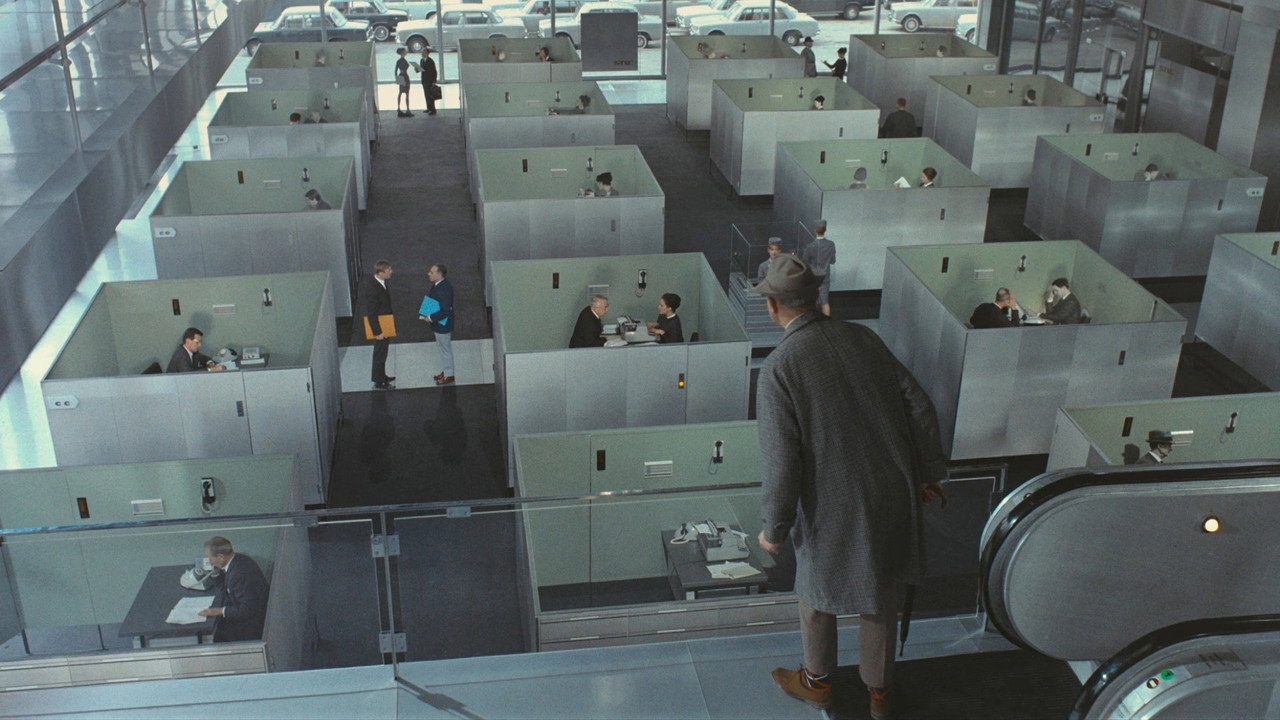
There is no protagonist. Hulot appears, disappears, is mistaken for other men who are mistaken for him; the tourists circulate; the office workers are interchangeable and know it. Tati shoots in deep focus and wide frame so that no figure in the image is privileged over any other, and then refuses to tell you where to look. The effect is closer to an organisational chart than to a story: the system is the subject, and the individuals inside it are instances rather than characters. That is a genuinely uncomfortable formal choice, because narrative attention is how films confer importance, and Tati withholds it evenly. The famous overhead shot of the open-plan office — a grid of identical cubicles seen from above, people moving between them like tokens — is not a joke about bureaucracy. It is a diagram of one.
The trade exhibition sequence is the closest thing in cinema to a product review of an entire industry. A German exhibitor demonstrates doors engineered to slam without sound, delivered with the line that his firm was the first to study silence. Nearby, a flip-top bin is sold as Thro-Out Greek Style, a classical column repurposed as a waste container. Neither product answers a question anyone asked. They are solutions generated inside the design process, for problems that exist only inside the design process, and they are presented with complete conviction — the exhibitors are not cynics, they are enthusiasts. This is the failure mode that no amount of process discipline prevents: a roadmap can be perfectly executed and still be a catalogue of features in search of users.
Then the Royal Garden opens before it is finished, and the film changes register. A ceiling tile drops. A chair stamps its crown motif into the back of a customer's jacket. The air conditioning gives out, the kitchen falls behind, the neon sign loses letters, the dance floor tiles come loose. As each designed element fails, the evening improves. Guests start improvising — cooking, serving, taking over the band, tearing down what remains of the décor — and by dawn the room has produced something the architecture never allowed for: people enjoying themselves together. It is the most precise thing ever filmed about emergence. The controlled system had to break before anything human could happen in it, and Tati stages that collapse not as catastrophe but as relief. The uncomfortable question he leaves open is whether the good part could ever have been designed in, or whether it only arrives when the design lets go.