Brazil
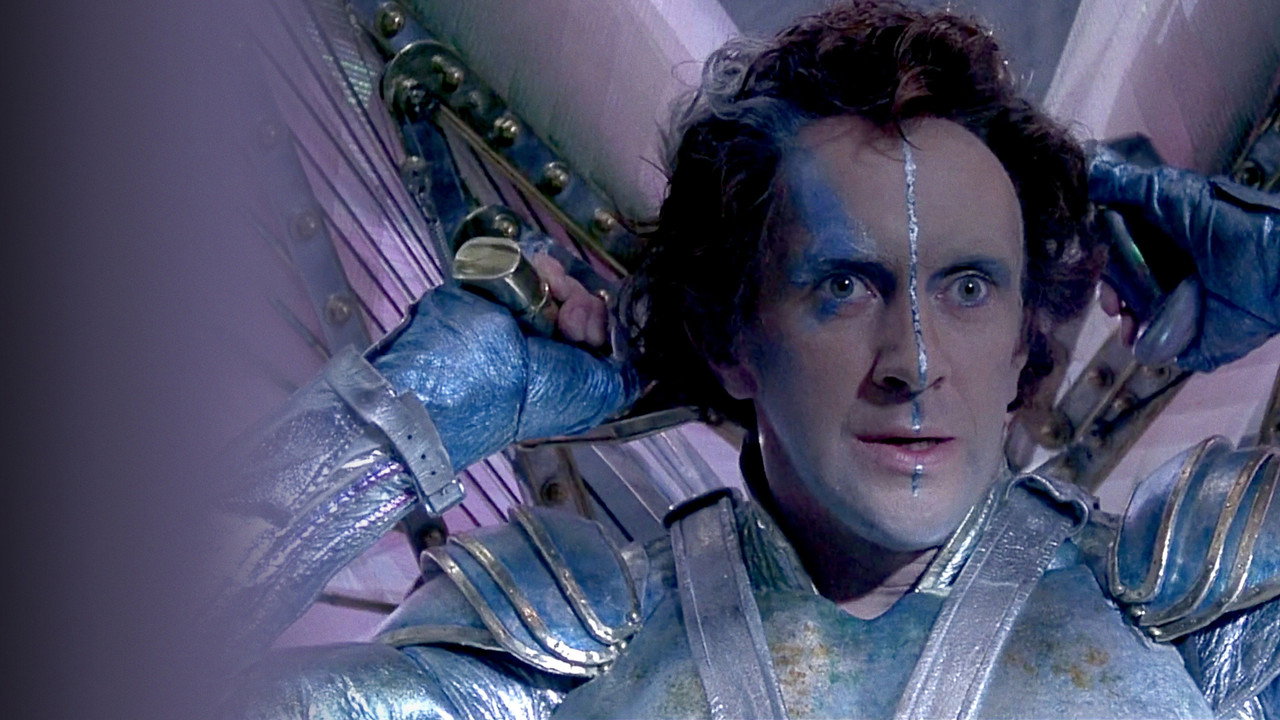
Writers: Terry Gilliam (screenplay), Tom Stoppard (screenplay), Charles McKeown (screenplay)
Cast: Jonathan Pryce, Robert De Niro, Katherine Helmond, Ian Holm, Bob Hoskins, Michael Palin
Sam Lowry is a low-level bureaucrat in a retro-futuristic society where everything runs on ducts, forms, and paperwork. A bug — literally, a fly that falls into a teleprinter — produces a typographical error that causes the state to arrest the wrong man, who dies under interrogation. Sam's attempt to correct the error pulls him into the machinery he has spent his career ignoring, and the machinery does what machinery does.
A fly falls into a teleprinter and a letter is struck wrong. Archibald Tuttle, heating engineer, becomes Archibald Buttle, cobbler. Armed men come through the ceiling of the Buttle flat at Christmas, bag the father in front of his children, and hand his wife a piece of paper: that is your receipt for your husband, and this is my receipt for your receipt. Buttle dies under interrogation, and here is the part worth sitting with — nothing in the state's response treats a death as different in kind from a clerical discrepancy. The file is reconciled. Charges for information retrieval were levied against the wrong account, so a refund cheque is raised, and a functionary is dispatched to deliver it to the widow with the assurance that the Ministry is very scrupulous about following up and eradicating any error. The error was corrected. That sentence is true, and it is the whole horror. Gilliam is not showing us a system that failed; failure implies a specification the system fell short of. He is showing us a system whose specification never contained a field for the difference between processing a person and processing paperwork about a person, and which therefore cannot notice that it killed someone, because killing someone is not a value the schema can hold. Every organisation that has ever closed a ticket on a problem it did not solve has performed a smaller version of the same reconciliation.
The man carrying that cheque is the film's most recognisable figure, and the recognition is uncomfortable. Sam Lowry works in Information Retrieval, and he has built a career out of retrieving nothing. He is competent, decent by disposition, well-liked, and structurally useless — the only thing he actively does at his desk is hide a small television from his supervisor. His mother, who is having her face surgically reconstructed in instalments, keeps pressing him toward the promotion he is entitled to; over dinner he refuses all of it at once, dessert and promotion and anything else on offer. It reads as modesty and it is not. Promotion means Information Retrieval proper, and Information Retrieval proper means signing the documents that turn a name into a body, which means knowing. Sam has correctly worked out that the cost of the job he could have is that he would have to look at what the job he already has is part of. So he stays put, keeps the lights on, keeps his eyes down, and daydreams about flying. This is the universal middle position in any institution that does harm at scale — not the people who decide, and not the people who suffer, but the large stable population who keep the pipes flowing on the understanding that nobody will ask them to trace where they lead.
Which brings us to the ducts. They are everywhere in this film, in every room, coiling through flats and offices like exposed viscera, and they are the point. The only character in Brazil who can actually make anything work is Harry Tuttle, and he operates illegally — a heating engineer who rappels through the night fixing systems he has no authorisation to touch. He quit Central Services over paperwork, and his explanation is exact: the whole system could be on fire and he could not turn on a kitchen tap without filling out a twenty-seven B stroke six. He came into the trade for the action, and now the country is sectioned off and you cannot move without a form. Against him the film sets Spoor and Dowser, the licensed repairmen, who arrive carrying documents rather than tools, do not fix the flat, and then return to punish it — the sanctioned intervention makes the situation strictly worse than no intervention at all. The film's structural claim is that the ducts are the real state. The infrastructure governs; the enormous administrative apparatus stacked on top of it long ago stopped being connected to the thing it administers, and now maintains itself instead. Anyone who has watched a competent engineer fix something on a Saturday, quietly, outside the change-management process, because the process would have taken six weeks and produced a different outcome, has met Harry Tuttle and knows which side of that arrangement the work actually happens on.
The form 27B/6 is the mechanism, and it is more subtle than obstruction. Notice that nothing in this society is forbidden. The tap can be turned on, the repair can be requested, the error can be reported, the arrest can be queried — every one of these is permitted, and every one requires authorisation, and authorisation requires a document, and the document requires a signature from a department that requires a document. Nobody says no. The system does not prevent work; it defers work through process until the work has stopped mattering, and then closes it. This is why the film is a comedy rather than a tragedy for most of its length: the machinery is not malevolent, it is merely slower than reality, and it has no representation of the gap. Buttle is not murdered by anyone in particular. He is murdered by latency plus indifference plus a fly. And the ending Gilliam fought his studio to keep — Sam finally happy, humming, catatonic in an interrogation chair while his torturers agree he has got away from them — is the last turn of the same screw. The organisation does not need to defeat you. It only needs to outlast the version of you that was trying to correct it.