The bandwidth tax
Scarcity captures the mind, taxes cognitive bandwidth, and creates self-reinforcing traps. What a behavioral economist and a psychologist discovered about poverty explains why product teams under pressure think worse, not just slower.
A mall in New Jersey. Researchers stop shoppers and ask them to imagine their car needs a repair. Half hear the bill is $150. The other half, $3,000. Then everyone takes a standard cognitive test — the kind that measures fluid intelligence, the raw processing power of the mind.
For the well-off shoppers, the number on the bill makes no difference. They score the same whether the hypothetical repair costs a hundred and fifty dollars or three thousand. For the lower-income shoppers, thinking about the $3,000 repair drops their score by 13 to 14 IQ points. Not because they are less intelligent. Because the mere act of contemplating a financial problem they cannot easily solve consumes cognitive resources that are then unavailable for anything else.
Thirteen points is not a rounding error. It is the difference between average and borderline intelligence on a standardized scale. It is roughly what you lose after a full night without sleep. And the repair is hypothetical — nobody has actually spent the money. The worry alone, before anything has happened, degrades how well they think.
Sendhil Mullainathan, an economist who has taught at Harvard and MIT, and Eldar Shafir, a cognitive psychologist at Princeton, built a theory on findings like this one. Their book, Scarcity: Why Having Too Little Means So Much, argues that scarcity — of money, time, social connection, or any resource — produces a distinctive cognitive state with predictable, measurable consequences. The state is not a personality trait. It is a tax imposed by circumstance, and it reverses when the circumstance changes.
The implications reach well beyond poverty policy — into how we build organizations, how we plan product work, and what it means to design systems that compete for human attention.
I. The empty operating room
St. John's Regional Medical Center performed about 30,000 surgeries a year across 32 operating rooms. Every room was booked. The schedule looked efficient on paper, and it was miserable in practice. Roughly 20% of the surgical volume came from emergencies — cases that could not wait for a slot to open up. Each emergency displaced a planned surgery, which displaced the next, which pushed operations past 3pm — overtime, fatigue, a scrambling staff making decisions at the worst possible hour.
The solution that the hospital eventually adopted seems, at first glance, like an act of waste: leave one operating room empty. Not underbooked. Empty. Reserved exclusively for the emergencies that everyone knew would arrive but nobody could schedule.
The result: 5.1% more surgeries per year, 45% fewer operations running past 3pm, and an increase in revenue. The hospital did more with 31 rooms than it had been doing with 32, because the thirty-second room was not producing surgeries — it was absorbing the shocks that prevented the other thirty-one from functioning.
Mullainathan and Shafir use this case to illustrate a principle that runs through the entire book: slack is not waste. Slack is infrastructure.
A road at 85% capacity handles traffic smoothly. The same road at 100% turns a single driver tapping the brakes into a ten-mile jam.
The instinct to eliminate slack is powerful, because slack looks like inefficiency. It looks like people who could be doing more, rooms that could be booked, sprints that could be fuller. The instinct is correct about the appearance and wrong about the economics. Taiichi Ohno understood this at Toyota: eliminating waste does not mean eliminating all buffers — it means eliminating muda, activity that adds no value. A buffer that absorbs variation is not waste. It is what allows the rest of the system to flow.
The corporate history of the past half-century is a pendulum between too much slack and too little. The bloated conglomerates of the 1970s had so much organizational fat that leveraged buyouts in the 1980s could strip it away and improve performance. But the efficiency drive kept going. By the early 2000s, researchers were documenting a new pathology: managerial myopia caused by organizations so lean they had no room for anything that did not produce immediate, measurable output. The hard part — the part that never gets a clean solution — is distinguishing slack from bloat. They look similar from the outside. One is a structural necessity; the other is genuine waste. And the people inside the system, the ones best positioned to tell the difference, are often too busy juggling to step back and look.
The firefighting trap
Mullainathan and Shafir describe a pattern they call firefighting — organizations where too many problems arrive simultaneously, where solving one urgent issue creates the conditions for the next, and where the backlog of important-but-not-urgent work grows until it generates its own emergencies. The pattern is self-reinforcing. The people inside it know what they should be doing. They simply cannot reach it, because the immediate always crowds out the important.
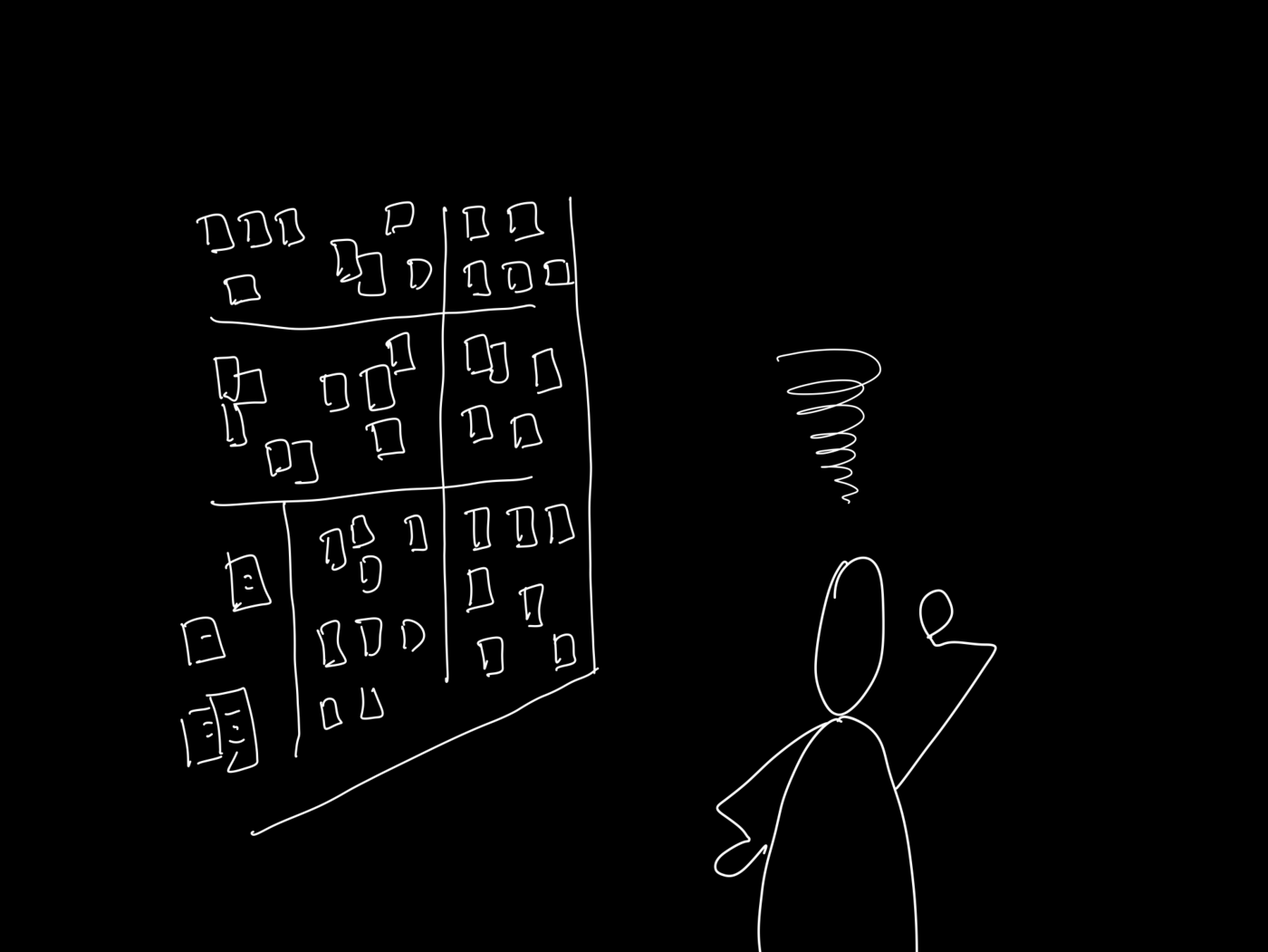 The firefighting trap. A figure stands before a wall full of open tasks — every window lit, every slot occupied. The spiral above the head is the cognitive load of an organization operating without slack: not the absence of effort, but the impossibility of directing it. The building is full and the person knows what needs to be done. The problem is that everything needs to be done right now.
Microsoft shipped Windows 2000 with 28,000 known bugs. Not because the engineers were unaware of them. Because the schedule pressure had created a tunnel so narrow that only the bugs blocking the release were visible. The 28,000 others sat on a list that everyone intended to get to and nobody did, because each day brought a new fire that demanded attention right now.
NASA's Mars Climate Orbiter crashed in 1999 because of a unit conversion error — one team used metric, another used imperial. The proximate cause was a software bug. The root cause was that the team at JPL was understaffed and behind schedule, operating under a policy called "faster, better, cheaper." The team had noticed the trajectory anomalies months before the crash, flagged them, put "investigate the anomaly" on a list that was permanently displaced by more urgent work. The investigation that would have saved the mission was important but not urgent, and in a system without slack, important-but-not-urgent is where things go to die.
The parallel to product organizations is not metaphorical. Any team that has lived through a sustained period of operating above capacity will recognize the sequence: planned work gets displaced by incidents; incidents get patched instead of fixed; patches create new fragility; fragility generates more incidents. The team is not incompetent. It is in a scarcity trap — a system whose defining feature is that the behavior it produces is exactly what keeps it going.
II. What scarcity does to the mind
The mall study is striking, but it could be a fluke. People imagining an expense in a shopping center, taking a test they have no stake in — perhaps the result says more about the experimental setup than about cognition under scarcity.
So Mullainathan and Shafir went to the sugar cane fields of Tamil Nadu. Indian sugar cane farmers receive the bulk of their annual income at harvest time, in one lump sum. Before harvest, they are poor — managing loans, rationing food, juggling obligations. After harvest, they are relatively comfortable. Same people. Same village. Same cognitive machinery. The only variable is whether the harvest money has arrived.
The farmers scored 9 to 10 IQ points higher after harvest than before. The effect was not explained by stress, nutrition, physical effort, or any of the obvious confounds the researchers tested for. It was explained by the cognitive load of poverty — the constant background computation of matching insufficient resources to excess demands.
Dickens had already seen it. In the workhouse of Oliver Twist, the boys who have finished their single daily bowl of gruel cannot stop their minds from returning to food:
The bowls never wanted washing. The boys polished them with their spoons till they shone again; and when they had performed this operation (which never took very long, the spoons being nearly as large as the bowls), they would sit staring at the copper, with such eager eyes, as if they could have devoured the very bricks of which it was composed.
— Oliver Twist, Chapter II
The scene is a portrait of attentional capture before anyone had a name for it. The boys are not choosing to think about food. Hunger has seized their minds so completely that they sit polishing empty bowls and staring at an empty pot, every scrap of cognitive bandwidth consumed by the scarce resource. What Mullainathan and Shafir measured with IQ tests in New Jersey and Tamil Nadu, Dickens observed in a fictional workhouse in 1837: scarcity does not leave room for anything else.
This is what the authors call the bandwidth tax. Scarcity does not merely make people unhappy. It commandeers mental bandwidth — the combination of cognitive capacity (fluid intelligence, the ability to reason and solve problems) and executive control (the ability to manage impulses, plan ahead, stay focused). Both decline measurably under scarcity, and both decline for the same reason: the scarce resource captures attention involuntarily, consuming processing power that is then unavailable for anything else.
The capture is not a choice. It operates through what psychologists call goal inhibition: the automatic suppression of competing goals when one goal becomes urgent. A person worried about rent is not choosing to neglect their child's homework. Their mind is doing what minds do under scarcity — focusing on the threat at the cost of everything else.
The focus dividend and its cost
The tunnel has an upside, and the authors are careful to document it. People operating under scarcity become remarkably efficient at whatever falls inside the tunnel. The hungry think about food with extraordinary precision; the financially constrained make trade-off calculations that the comfortable never bother with.
In an experiment modeled on the TV show Family Feud, Princeton students were given budgets of "time" to answer questions. The "poor" players — those given fewer seconds per round — were more efficient per second than the "rich" players. They squeezed more value from every unit of the scarce resource, precisely because scarcity forced them to. This is the focus dividend: the heightened performance that scarcity produces on whatever falls inside the tunnel of attention.
 The tunnel of scarcity. Everything inside it becomes sharper, more urgent, more efficient. Everything outside it disappears. The mechanism is not a choice — it is how the mind responds when a resource runs short. The opening narrows, and what remains visible is all there is.
But the focus dividend has a price, and the price is everything outside the tunnel. The same "poor" players borrowed time from future rounds at high interest, dug themselves into deficits, and ended the game with worse overall scores — despite their superior per-second efficiency. When the researchers removed the option to borrow, the poor players gained 60 points. The rich players were unaffected. Borrowing was not helping the poor; it was the mechanism through which the tunnel vision produced by scarcity turned a local advantage into a global loss.
This is the architecture of the scarcity trap. Scarcity produces focus. Focus produces tunnel vision. Tunnel vision produces borrowing — from the future, from other domains, from the slack that would be needed to plan an exit. Borrowing deepens the scarcity, which intensifies the focus, which narrows the tunnel further. Not a failure of character — a predictable consequence of a cognitive mechanism operating exactly as designed, in an environment with no margin for error.
The trade-off mind
There is one more finding worth pausing on, because it inverts a common assumption. Mullainathan and Shafir asked shoppers to consider buying a product. Some were told the product cost $100, others $1,000. Then they were asked whether they would travel 30 minutes across town to save $35.
For most people — and for most economists modeling most people — the answer depends on the base price. Saving $35 on a $100 purchase feels significant. Saving $35 on a $1,000 purchase feels trivial. This is Weber's law applied to money: we perceive value in relative, not absolute terms. The finding is textbook behavioral economics.
Except that lower-income shoppers did not behave this way. Their willingness to travel for the $35 saving barely changed with the base price. Thirty-five dollars was thirty-five dollars. In a study at a Trenton soup kitchen, the pattern held even more sharply: the responses of the poor were close to what a perfectly rational economic agent would do — value money in absolute terms, not relative ones.
The poor, in other words, are better economists than economists. They know prices. They calculate trade-offs. They understand opportunity cost with an intuition that comes from having lived it every day. In a study by Ferraro and Taylor, 78% of professional economists got an opportunity cost question wrong. The poor, who trade off constantly because scarcity forces them to, get it right — not because they studied it, but because the bandwidth tax, for all its costs, also sharpens the ability to evaluate the scarce resource with precision.
This is the duality that makes the book's argument uncomfortable. The same mechanism that makes scarcity destructive also makes it locally intelligent. The mind under scarcity is more efficient at managing the scarce resource and worse at everything else — and there is no version of the mechanism that delivers one without the other.
III. Attention is a scarcity economy
Herbert Simon identified the equation in 1971: a wealth of information creates a poverty of attention. Michael Goldhaber mapped its economic structure in 1997: attention is the true scarce currency of the networked age. What Mullainathan and Shafir add is the mechanism — what happens inside the mind when a resource becomes scarce, and why the consequences compound.
If attention is scarce, and scarcity captures attention involuntarily, then every product competing for attention is doing something more precise than "taking up time." It is triggering the cognitive machinery that Mullainathan and Shafir documented in the malls of New Jersey and the cane fields of Tamil Nadu. The notification that interrupts your work is not merely a distraction. It creates a micro-scarcity — a momentary sense that something requires your attention right now — and the mind responds with tunnel focus, suppression of competing goals, narrowing of bandwidth. The full apparatus.
This is not metaphor. The attentional capture that drives engagement metrics operates through goal inhibition. The focus dividend that makes a well-designed feed feel productive for the first few minutes is the one that makes a time-pressed worker efficient within her tunnel and blind to everything outside it. And the borrowing that follows — time taken from sleep, from deep work, from the unscheduled thinking that produces insight — is what traps the Koyambedu market vendors in cycles of debt they could theoretically escape in thirty days but have sustained for an average of 9.6 years.
The regressive tax
Mullainathan and Shafir describe what they call the temptation tax: the cognitive cost of resisting an impulse. For a person with a large budget, resisting the occasional expensive temptation costs about 1% of their resources. For a person with a small budget, the same resistance costs 10%. The tax is regressive — it falls hardest on those with the least.
The attention economy operates the same regressive structure. A person with ample slack — few obligations, flexible schedule, secure income — can afford to lose twenty minutes to a feed. The attentional deficit barely registers. A person already managing scarcity of time, money, or cognitive bandwidth loses those same twenty minutes from a budget that had no margin. The notification that is trivial for one person is the straw that displaces an important-but-not-urgent task for another — a medical appointment that does not get scheduled, a savings decision that does not get made, a difficult conversation that gets postponed one more day.
The products that capture attention most effectively are, by the logic of Mullainathan and Shafir, imposing a bandwidth tax whose incidence is invisible and whose distribution is regressive. They do not tax attention equally. They tax it hardest where it is already scarce, which is where the bandwidth effects compound most destructively.
Designing for bandwidth
The last third of Mullainathan and Shafir's book is about design — not product design in the Silicon Valley sense, but the design of systems, policies, and interventions that must work for people whose bandwidth is already taxed. Their central analogy is Alphonse Chapanis and the B-17 bomber.
During World War II, pilots kept retracting the landing gear instead of the flaps on approach. The mistake was so common that the Air Force investigated. Chapanis, a psychologist, found the answer: the landing gear lever and the flap lever were identical in shape, placed side by side. The problem was not pilot error. The problem was cockpit design. The fix was elegant and small: a rubber wheel on the landing gear lever, a flat wedge on the flap lever. Different shapes for different functions. Error became rare overnight. The pilots had not improved. The environment had.
"Error is inevitable," Chapanis concluded. "Accidents are not."
The principle translates directly. A training program for low-income workers that assumes perfect attendance is designing for the cockpit, not the pilot. The bandwidth tax predicts that participants will miss sessions — not because they are unmotivated but because juggling multiple scarcities produces exactly the kind of neglect that absenteeism represents. A program designed for scarcity would be modular, tolerant of missed sessions, structured so that each class delivers value independently rather than requiring the full sequence.
Antoinette Schoar tested this with financial education at ADOPEM, a micro-lender in the Dominican Republic. Traditional accounting courses taught comprehensive bookkeeping — double-entry ledgers, balance sheets, the works. Schoar's alternative taught simple rules of thumb: separate business money from personal money. Keep the business cash in a different place. That is all. The rules-of-thumb course was shorter and simpler. It also produced a 25% increase in income during bad weeks, outperforming the comprehensive course by every measure. The comprehensive course was better education. The simplified one was better design — it fit inside the bandwidth that the participants actually had.
This is the frame that matters for product. Every feature, every flow, every decision point consumes bandwidth — and the cost is not just time but the cognitive capacity that becomes unavailable for everything else the user needs to think about that day.
A product designed with bandwidth in mind asks different questions. Not "how do we increase engagement?" but "how do we deliver value with the least attentional cost?" Not "how do we get users to come back?" but "what would it mean to respect that every minute of attention we capture is a minute taken from something else?" These questions do not have clean answers. But they are better questions, and asking them changes what you build.
The dance between abundance and scarcity
Mullainathan and Shafir make one observation that is easy to miss and difficult to forget. Scarcity, they argue, does not originate in periods of scarcity. It originates in periods of abundance.
The sugar cane farmer who receives a lump-sum harvest payment and spends freely in the first weeks is not being irresponsible. He is behaving the way humans behave when a resource is abundant: without trade-off thinking, without the focus that scarcity would impose. The abundance phase feels like freedom. It is, in fact, the phase where the next scarcity is being constructed.
The cycle is visible in product organizations. A team that has just shipped a major release, or that has just received a budget increase, or that has just hired several new people, enters a period of abundance. There is time for everything. The backlog of important-but-not-urgent work can finally be addressed. Technical debt can be paid down. Architecture can be rethought. And then, with remarkable regularity, none of that happens. The abundance is spent on new commitments — new features, new projects, new hires who need onboarding — and within a quarter the team is back at capacity, back in the tunnel, back to juggling. The abundance did not fail because of bad decisions. It failed because abundance, by its nature, does not produce the focus that would be needed to prepare for the scarcity that follows.
Thoreau wrote that a man is rich in proportion to what he can let alone. It is the most concise summary of slack I have encountered. The ability to not optimize, to leave a room empty, to keep a sprint at 70% — this is not laziness or waste. It is the only reliable defense against the tunnel that scarcity constructs around the minds of capable, intelligent people who happen to have run out of room.
The bandwidth tax is not a theory about the poor. It is a theory about all of us, whenever we operate at the limit of any resource we depend on. The poor experience it most acutely and most persistently — that is the moral urgency of the book. But the mechanism is universal, and the implication is the same whether you are managing a household budget, a product roadmap, or your own attention on a Wednesday afternoon: the mind under scarcity is not your mind at its best. The exit from the trap is never discipline. It is slack.