Metropolis
Writers: Thea von Harbou (screenplay), Fritz Lang (screenplay)
Based on: "Metropolis" by Thea von Harbou (1925) ↗
Cast: Brigitte Helm, Alfred Abel, Gustav Fröhlich, Rudolf Klein-Rogge, Fritz Rasp, Heinrich George
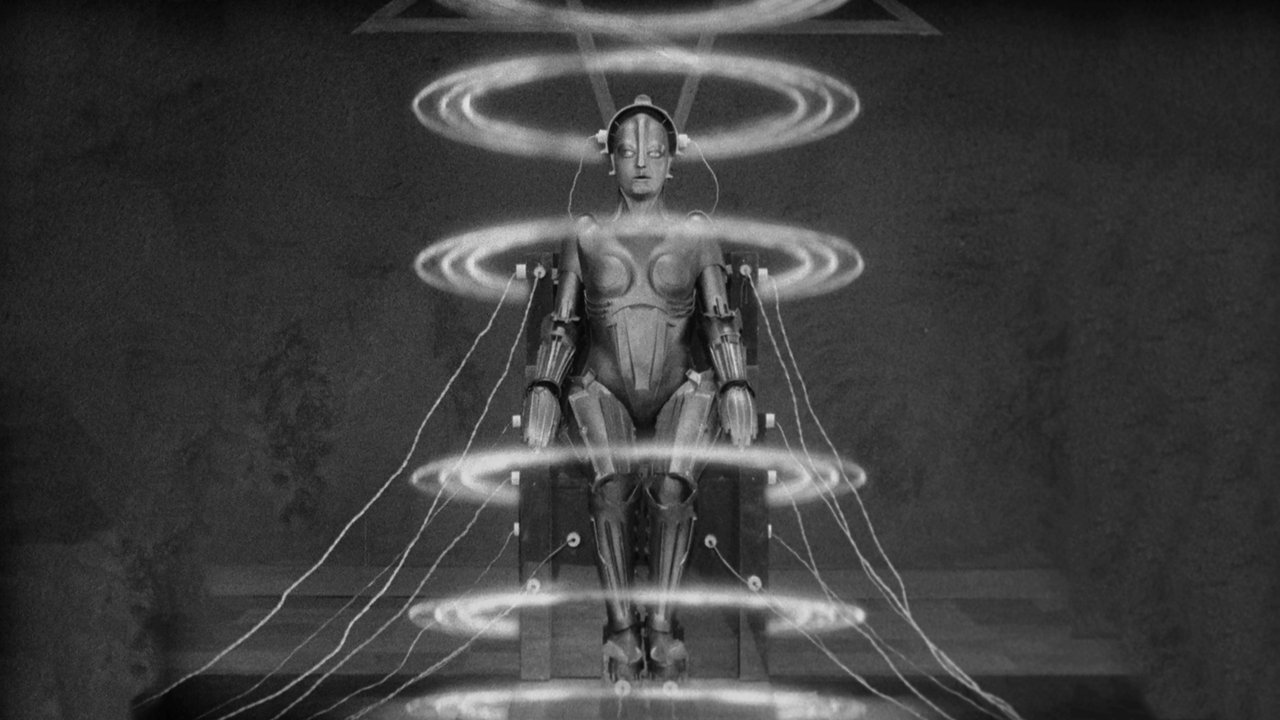
In a future city built in two halves, the sons of the wealthy live in towers and gardens above ground while an underclass of workers operates the machines that keep it running, in shifts measured by a ten-hour clock. Freder, son of the city's master Joh Fredersen, descends into the machine halls and sees what his inheritance is made of. Below, a young woman named Maria preaches patience and the coming of a mediator; above, the inventor Rotwang has built a machine in human form. Joh Fredersen orders the machine given Maria's face, and sends it down to discredit her — a decision that nearly destroys the city from beneath.
Metropolis is the first film to take a management theory and build it as architecture. The city is stacked: intellect on top, hands underneath, and a hundred metres of rock in between so that neither has to look at the other. When Freder asks where the people are whose hands built the city, his father answers "where they belong" — not cruelly, but as a statement of design. Joh Fredersen is not a tyrant improvising; he is an organisational chart made concrete, and the answer he gives is the answer any structure gives when asked to justify itself. Lang shot this in 1926, the same decade in which Taylor's stopwatch and Ford's moving line were being installed across Europe as the definitive method for arranging human beings around a process. The workers in the machine halls do not operate their machines so much as complete them. They move to a rhythm set elsewhere, in postures the equipment requires, for a shift whose length is the only quantity anyone tracks. The film's most famous image — the great dial whose hands the worker must chase, arms outstretched, swaying — is not a metaphor for alienation. It is a job description.
What makes the film more than a protest is that its machines genuinely work. The city above is beautiful; the trains run; the gardens are real. Lang refuses the easy version in which the system is also inefficient, and this refusal is the whole difficulty of the thing. An arrangement that produces excellent results while consuming the people inside it does not collapse on its own, because the results are the argument for continuing. Grot understands this better than anyone. When the workers finally break the machines, his shout — that without them everyone dies — is the most awkward line in the film, because he is right, and because he is right the revolt destroys the flooded lower city rather than the order that built it. Anyone who has watched a team rise against a process it depends on has seen this scene. The instinct to smash the mechanism and the fact that the mechanism is load-bearing are both true at once, and no amount of justified anger dissolves the second fact.
Then there is Rotwang, who is where the film touches something we now recognise every week. He has lost a hand building his Machine-Man and considers the trade obviously worth making. That is not madness; that is the ordinary economy of the ambitious builder, who accounts for the cost in himself and never for the cost in others. The machine he makes is not put to work in the halls below — Lang, remarkably, has no interest in automation as labour substitution. It is put to work as an interface. Joh Fredersen's order is to give it Maria's face, because the workers trust Maria, and a false Maria can be made to say the thing that a true Maria never would. This is the oldest attack in the book rebuilt in silver nitrate: capture the channel people already believe in and you do not need to persuade anyone of anything. The false Maria succeeds not because the machine is powerful but because trust is portable and its holders cannot tell it has changed hands.
The closing intertitle is the part everyone remembers and the part that has aged most awkwardly, and it is worth being honest about why. The mediator between head and hands must be the heart: as politics this is close to useless, a handshake between an industrialist and a foreman that changes nothing structural about who lives underground. But read as a thesis about management rather than about class, it is unexpectedly durable. Lang's diagnosis is that the fatal flaw of the two-level city is not inequality of comfort but the absence of any organ that transmits information between the level that decides and the level that knows. Joh Fredersen has data — clocks, output, plans on a desk — and no route by which the experience of the machine halls can reach him and alter what he does. The heart, in that reading, is not sentiment. It is a feedback channel with enough standing to change a decision, and every organisation that has ever built an escalation path, a retro, or a customer call the executives are required to sit in has been trying to install one ever since.