Nothing is free
Bluesky's growth curves are what every digital product dreams of. They also inherit the same unanswered question about who ultimately pays for a social network.
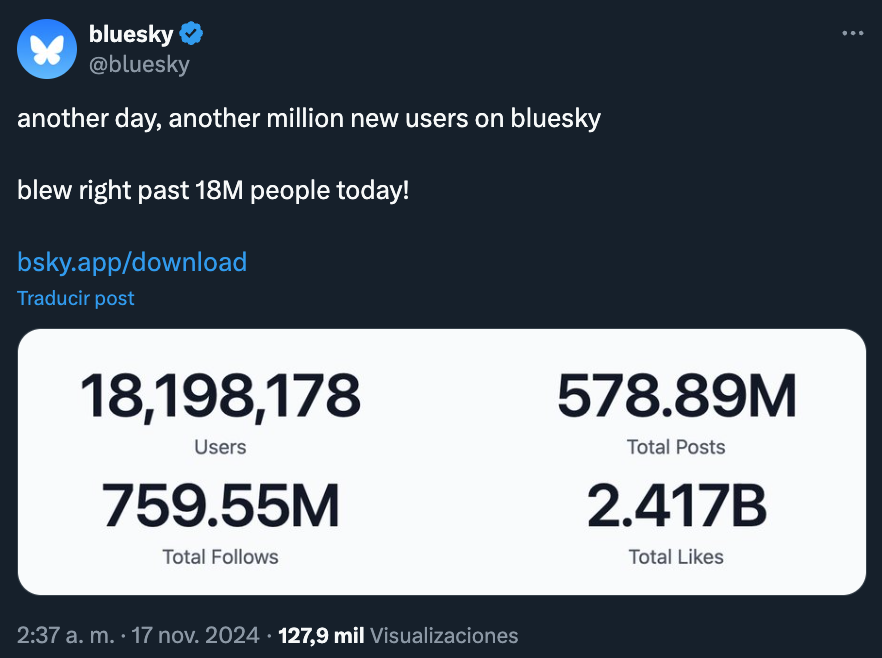
The new-user charts on Bluesky are the beautiful steep slopes that many digital products dream about. They also come accompanied by a hope of not falling back into the same mistakes that get attributed to X/Twitter.
But it does share with that latter company the classic question about its economic viability.
(The original post included a chart of Bluesky's user growth in November 2024.)
The question is not commercial
It is tempting to treat funding as somebody else's problem, filed under business model, to be resolved later by people with spreadsheets. It is the most consequential product decision on the table, and it is nearly always made before anyone thinks of it as a product decision.
The reason is that a revenue mechanism is an optimisation target, and optimisation targets propagate. They do not stay in the finance department. They reach into ranking, notification frequency, what the default feed contains, how easy it is to leave, and what counts as a successful week. Nobody has to decide to degrade the product. The pressure arrives quarterly and the decisions accumulate, each individually reasonable.
Tim Wu's history of the attention merchants is the long view on this, and its usefulness is in showing how old the pattern is. Radio, television and the free press each ran the same sequence: a product funded by attention, an audience that mistakes free for costless, and a gradual reorientation of the thing towards whatever holds the eye. Michael Goldhaber saw the digital version coming in 1997, before there was much to look at.
Where the arithmetic bites
Shapiro and Varian give the economics of information goods, and one consequence matters more than the rest here. The marginal cost of serving another user is approximately zero, which makes free the natural price. Anything you charge is a barrier, and a barrier on a network is not the same as a barrier on a product.
Barabási's work on networks explains why. Value grows with participation, so any charge that limits participation attacks the asset the whole thing rests on. This is the structural bind, and it is why so many social products end up charging for something adjacent — verification, reach, a badge — rather than for the participation itself. The adjacent charge does not solve the problem. It converts it into a status market, which has its own pathologies and at least does not shrink the graph.
Yochai Benkler's argument for non-market production is the genuine alternative, and it is worth taking seriously rather than dismissing as idealism. Wikipedia exists. So does most of the software everyone runs. But both are shaped by having no growth imperative, and a social network with a growth curve like the one in that chart has an infrastructure bill arriving monthly and investors who read the same chart differently than users do.
Who pays, and in what
37signals's position — stated plainly and repeatedly, which is why the argument carries — is that the only honest model is the one where the person using the product is the person paying for it. Anything else creates a party whose interests are served by the product and who is not the user, and Zuboff's account is the exhaustive documentation of where that leads.
Which brings the question back to Bluesky, and to any successor. The hope is not to repeat the mistakes. The hope is genuine and the mistakes were not really mistakes; they were the accumulated consequence of a funding structure doing exactly what funding structures do.
So the interesting question is not whether the intentions are better. It is what happens in the quarter when growth flattens, the infrastructure bill does not, and somebody proposes a small change to the default feed. Nothing is free. The only variable is who finds out, and when.