Paying for the algorithm?
If the algorithm is the real reason people stay on a social product, why does it never appear as a value proposition? On black boxes and control.
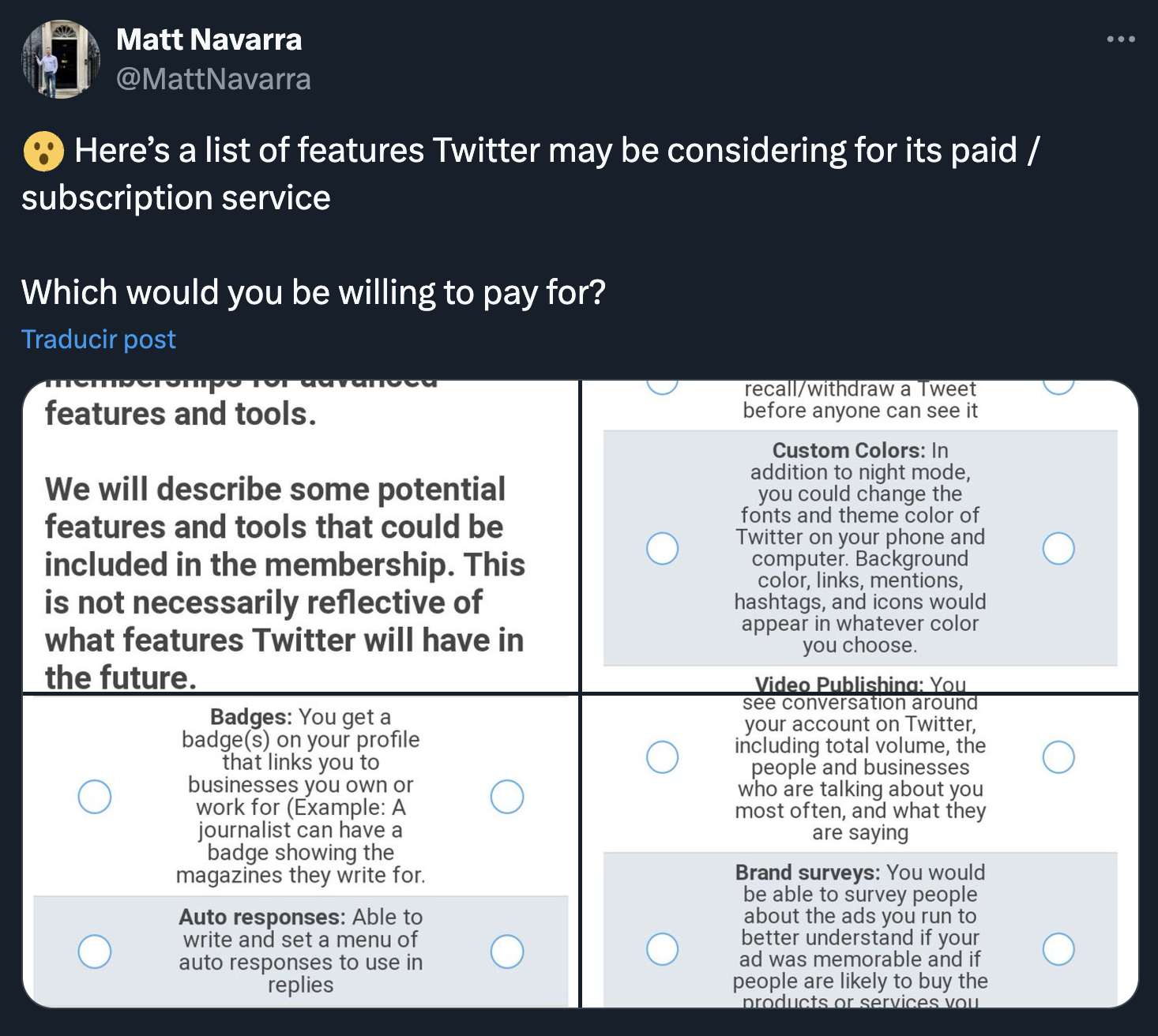
In one of this year's group exercises on the product management programme, we set out to build conjectures about why anyone would pay for X/Twitter. We connected it to the demand people themselves had expressed, visible in the threads Elon Musk actively encouraged when he bought the company.

Josu Goñi: "I think we should have more control over 'the algorithm'. I always say that if I'm going to pay, I don't want longer tweets, I want better control over what I see (and how much time I spend)."
What caught my attention in that exchange was that the algorithm itself became one of the reasons.
THE ALGORITHM — and it is nearly always spoken in capitals — is a fine example of software as a black box, both for how opaque it is and for how little control anyone has over its behaviour, including the people who built it. The number of times we invoke it is inversely proportional to our understanding of how it works.
The reason nobody writes down
Here is what struck me. That inverse proportion also seems to hold for the reasons. The algorithm is what people talk about constantly and it is what almost never appears when you ask them directly why they would pay. In our exercise it did not come up at all.
Which raises an obvious question. If it is the protagonist, should it not be an explicit line in product invention? If a new social network appears, should its strategy not put something about our relationship with ranking — and our control over it — at the centre?
In other digital products, themes around privacy and control have hardened into clear value propositions over the last decade. Nobody had to be persuaded that data handling was a product feature; the market got there. Ranking has not made the same journey, and I do not think that is an accident.
Why the pitch does not get made
Frank Pasquale's argument about the black box society is usually read as a critique of opacity, but there is a commercial reading underneath it: opacity is convenient in both directions. Companies benefit from not having to explain, and they also benefit from not having to promise.
That second part is the constraint. A ranking system is the part of the product a company can least credibly commit to. Its behaviour emerges from interactions nobody fully models, it changes every week, and any explicit undertaking about it becomes a liability the first time engagement dips. Privacy can be stated as a guarantee. Encryption either happens or it does not. Ranking cannot be stated as anything except an aspiration.
Shapiro and Varian's account of information goods explains the other half. The economics push towards a default that maximises attention, and the default is where nearly all the value gets captured. Selling control over the default means selling something that works against the revenue mechanism. It is a hard slide to present internally.
Solving the algorithm with more algorithm
Bluesky has begun orienting its messaging around exactly this territory, and its answer is a curious one: more algorithm. Build your own feeds instead of depending on someone else's.
I find the move genuinely interesting and also want to be careful about it. Custom feeds move a real cost onto the user. Curation is work, and the overwhelming majority of people adopt defaults — this is one of the most robust findings we have about software, and Eli Pariser's filter bubble argument depends on it. If the default feed is where almost everyone lives, then handing out the tools to build alternatives is a freedom exercised by a minority while the majority inherits whatever the default optimises for.
Which suggests the real differentiator is not the control. It is the credible commitment that the default will not be quietly tuned against you. That is not a feature. It is governance, and Lessig's point holds: the architecture is the regulation. What the code permits is what the policy actually is, regardless of what the policy document says.
So can you sell the algorithm? Not as a promise about outputs, I suspect. Perhaps as a promise about who gets to change it, how often, and whether you find out. That is a much less exciting pitch and considerably more honest, and it puts the question where it belongs: not on whether the box can be opened, but on who holds the key and what they owe you.