Blade Runner
Writers: Hampton Fancher (screenplay), David Peoples (screenplay), Philip K. Dick (based on the novel "Do Androids Dream of Electric Sheep?")
Cast: Harrison Ford, Rutger Hauer, Sean Young, Edward James Olmos
Los Angeles, 2019. Rick Deckard, a former blade runner, is pulled back into service to hunt four Nexus-6 replicants who have escaped an off-world colony and returned to Earth looking for their maker. His only instrument is the Voight-Kampff test, a procedure that measures involuntary emotional response to distinguish manufactured people from born ones. As Deckard works his way towards Roy Batty, the leader of the escaped group, the test begins to produce answers that neither he nor the Tyrell Corporation is prepared to accept.
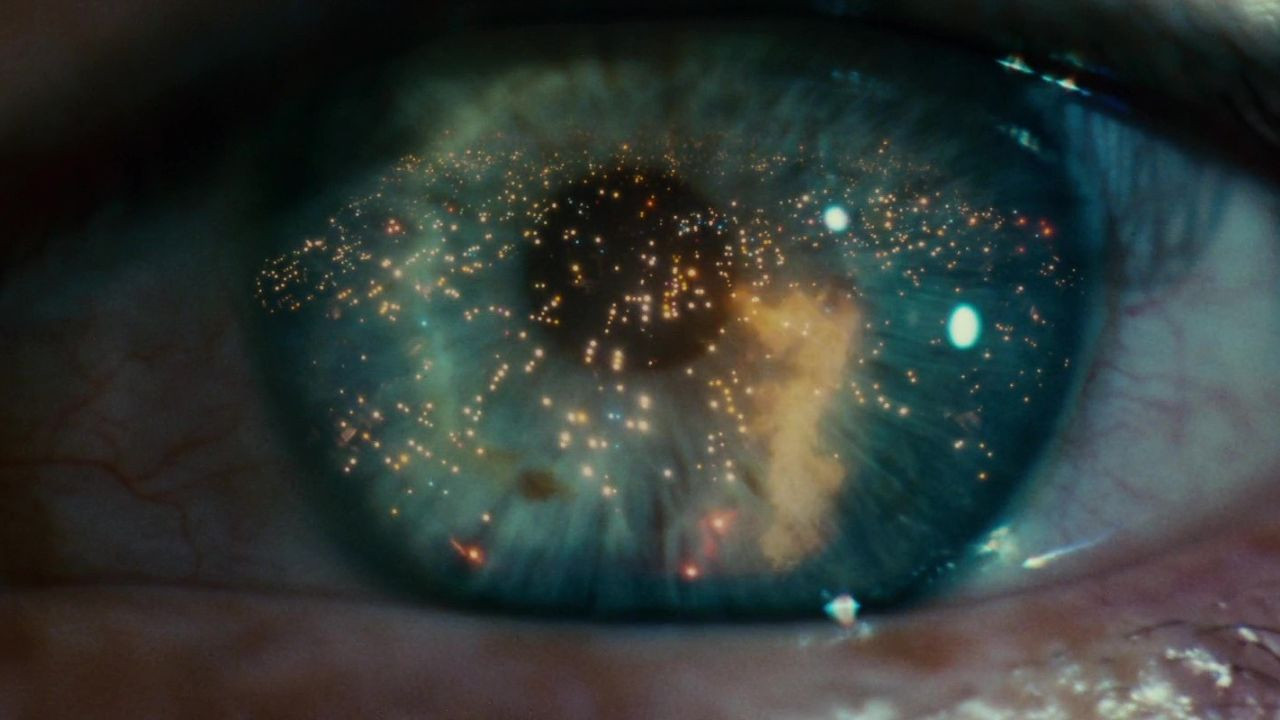
The Voight-Kampff machine is a classifier, and everything that goes wrong in Blade Runner goes wrong in the way classifiers go wrong. It does not detect artificiality directly, because artificiality is not observable; it measures capillary dilation, pupil fluctuation and blush response while the subject is walked through scenarios designed to provoke empathy, and it infers the category from the signal. This is a proxy, and like every proxy it holds up on the easy cases and breaks on exactly the case that matters. Leon fails in a handful of questions. Rachael requires more than a hundred, and Deckard only pushes that far because Tyrell wants to demonstrate something. When Rachael asks him whether he has ever retired a human by mistake, she is asking for the false positive rate, and the striking thing is that nobody in the film has one. The test is deployed at lethal stakes by an organisation that has never measured its own error. Deckard's answer is procedural rather than empirical — that is not his function — which is the answer given by everyone who has inherited a scoring system they did not build and cannot audit. Her second question is sharper still: has he ever taken the test himself? The operator of a classifier is almost never inside its evaluation set, and the entire apparatus depends on the assumption that he does not need to be.
Tyrell's corporate motto is the specification that destroys the test. More human than human is not marketing; it is a product requirement, and the requirement is indistinguishability. An organisation cannot simultaneously optimise a product for being indistinguishable from humans and maintain a reliable procedure for distinguishing it from humans, yet Tyrell does both, sells both, and treats the contradiction as a business model. The memory implants make this explicit. Tyrell explains that giving the replicants a fabricated past provides a cushion for their emotions, something to hold their responses steady — which is to say the fix for the instability that Voight-Kampff detects is more training data, deliberately synthesised, deliberately false. Every improvement to the product degrades the instrument. Rachael does not know what she is, and her ignorance is not an accident of the story but the intended output of the design. This is the shape of a great many technology businesses: the same company builds the capability and the safeguard, and the safeguard is funded out of the margin on the capability.
Bryant's summary of the situation is the most quietly damning line in the film. Replicants are machines; machines are either a benefit or a hazard; if they are a benefit, it is not his problem. That is an accountability structure stated in a single breath, and it is the structure the whole city runs on. The Nexus-6 four-year lifespan works the same way — a governance question answered with an engineering control, because a hard expiry is cheaper than any regime of rights or oversight. The escaped replicants are, in the language of the organisations that made them, a production incident, and Deckard is the on-call rotation. Roy Batty is the only character who describes the arrangement from the inside, and he does it while holding Deckard's life in his hand: quite an experience to live in fear, isn't it, that's what it is to be a slave. He is not making a metaphor. He is reporting the operating conditions of a product built to work off-world in hazardous environments, given enough interiority to notice, and given four years so that noticing does not compound.
Then Roy sits down in the rain and delivers what remains the most precise statement anyone has made about the loss of institutional memory. He has seen attack ships on fire off the shoulder of Orion and C-beams glittering near the Tannhäuser Gate, and no one else has, and in a moment no one ever will. All those moments will be lost in time. There is no export, no handover, no log; the experience was never stored anywhere except in the system that is about to stop. Everything Roy learned about combat, about survival, about Tyrell's own architecture goes with him, and the corporation that built him has no mechanism for retrieving any of it because it never occurred to anyone that the product might have accumulated something worth keeping. The scene works as an elegy, but it is also an unusually exact piece of systems thinking, and it describes something familiar to anyone who has watched a long-tenured engineer walk out of a building: the documentation captured the interfaces, and the interfaces were never where the knowledge lived. Deckard survives the fight because Roy chooses to let the knowledge be witnessed rather than merely lost. That is the closest thing to a handover the film allows.