Gattaca
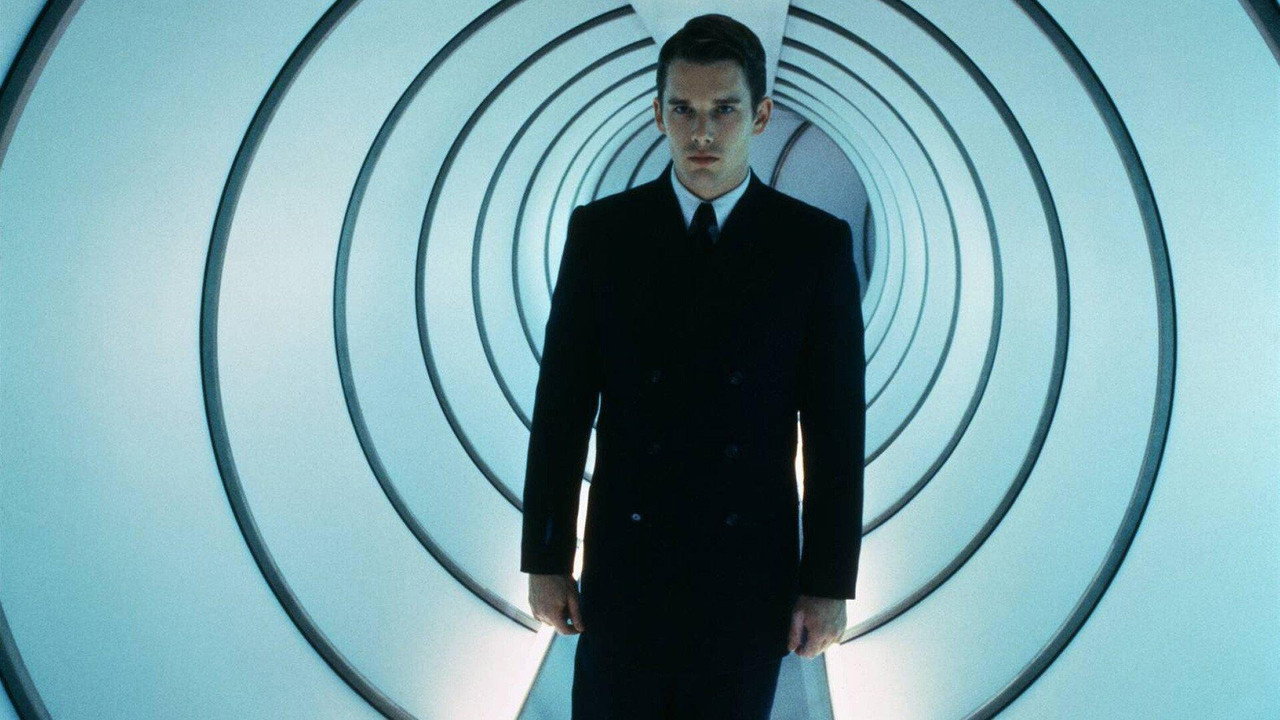
Writers: Andrew Niccol (written by)
Cast: Ethan Hawke, Uma Thurman, Jude Law, Loren Dean, Alan Arkin, Gore Vidal
In the not-too-distant future, genetic engineering has divided society into Valids — conceived with curated genomes — and In-Valids, left to natural chance. Vincent Freeman, an In-Valid with a heart condition and a projected lifespan of 30.2 years, assumes the genetic identity of a paralysed Valid named Jerome to infiltrate Gattaca Aerospace and pursue his dream of space travel. The film follows his daily discipline of deception — scrubbing skin cells, wearing contact lenses, carrying urine samples — while a murder investigation threatens to expose him.
Gattaca is the clearest film ever made about what happens when a proxy metric becomes the thing itself. The genome was meant to predict outcomes; by the time the film opens it has stopped predicting anything, because it now determines everything. Nobody inside Gattaca Aerospace evaluates work. They evaluate the profile that was supposed to stand in for the work, and they do it with such institutional confidence that the question of actual performance never arises. Vincent's daily blood test is not a check on whether he is any good at his job. It is a check on whether he is still the person whose score authorised him to hold it. This is Goodhart's Law rendered as architecture — a whole civilisation built on a measurement that has quietly replaced the thing it measured, and that continues to work perfectly as a sorting mechanism long after it has ceased to tell anyone the truth.
The routine Vincent maintains to survive this is the film's real argument about identity as data. He scrubs away dead skin so he sheds nothing of his own, plants borrowed hairs and flakes at his workstation, carries prepared blood and urine, wears lenses over the wrong-coloured eyes. What defeats the system is not a technical exploit. There is no flaw in the sequencing; the machines read exactly what they are given, and what they are given is genuine. The vulnerability is epistemic. Gattaca trusts the fidelity of its instrument so completely that it never models an adversary who supplies authentic data belonging to someone else. Anyone who has watched an organisation confuse a verified signal with a verified person will recognise the shape of this. The gap is not in the sensor, it is in the assumption that the sensor is attached to the thing you care about — and Vincent walks through that gap for years on nothing but operational discipline.
Jerome Morrow is the same argument from the opposite side, and he is the reason the film outgrows its premise. Here is a man engineered for greatness, holding a genome that promised everything, who came second in a swimming competition and never recovered from it. His line about never having been meant for one step down the podium is not vanity; it is the sound of a metric collapsing under the weight of what it claimed. The score said he would be first. Being second was therefore not a result but a contradiction, and a life cannot be lived inside a contradiction for very long. Jerome is living proof that the map is not the territory — that an optimisation performed at conception says nothing whatsoever about what a life will contain, and that promising too much is its own kind of harm. Vincent is discriminated against by a number that underestimated him. Jerome is destroyed by one that overestimated him. Both are victims of the same instrument.
Which leaves the doctor. Lamar has known who Vincent is, probably for a long time, and says so only at the end, in a remark about a son who did not turn out to be what the genome promised. The system was never blind. It had all the evidence it needed and chose not to assemble it, because the man holding the evidence had his own private reason to doubt the score. This is the most useful thing in the film and the least cinematic: the measurement regime does not fail on its own terms. It fails because somebody inside it, standing next to a result and a person and noticing the distance between them, decides to believe the person.